The website lists public gardens in the Puget Sound region. The site also hosts galleries of beautiful photography and botanically themed art, an event calendar and a list of gardening resources.
Johns Hopkins Center for a Livable Future
The Center is devoted to building “a healthier, more equitable and resilient food system” with with articles, reports programs and events that focus on:
- Food Systems & Climate Change
- Food Policy & Governance
- Diet, Health & Planetary Boundaries
- Food Systems & Urbanization
- and related topics
An Integrated Approach to Identifying and Characterising Resilient Urban Food Systems to Promote Population Health in a Changing Climate
A scholarly article from the Cambridge University Press journal Public Health Nutrition.
Urban Farming Work Book
A comprehensive PDF booklet introduction to urban farming benefits, strategy, and practices.
World Resources Institute – Food
Resources about sustainability, agriculture, and environmental issues.
Arboriculture and Urban Forestry
Peer reviewed research.
The Ferns of Great Britain
 One of the earliest fern books, ”The Ferns of Great Britain” (published in 1855), is better known for its illustrator John Edward Sowerby (1825-1870) rather than the botanist who wrote the text, Charles Johnson (1791-1880). While this was not typical, it is perhaps because Sowerby was also the publisher. There is no record of professional jealousy, as the pair produced several other books on wild flowers, poisonous plants, grasses, and useful plants found in Britain and Ireland.
The Sowerby family included four generations of noted illustrators from the late 1700s to the early 1900s. For this book, John Edward Sowerby created forty-nine, exquisite copperplate engravings and, in a bit of mid-19th century marketing, sold the finished books in three versions. The images could be left uncolored for 6 shillings, be partially hand-colored for 14 shillings, or fully colored for 27 shillings, a range of about $42 to $189 in US dollars today. The Miller Library copy is partially colored, the best of both worlds as it shows both detail and beauty. Johnson’s text was also outstanding, describing Blechnum boreale (now B. spicant or Struthiopteris spicant), the deer fern as “a highly beautiful fern, well worthy of cultivation as an evergreen little liable to injury by frost, and, during the summer presenting an elegant contrast in its varied fronds.”
Excerpted from the Spring 2020 issue of the Arboretum Bulletin
Ferns of Great Britain and their Allies
The Victorian fern craze of the late 19th century was noteworthy for its inclusiveness. All classes of English society were engaged, and participants included men, women, and children. One of the leading botanical authors and illustrators of the time was Anne Pratt (1806-1893) who because of a childhood illness was encouraged to pursue botanical illustration. That she did very well, publishing more than 20 books popularizing botany.
Her ”Ferns of Great Britain” (1st edition 1855, the Miller Library has an undated edition from approximately 1871) was one of her major works and was later combined into a six-volume work that included flowering plants, grasses, and sedges. Her writing shows a clear understanding of the science of her subjects, but she also appreciated the pleasures for the amateur: “It is pleasant to see the rambler in the country searching through green lane or by dripping well for the feather fern.”
Excerpted from the Spring 2020 issue of the Arboretum Bulletin
How to Know the Ferns
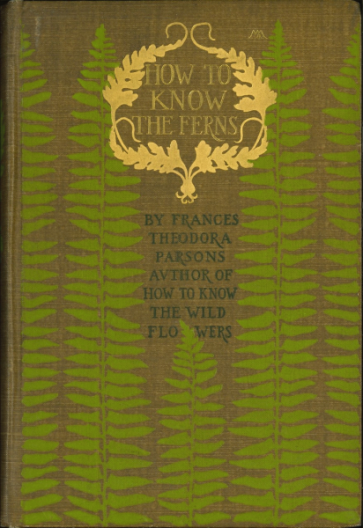 While the Victorian fern craze of late 19th century Britain had less impact in North America, one noted author who recognized the need for a guide to the ferns of the northeastern United States was Frances Theodora Parsons (1861-1952), who wrote the field guide “How to Know the Ferns” (1899). Parsons was very active in New York City and State politics and active advocate for women’s suffrage. Her autobiography, written late in her long life, talked little of her botanical writing that included three other books. However, during her active botany period, before the death of her second husband in 1902, her books were very popular.
She recognized that “in England one finds books of all sizes and prices on the English ferns, while our beautiful American ferns are almost unknown, owing probably to the lack of attractive and inexpensive fern literature.” Unusual for the time, her books were both written and illustrated by women, the artists being her sister and a long-time friend. Parsons books were also noted for the covers of their bindings, designed by book cover artist Margaret Armstrong.
Excerpted from the Spring 2020 issue of the Arboretum Bulletin
Our Native Ferns
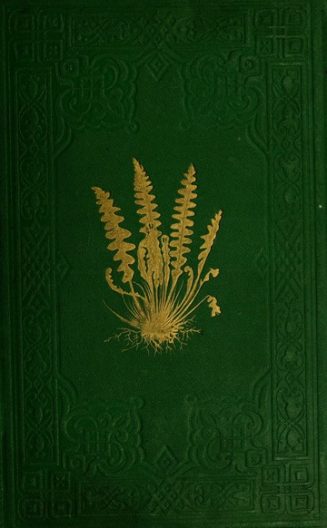 Edward Joseph Lowe (1825-1900) had the financial means to be an astronomer, a meteorologist, and an expert on ferns, the latter for him being “a matter of everyday life.” He wrote several very popular books in the last half of the 19th century, during the “fern craze” that engulfed England at the time. In “Our Native Ferns” (1867-69), he focuses on many of the highly coveted mutations, including Athyrium filix-femina var. multifidum, which he describes as “a most beautiful, symmetrical, and graceful Fern, although a monstrosity.” This book was a catalogue to these many forms, which were the most desirable objects for fern collectors.
Lowe used a third technique for producing his images. Although his title pages lack credits, it is widely known that his images were from the printing company of Benjamin Fawcett (1808-1893) that used a centuries-old technique of wood blocks, but with a difference. Fawcett’s blocks were engraved in aged Turkish boxwood using the especially hard end grain, allowing for very fine lines and detail. For each color, a separate block was used that were carefully aligned and pressed on the page.
Excerpted from the Spring 2020 issue of the Arboretum Bulletin