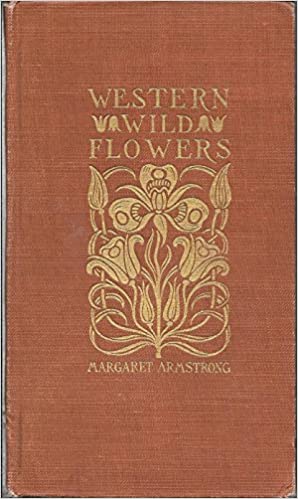
Margaret Armstrong was from the Hudson River valley of New York; she explored the West as part of an extended adventure, but never settled here. She traveled from 1911 to 1914, often with two or three female companions, exploring all of the states west of the Rocky Mountains and into Canada. She was possibly the first woman of European descent to travel to the floor of the Grand Canyon, where she found, described, and illustrated several new plant species. The result of these adventures was the “Field Book of Western Wild Flowers,” published in 1915.
She had considerable training as an artist and is perhaps best known amongst bibliophiles for the over 300 book covers she designed, an art form mostly lost in the 20th century with the development of dust jackets. She also wrote biographies in her 60s, and mystery novels in her 70s! Her schooling was in art, but she understood botany practices very well, collecting and pressing some 1,000 herbarium specimens. Many remain in the New York Botanical Garden herbarium. She lists as her co-author, John James Thornber (1872-1962), professor of botany at the University of Arizona, crediting him and many others (including Alice Eastwood and Julia Henshaw) for assuring the accuracy of her text.
“But it is her illustrations that make the book so appealing,” according to a review by Bobbi Angell in the December 2018 issue of “The Botanical Artist.” These included some 500 pen and ink drawings and almost 50 watercolors, all drawn or painted on site. While there is a glossary of terms and a short set of keys, this book relies more on its illustrations for identification than the others in this review.
Excerpted from the Winter 2020 issue of the Arboretum Bulletin
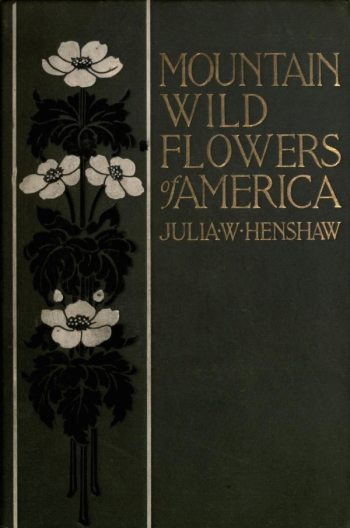 Photography was a major innovation for field guides in the early 20th century. Julia W. Henshaw (1869-1937) was an early adopter with her 1906 book “Mountain Wild Flowers of America.” While this title implies inclusion of alpine plants across Canada and the United States, she lived in Vancouver, BC and gives special attention to our regional mountains. The Miller Library also has a later edition (1917) under the slightly revised title of “
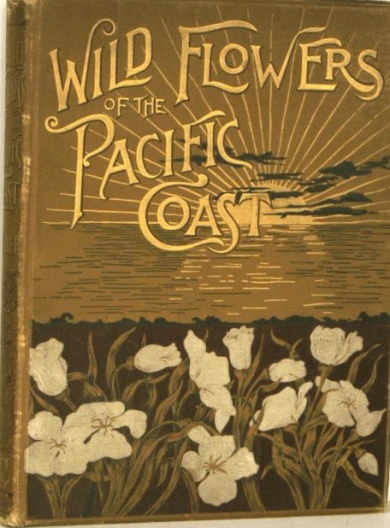 “On the very top of the mound grew this fine salmon blossom, and a few feet away a bed of tall pink grass, the finest I had ever seen. It waved and nodded in the warm breeze, as if inviting me to select its finest bunch to keep company with the pretty white blossoms that had been its neighbors, and from whom it was loth to part company.”
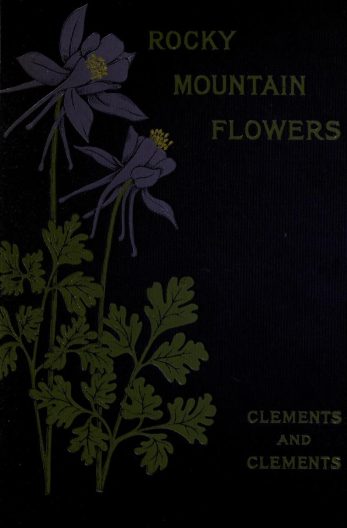 Unusual for her time, Edith Clements (1874-1971) had a formal botanical education; she received a Ph.D. in botanical ecology from the University of Nebraska, and spent her life in various academic and research pursuits. Typically this was in conjunction with her husband, Frederic Clements (1874-1945), who was also a plant ecologist. Together, they published “Rocky Mountain Flowers” in 1914, a botanically detailed flora of the flowering plants including trees, but no conifers or ferns. This is not a field guide, but the watercolor illustrations by Edith Clements are exquisite, typically showing several plants from the same family together. On her own, she later published “
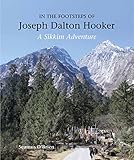 O’Brien wrote “In The Footsteps of Joseph Dalton Hooker” about his trips to Sikkim, skillfully weaving his travel stories around a biography of Hooker’s trip. “Unlike Hooker, our mission was not to collect, but to study and compare places he visited and to record how they had fared and appeared over 160 years later. In some ways Sikkim has changed little over the course of time.”
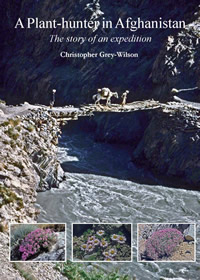 Christopher Grey-Wilson is a major author in the Miller Library collection with twenty-four books he either wrote or edited. Many focus on a specific plant such as cyclamen, pasque-flowers, saxifrages, or poppies of the genus Meconopsis. Others are excellent guides to alpine and rock garden plants. As you read these books, you learn that he has considerable experience as a plant explorer. In “A Plant-hunter in Afghanistan,” he provides a detailed and fascinating account of his nine months of plant exploring through southern Iran and Afghanistan in 1971.
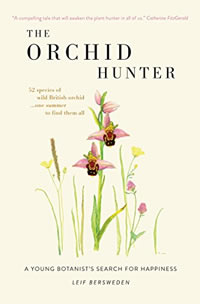 Taking a gap year between college and graduate school is often a time for young students to explore distant parts of the world, perhaps to donate their time to a devoted cause, or to learn a different culture. Very few spend the time botanizing. This is what makes Leif Bersweden’s story so interesting. At age seven, he found his first orchid: “Mum, this flower looks just like a bee.” From this simple beginning, a passion grew, and he decided to spend his gap year tracking down and photographing all 52 native species of Orchidaceae in Great Britain and Ireland. He relates his story in “The Orchid Hunter: A Young Botanist’s Search for Happiness.”
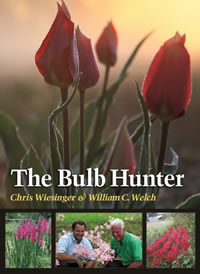 I received at an early age a birthday present of a dozen gladiolus corms. The results – plants taller than I was, with brilliant colors – were enthralling and made me a life-long bulb (more accurately: geophyte) enthusiast. For author Chris Wiesinger, it started with a single red tulip bulb. He planted “his little rock” in his Central Valley of California home and forgot it. The next spring “something magical had occurred; my living rock had turned into the most striking red tulip.”