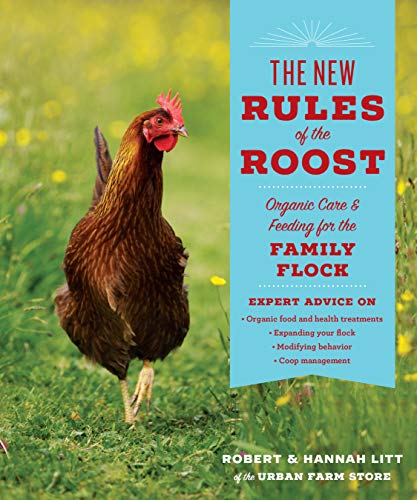
 Robert and Hannah Litt of Portland wrote A Chicken in Every Yard, published in 2011. They regard their chickens as pets to pamper and keep safe – they only eat their eggs. This book will tell you how to do the same.
On a visit to the island of Kauai in Hawai’i, the Litt family discovered that chickens have naturalized and do quite well looking after themselves. This led to a new book, The New Rules of the Roost (2018) that incorporates some of this avian independence. Now the setting for their home flock is “more dynamic, so that our chickens can safely forage for food and scratch around, but when and where we want them to.”
How does all this work with the garden? Very well, if you consider the hens as part of the family – it just takes a lot of compromise and ingenuity.
Published in Garden Notes: Northwest Horticultural Society, Fall 2018
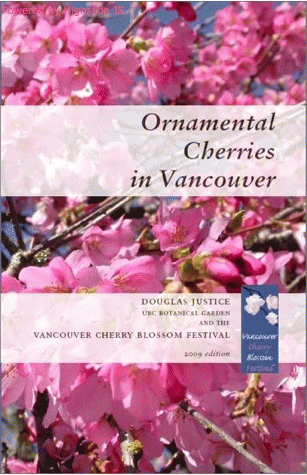 Douglas Justice of the University of British Columbia Botanical Garden is the author of “Ornamental Cherries in Vancouver”. Published by the Vancouver Cherry Blossom Festival, this excellent guide celebrates a rich collection of urban flowering cherries, some 40,000 trees as of the 125th anniversary of the city in 2011.
Ornamental cherries are a major component of the Washington Park Arboretum, especially along Azalea Way. This book’s photographs include close-ups of flowers and an example of the tree in a landscape. Leaves are described as they emerge, in the full leaf of summer, and as they color in the fall. Sadly, this book is hard to obtain (we are still hoping to add the 2014 edition to the Miller Library) and is not available to borrow and take with you strolling in the Arboretum next spring.
However, there is much to learn from a visit to the library. For example, the Yoshino cherry (Prunus x yedoensis ‘Somei-yoshino’) is of uncertain origin, but is famous for the Hanami (cherry viewing) festivals in Japan. This is also the cherry of the Tidal Basin in Washington, D. C. and at “The Quad” on the University of Washington campus. Another widely planted selection is the Kanzan or Kwanzan cherry (Prunus Sato-zakura Group ‘Kanzan’), perhaps because the “apparent good health of this cultivar often borders on the miraculous.”
Excerpted from the Fall 2018 Arboretum Bulletin.
 Wybe Kuitert has written two deeply researched books on the history of Japanese gardens. The first, “Themes in the History of Japanese Garden Art” (1st edition 1988, revised 2002 – this later edition is at the Miller Library), is the history from roughly 900 to 1650 CE, concluding when “the practice and theory of garden art became established in a way that does not differ much from our own days.”
Kuitert’s new book, “Japanese Gardens and Landscapes, 1650-1950,” brings that history up to near present day. Despite his conclusion in the earlier book, I found this history surprisingly dynamic. During the Edo period (1603-1868), gardens of the “daimyo,” or regional rulers, became quite fanciful. “These were Disney-type re-creations that functioned primarily as leisure environments.”
This was also a time when variegated plants and flowers with unusual and flamboyant forms became popular. As printing techniques became more widely and cheaply available, there was an explosion of published gardening books, codifying some of the earlier customs but with a loss of their symbolism. Kuitert laments this, describing these books as only a “crowd-pleasing version of garden traditions and ideas.”
After Japan opened to the West in the mid-1800s, there was much upheaval in all ways of life, including gardening. Western-style gardens appeared and Japanese garden designers who studied in the West were in high demand.
For local readers, this book’s profile of Jūki Iida (1889/90-1977), the major designer of the Seattle Japanese Garden, will be of great interest. Kuitert reviews Iida’s early training and his developing understanding that there exist two worlds of Japanese gardening: the formal, built garden and the naturalistic garden. By his emphasizing the latter approach, Kuitert credits Iida as “a key figure in democratizing the long tradition of garden-making in Japan” and for making individual gardens more accessible to everyone.
Excerpted from the Fall 2018 Arboretum Bulletin.
![[The Bee Tree] cover](https://depts.washington.edu/hortlib/graphix/beetree.jpg)
The Bee Tree is composed of two parts. The first part will appeal to a younger audience, and presents in words and pictures the tradition of harvesting honey in the Malaysian rainforest. Bees build the honeycombs on the tualang trees, the tallest trees reaching heights of about 250 feet. Hauling their special tools, honey hunters climb the trees with skill and courage. Gathering the honeycombs is a cooperative venture with rituals that express gratitude for the food and medicine that honey provides. The hunters share their bounty with friends and neighbors, and also sell the honey in local markets. The honey hunt is central to the culture and way of life of the indigenous people of Malaysia.
The second part of the book covers basic background information for adults on Malaysia and its peoples, the rainforest, the giant honeybee, and the tradition and future of the honey hunters. As for the future for honeybees: “As long as there is the rainforest, there will be bees, and as long as there are bees, there will be honey, and as long as there is honey, there will be honey hunters.” The giant honeybee, Apis dorsata, is crucial as a pollinator. It is a keystone species, important in the preservation of the entire ecosystem in the rainforest. It is another beautiful example of the interaction of plants and pollinators and their importance to a culture that preserves natural systems.
Published in the August 2018 Leaflet, Volume 5, Issue 8.
![[Butterflies of the Pacific Northwest] cover](https://depts.washington.edu/hortlib/graphix/butterfliesofthepacificnorthwest.jpg)
Summer is a great time to see butterflies and now there is an excellent new field guide. Butterflies of the Pacific Northwest by Robert Michael Pyle and Caitlin C. LaBar is the perfect tool to guide you in identifying and learning about the more than 200 species that are native to Washington and Oregon. It “is intended for everyone who wishes to study, watch, collect, photograph, garden, or otherwise enjoy butterflies responsibly.”
This Timber Press Field Guide has a sturdy, rain-resistant cover designed for field use. The Miller Library copy is an important reference source and not available to check out, but you can use it to compare with your field notes. Alternatively, check out Pyle’s earlier (2002) The Butterflies of Cascadia. The major difference between two books is the quality of the photographs. The advent of digital photography and the special expertise that new co-author LaBar brings have produced stunning results.
Each description includes range maps (within Washington and Oregon), habitat, host plants, and when the species is “on the wing.” Carefully documented are the often significant differences between males and females, and between dorsal (with the wings open) and ventral (wings closed) views.
Pyle also writes poetry, and his pleasure in the subtleties of language is evident in the anecdotal section under each species. He describes unusual sightings, gives hints for distinguishing between similar species, and relishes quirks of nomenclature. If you are city bound this summer, he even identifies those species that thrive despite intense urban environments.
Published in the August 2018 Leaflet for Scholars, Volume 5 Issue 8.
An article from Mother Earth News with details on soil mixes, fertilizing, and recommended crops.
A collection of articles on design, recommended plants and more.
A longtime gardening columnist for the Seattle Times (and founding librarian of the Miller Library), Valerie Easton started blogging in early 2009. Topics include Easton’s favorite new plants, horticultural happenings and reflections on her home garden.
Seattle Tilth, Tilth Producers and Cascade Harvest Coalition merged to form Tilth Alliance, “a nationally recognized non-profit organization dedicated to cultivating a sustainable community, one garden at a time.” Their mission is to build an ecologically sound, economically viable and socially equitable food system.
Tips for gardening in a drought year. A newspaper article by Linda Plato.