This site will help you locate that rose, peonies and clematis you’re looking for. They have information for over 45,000 varieties and species, many with sources.
PlantScout
Dave’s Garden’s PlantScout searches listings from 77 vendors (as of July 2018). Searching for a plant will generate a list of linked nurseries that report selling it. From the results page, the plant name link goes to the Plant Files database; “purchase” goes to the nursery’s web site; while the nursery name link goes to a list of all the plants offered by that nursery. The nursery inventory page has a link to the Garden Watchdog customer review page for that nursery. Vendors pay a yearly fee to include their inventory in the database, but it is free to visitors.
Garden Watchdog Guide to Gardening by Mail
Dave’s Garden is a long time gardening community site with forums, a plant description database and other features, much of it for free. Garden Watchdog harnesses one of the more potent Internet developments: the customer opinion. Plant hunters should search the Watchdog database for over 86,000 customer ratings of 4,000+ vendors and nurseries before buying.
The Quiet Extinction: Stories of North America’s Rare and Threatened Plants
![[The Quiet Extinction] cover](https://depts.washington.edu/hortlib/graphix/quietextinction.jpg)
The Quiet Extinction: Stories of North America’s Rare and Threatened Plants profiles plants native to the United States and Canada which are in danger of extinction. The causes vary, but humans are the main culprit, especially by driving climate change and loss of habitat.
While the topic is grim, author Kara Rogers has a knack for telling compelling stories, while still presenting good science. She wisely concentrates on a handful of species to drive her narrative, explaining that these are bellwethers of a much greater problem.
Some of these have special interest for Pacific Northwest readers. White bark pines (Pinus albicaulis) are a key species in the ecology of the Olympic and Cascade Mountains. They are facing a double whammy from white pine blister rust and outbreaks of mountain pine beetles. Hikers at high altitudes may recognize the problem, “but the real tragedy is that few people are aware that the region’s iconic tree and beautiful plants are disappearing and that they are doing so rapidly.”
As with many of these plants, their interaction with animals, including pollinators and herbivores, and with naturally occurring phenomena such as fire, are important parts of the story. This is an excellent book for anyone interested in the interconnections within North American ecosystems, as well as those fighting to reverse the plight of endangered plants.
Published in the July 2018 Leaflet for Scholars, Volume 5, Issue 7.
Country Notes
Editor’s note: A recent review by Dorothy Crandell asked readers “When is the right time to reread a classic?” In the spirit of that question, we’re taking a fresh look at some books that have been available here at the Miller Library for many years.
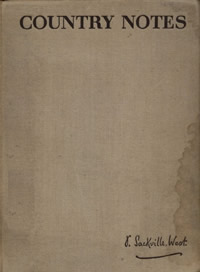
Country Notes is a collection of charming short articles, most of them originally published in New Statesman and Nation magazine in 1938 and 1939. They describe life on the farm as seen by Sackville-West from her estate, Sissinghurst, in Kent, England. She has a knack for description of botanical detail. For example, of the witch hazel she says the “dark brown twigs look as though some child had amused itself by tying them up with bunches of yellow ribbons, and then snipping the ends short.” The articles describe farm events such as harvesting hops and dealing with animals, including the horses still pulling plows. She also introduces local characters, like her gardener and the seasonal workers who camp out on the property during harvest time.
It is particularly intriguing to read this book in the context of its times. By the end of 1939, England was at war. In only one or two spots does the author mention “Herr Hitler” or the threat of conflict. But a cloud of worry must have hung over her writing. In addition, Sackville-West herself, in spite of her protesting that she loves the old ways, was part of the very modern Bloomsbury group, and was herself somewhat infamous for her multiple lovers, including Virginia Woolf. Beyond that background, Sackville-West was a well-known gardener, and wrote several books on gardening, including some in our library. A recent account of the history of her garden appears in Sissinghurst: An Unfinished History, by her grandson Adam Nicholson, also in our collection. So there is much to think about while enjoying these sketches of the Kentish countryside.
Published in the July 2018 Leaflet, Volume 5, Issue 7.
Incredible Edibles
![[Incredible Edibles] cover](https://depts.washington.edu/hortlib/graphix/incredibleedibles.jpg)
My favorite publisher of travel guides is DK (Dorling Kindersley Limited). They do very well with gardening books, too, creating visually rich yet uncluttered plant encyclopedias.
A new favorite in this style is Incredible Edibles: Grow Something Different in your Fruit and Veg Plot. The use of the term “veg” is a clue that the author, Matthew Biggs, is British, but he writes for a global audience. But no worries, most of these edibles will do well in a Seattle garden.
Here is the opportunity to expand your palate. While many of the plants are exotic, others are already familiar to gardeners. Fuchsia berries, daylily flowers, and the leaves and flowers of your hosta border all provide tasty treats. Most surprising (for me) was learning that dahlias are edible.
The author typically points out the horticultural value of his subjects and has a knack for taste-tingling imagery. He describes Chilean guava (Ugni molinae) as being a favorite of Queen Victoria because the fruits have little crowns. In addition, “the aromatic fruits are the size of blackcurrants, but taste like wild strawberries and bubblegum. It really should be more widely grown.”
Northwest natives, such as camas and Oregon grape, are included. Never taken a class on cooking camas? A sidebar of “cook’s tips” will get you started. We purchased this fun book with a grant from the Washington State Nursery and Landscape Association.
Published in the July 2018 Leaflet, Volume 5, Issue 7.
The illustrated history of apples in the United States and Canada
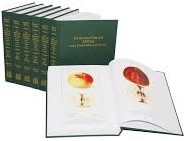 “The Illustrated History of Apples in the United States and Canada” is a seven-volume set with description of all apples found in North American publications through 2000. The information will have immense importance to any pomology researcher, but the more casual reader will find pleasure in the beautiful images: 1,400 watercolors created by artists employed by the United States Department of Agriculture from 1886-1942.
Excerpted from the Summer 2018 Arboretum Bulletin.
The Trees of North America
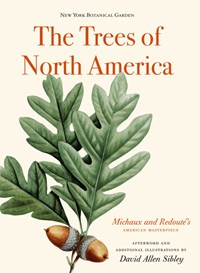 “The Trees of North America” is an excellent new book and winner of one of the three book awards given by the AHS in 2018. Who is the author? It’s complicated.
The short answer is François-André Michaux (1770-1855) and Thomas Nuttall (1786-1859) with considerable help from skilled engravers, the most famous being Pierre-Joseph Redouté (1759-1840). Their collective publications span the first half of the 19th century, produced in both France and the United States, and first in French and later in English. The full bibliographic story is in the preface of this new book.
The New York Botanical Garden (NYBG) in their LuEsther T. Mertz Library has perhaps the most complete collection of the (at least) 16 different editions by Michaux and Nuttall. Mertz Library staff have produced this new book, using faithful reproductions of the plates. The horticulture staff for NYBG add notes with current updates of nomenclature, ranges, and horticultural uses.
Enough words. This is mostly a picture book, but what a glorious one it is. We are fortunate to have an 1857-1865 original in the Miller Library rare book collection. While a reprint can never quite match a hand-colored original, this comes very close.
These accurate images made the original the standard reference book for North America trees until the early 20th century. A concluding essay by David Allen Sibley explains the process of making the reprinted images – a process as complex as the authorship. Sibley declares, “The end results are beautiful, and the prints are true works of art on their own, but they are different from the originals.”
Excerpted from the Summer 2018 Arboretum Bulletin.
The Rose Rustlers
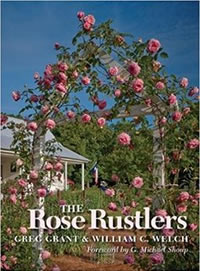
“The Rose Rustlers” is a fun book, a bit of a garden journal, a bit diary mixed with a family photo album. Nominated for an AHS award, the authors Greg Grant and William Welch take turns sharing their stories, their favorite plants (mostly roses), and their favorite people.
Their heroes are a dedicated group promoting old roses, many of the plants surviving with no care in cemeteries or abandoned home sites throughout Texas. While this is a very different climate from ours, every gardener will appreciate the tenacity of plants that are good-doers and the humans that cherish them.
One quirk of this book is the nomenclature. Rose variety names in single quotation marks are cultivars, the same as with most plants. Other varieties have double quotation marks, meaning these are study names. These substitute for real names that have been lost in time. No quotation marks means this rose is legendary and needs no further clarification, including “popular roses like the butterfly rose, the sweetheart rose, and the green rose.”
There is a lot of good horticultural advice and garden design in this book, but best are the stories. The “Air Conditioner Rose”, was name because Grant’s first planting of it covered unsightly equipment. It also survived being under salt water for two weeks after Hurricane Katrina. A suckering rose in Scottsville, Texas has possibly survived since 1834. The magenta flowers are sometimes flushed with blue edges.
These roses are resilient. “Roses didn’t start out as wimpy flowers. Humans did that to them. In addition to being beautiful in a simplistic way, roses were initially wiry and mean as snakes. This made them perfect Texans, of course. If an antique rose is still around, it’s because it’s tough and because it’s pretty.”
Excerpted from the Summer 2018 Arboretum Bulletin.
Ruth Shellhorn
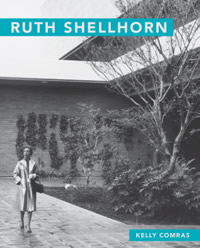 The Masters of Modern Landscape Design is a series of biographies featuring landscape architects prominent in the mid to late 20th century in North America. Ruth Shellhorn (1909-2006) was a west coast landscape architect, who lived productively into her 90s. This biography is written by Kelly Comras, a landscape architect based in Los Angeles. Much of Shellhorn’s work was also in greater Los Angeles, but she attended what is now Oregon State University for her undergraduate degree.
Comras observes that if Shellhorn had made a greater effort of self-promotion, she would be more famous today. She quotes David Streatfield, a landscape architecture historian at the University of Washington, who “noted the ‘terrible imbalance in terms of the public’s perception between Ruth Shellhorn…and many of her contemporaries, such as Garrett Eckbo, Lawrence Halprin, and Thomas Church, who wrote books about their own work, hired professional photographers, and published extensively.'”
One of the most fascinating chapters is about Shellhorn’s work on Disneyland. She was hired just four months before the opening in 1955, after Walt Disney belatedly recognized the need to “unify the distinctive elements” of the variously themed areas. She proved very skillful in not only unifying buildings that were already in place but also in creating a visitor experience that increases the sense of discovery while mitigating the challenges of large crowds. Comras describes the landscape design by Shellhorn to be largely intact today despite on-going changes to the park.
Excerpted from the Summer 2018 Arboretum Bulletin.