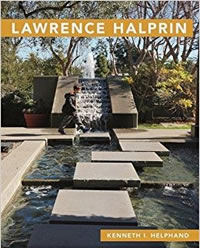
 The Masters of Modern Landscape Design is a series of biographies featuring landscape architects prominent in the mid to late 20th century in North America. Lawrence Halprin (1916-2009) was a west coast landscape architect who lived productively into his 90s. He is best known in Seattle for Freeway Park, but he was also responsible for the master landscaping plan for the Seattle World’s Fair, a project he worked on from 1958-1962. Author Kenneth Helphand is a professor emeritus in landscape architecture at the University of Oregon and wrote about “Defiant Gardens: Making Gardens in Wartime” (2007), an award winner which I reviewed in the Spring 2012 “The Bulletin.”
Freeway Park was the first capping of an interstate freeway, a model replicated widely since that time. This biography recounts the initial praise for the project (opened in 1976), the expansion by Halprin associate Angela Danadjieva, the subsequent decline of the park into disuse, and revitalizing revisions to the plantings of the last decade. Before his death, Halprin contributed to this last effort, which leaves the structure of the park in place.
Massive waterfalls are a Halprin signature. I’ve long admired those at Freeway Park but was surprised last summer to discover Forecourt (now Ira Keller) and Lovejoy Fountains in Portland. He designed these in the 1960s and linked them by an eight-block pedestrian mall. “Like all water features they invite attention—and for Halprin, participation.”
He demonstrated this at the dedication of the Forecourt Fountain in 1970. Vietnam War protests at nearby Portland State University created tension between the students and police gathered for the event. Halprin’s words, and even more so his action of walking into the cascading water, helped to calm the crowd and spark a celebration of community.
Excerpted from the Summer 2018 Arboretum Bulletin.
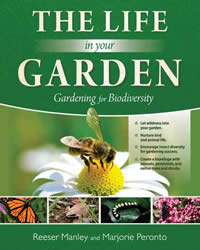 “The Life in Your Garden” has an emphasis on milkweeds, promoting these plants as excellent for overall garden health and biodiversity. Authors Reeser Manley and Marjorie Peronto garden in Maine, but Manley received his PhD in Horticultural Science from Washington State University.
The authors strongly detest the word “pest” but instead see insects and other small garden creatures as pollinators, herbivores, and/or predators. All of these are both good and fascinating. Observing this life has been the source of many realizations for the authors about the positive impact even a small garden can have on its environment.
The book pays special attention to “functional” plants that provide more than just ornamentation, with a special emphasis on understory plants, which “are every bit as important as canopy trees in fostering garden biodiversity.” The lengthy encyclopedia section features east coast natives, but in most cases, western counterparts are found in the appendices. The authors also seek functionality in their annuals and perennials, “creating plantings that sustain garden life from the first emerging bumble bees in late April until the last hoverflies of late September.”
Excerpted from the Summer 2018 Arboretum Bulletin.
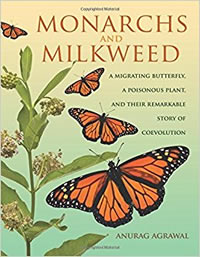 “Monarchs and Milkweed” is like a mystery novel of the highest order. Who will survive? The butterfly or the weed? Even better, this is not fiction!
Anurag Agrawal’s writing is very compelling. I read the pages of his book as quickly as any whodunit. The characters include the baby caterpillar monarchs, trying to survive their first encounter with their only source of food, the leaves of milkweed. Many do not.
The milkweed plant has many ways to protect itself including its own gooey latex-like sap, or by coaxing monarch predators to do the job. There is good reason for this – the plant gains nothing from its interaction as the adult butterflies are not helpful pollinators.
In contrast, the larval and adult butterflies gain a toxicity that protects them from significant predation by birds. But this toxicity is not effective against other insects or various parasites. The plant seems to know this. The battle of coevolution moves on.
Agrawal is a scientist who interweaves his personal life and research. He discovered the caterpillar of an unknown species, brought it into his living room, watched it pupate, and then emerge from its chrysalis as a butterfly. This was a serendipitous lesson in mimicry as it was a viceroy butterfly, with similar coloration to a monarch and thereby gaining some of its protection, even though it lacks toxicity for birds.
This year’s winner of the CBHL Award of Excellence in Gardening and Gardens, “Monarchs and Milkweed” has wide appeal, even for parts of the country like ours outside of the natural range of monarchs.
Excerpted from the Summer 2018 Arboretum Bulletin.
Published by the University of Idaho Extension, this well organized site contains articles on a wide variety of gardening topics such as fertilizing, transplanting trees, growing berries and growing Idaho native plants. Also included are links to contact the Master Gardeners or the Idaho Nursery and Landscape Association.
By National Wildlife Federation. How to attract birds, insects, and amphibians. How to build houses/nests for bats, bees, and birds. How to create a neighbor and wildlife friendly backyard.
The Lady Bird Johnson Wildflower Center site offers a database with information on native plants and related organizations searchable by region, state or city. Included are native plant societies, conservation groups, governmental agencies, botanic gardens and arboreta. Sources for nurseries and seed suppliers are searchable by an alphabetical list, or by state, city, or zip. The “Mr. Smarty Plants” database has questions answered by staff members of the Wildflower Center.
Oregon State University presents their online version of a guide to plant diseases. Search by the common name of either the plant or the disease. Each record describes the cause, symptoms and control for the particular disease, and most have a picture. The site also gives detailed instruction on how to submit a diseased plant sample to the Oregon State University clinics as well as addresses for the many official County Extension clinics in the Pacific Northwest.
Information on toxicity and alternatives to pesticides