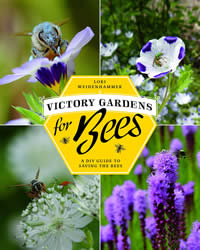
 Anyone who regularly dresses up as a queen bee to educate children has to be passionate about her topic. Lori Weidenhammer, a performance artist based in Vancouver, British Columbia, is certainly that. That same energy is now available in her book, “Victory Gardens for Bees.” The sub-title well describes the book’s style: “A DIY Guide to Saving the Bees.” Weidenhammer wants you to be engaged!
All this energy at first may distract you from the rich content. This is an excellent introduction and field guide to the many types of bees. Planting charts recommend plants for your gardens – starting with weeds! Each entry tells you which bees are attracted to the plant, and what it provides for them. Planting plans will suggest garden layouts. The photos, mostly by the author, are excellent at showing their small subjects in tremendous detail.
Sometimes, you may feel like a child at one of Queen Bee’s performances. Suppose you are accidently stung by a bee. “It hurts a lot and you will feel like unfriending bees. Don’t take it personally. Bad stings happen to good people. Once the pain goes away, you’ll be ready to forgive and refriend the bees.”
Excerpted from the Summer 2017 Arboretum Bulletin.
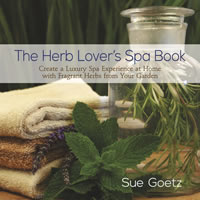 Sue Goetz loves to pamper herself. Even more, she wants you to pamper you. How? There is no single answer to this, but in the “The Herb Lover’s Spa Book” she ardently helps you create your own special place – a personal spa to nurture yourself.
This blissful goal isn’t reached without a lot of practical knowledge. The author’s experience as a garden designer helps you create a personal sanctuary in your own back yard. Similar principles are applicable to interior spaces, too.
Next, Goetz walks the reader through a concise list of herbal plants, each defined as “…cultivated for its usefulness in flavoring, perfume, or for cosmetic and medicinal uses.” Choosing, growing, harvesting, and preserving are all part of the lessons.
Finally, you create. Lotions and ointments to make your life a little easier, a little more enjoyable. The recipes are easy, difficult concepts are clearly explained, and there’s nothing else to do but try it. As you ease into your fragrance-enriched bathtub of steaming hot water, you’ll be glad you did.
Excerpted from the Summer 2017 Arboretum Bulletin.
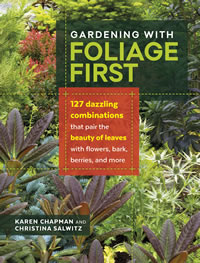 Karen Chapman and Christina Salwitz are crusaders for garden foliage. “Gardening with Foliage First” is their second book on this topic and greatly expands their 2013 book “Fine Foliage.” Their goal is to be your “personal design coaches,” and they tackle that project with great enthusiasm, starting with your choice of leaves. Flowers come later.
The authors have created a long list of vignettes of plant combinations. Some are simple, two or three plants, while others are very complex and may include ornaments. The setting can be in a large garden bed, or a simple pot. Flowers are allowed, but they must compliment the foliage and be chosen for embellishment. They are not the stars of the show.
The plans all have crazy names. For example, “The Ticklish Porcupine” includes a prickly pear cactus (Opuntia engelmannii) surrounded by Mexican feather grass (Nassella tenuissima). Why these designs work is carefully explained, along with general culture tips. Best is how the design will change with time. Attention is also drawn to potential problems, such as the invasiveness of the above-mentioned feather grass.
Excerpted from the Summer 2017 Arboretum Bulletin.
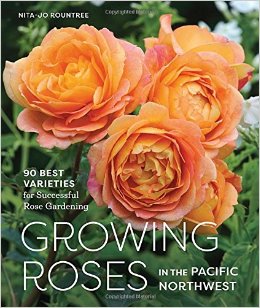 Nita-Jo Rountree move to the Bellevue, Washington 15 years ago after many years as a Master Gardener and the owner of a landscape design and installation company in Atlanta. She quickly learned to separate reality from the myths of our climate and she has used that knowledge to specialize in roses, one her favorite plants – perhaps her very favorite plant (she’s a bit coy on this subject; I know she loves hydrangeas, too).
She has chosen an impressive list of roses in all classes, all bred for health, or that have proved their durability in our region without a lot of fussing. Many of them are recent introductions that reflect the work of hybridizers for the home gardener, but she doesn’t ignore species or historical roses.
I have a passing knowledge of rose varieties, mostly from a brief period of heavy immersion in gardening with roses many years ago. At the same time, I learned a lot about the frequent spraying and other chemical rites of rose growing, as this was the expectation in almost every rose books of the time. Today, I only know a handful of Rountree’s recommendations. There is a good reason for this as her newer, recommended varieties don’t need the level of coddling I learned, thus avoiding the potential damage to the garden environment, the wildlife of the garden large and small, or to the gardener.
Rountree is emphatic in her most important advice. “Remember: The most important key to successful rose growing is choosing the right rose for the right place. Many books and articles about roses give generic advice for growing roses in a wide range of climates. They are of little specific help for growing roses in the Pacific Northwest.”
Excerpted from the Summer 2017 Arboretum Bulletin.
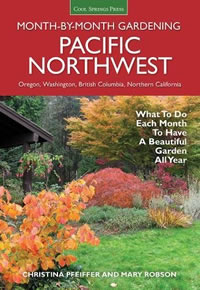 Gardening books that use a calendar format are especially valuable to newer gardeners, and having one that’s tailored to our region is even better. Best of all is having an author who worked in the Washington Park Arboretum for many years! Christina Pfeiffer brings her considerable experience to “Month-By-Month Gardening Pacific Northwest” and has consultation help from Mary Robson, a retired Horticulture Extension agent for Washington State University.
The same pair collaborated on a 2005 book, with Robson taking the lead on that publication. This new book begins with a short but very meaty introduction chapter covering the basics. The monthly chapters that follow build on the introduction with topics cleverly positioned when you’ll most likely want the advice. For example, in June we learned how to turn an area of your lawn into a garden bed, perfect timing so it will be ready for fall planting.
I appreciate that each month begins with a section on planning. What do you want from your garden? What is working well? What needs changing? Only after you’ve asked and answered these questions, do you start doing. These activities sections include planting and all aspects of caring for common garden plants ranging from annuals to trees. Lawns and houseplants are considered, too.
You are also encouraged to get out to nurseries and plant festivals, and to see our native plants where and when they are at their peak. Enjoying your own and other gardens is important, too. During July, “pause to revel in the beauty and bounty the garden has to offer. This is a time for picnics in the shade and leisurely strolls at local parks and gardens.”
Excerpted from the Summer 2017 Arboretum Bulletin.
Based in the UK, with Overseas membership available
This site provides assistance with identifying common conifers in the Pacific Northwest. It includes information about specific genera, user-friendly dichotomous keys, and a mystery tree section where you can test your knowledge.