“The National Association of Landscape Professionals passionately advocates for the economic, social and environmental benefits for the landscape industry.”
Lawn Care Information
Lawn care information from WSU Cooperative Extension.
Mushrooms Resource List
A list of the best books, articles and websites on mushrooms.
Seattle Youth Garden Works
“Seattle Youth Garden Works empowers homeless and under-served youth through garden-based education and employment.”
Garden Construction Resource List
A list of the best books, articles and websites on the construction of garden structures.
Puget Sound Mycological Society
PSMS is “an organization of people interested in mushrooms and mushrooming, which provides support and encouragement for research, education, cultivation, hunting, identifying, and cooking mushrooms.”
Annuals and Biennials Resource List
A list of the best books, articles and websites on annuals and biennials.
Forest Under Story
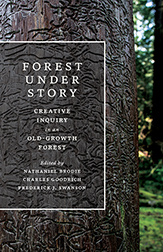
The H. J. Andrews Experimental Forest east of Eugene was established in 1948. At nearly 16,000 acres, it covers the entire Lookout Creek watershed on the west side of the Cascades. The Forest is used to study ecosystems, wildlife, logging practices, and many other natural and human processes in both old-growth and managed forests.
Started in 2003, the Long-Term Ecological Reflections program through Oregon State University sponsors “writers-in-residence” to spend one to two weeks in the Andrews Forest. Collectively, they have “…come to know the forest via the paths laid down in stories, stories told in anecdotes, photographs, essays, and poems, or in hypotheses, data, and graphs.”
The founders of this program are ambitious; they expect it to continue for 200 years. Fortunately, as readers, we don’t have to wait so long to read the results. Some of the early creativity is now captured in the book “Forest Under Story.”
This is a collection of poems, essays, and even field notes. Interspersed sections titled “Ground Work” provide the scientific basis that supports the more artistic writing. The black and white photography of Bob Keefer offers further context. This is a book to savor slowly, with lessons that are applicable to all coastal forests.
Excerpted from the Spring 2017 Arboretum Bulletin.
Street Farm
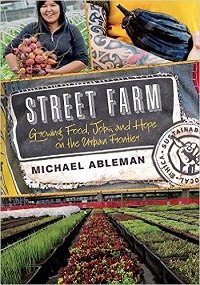
Street Farm is not a gardening book, but I’m reviewing it because it has a powerful message of the benefits of gardening, or – more accurately – urban farming, especially for those who do not have much else to bring hope and well-being to their lives. Author Michael Ableman is the co-founder of Sole Food Street Farms, a charitable organization that includes four farms on abandoned lots in downtown Vancouver, B. C. This book is the story of that organization and the people it has hired to become the urban farmers.
The neighborhoods around these farms are not tourist attractions. The author points out that “…while Vancouver’s prosperity is celebrated, its concentration of poverty and raw desperation endures in the midst of the polished and the preened.”
There are losses on these farms, both of the produce and of the humans who tend the crops, but overall this is a book of hope. Ableman is very clear that this endeavor is not a panacea for the challenges of poverty, mental health diseases, or addictions. He also recognizes his is a position of privilege by always having “…had a place to live and food to eat, and the color of my skin is not black or brown.”
Besides the human stories, all gardeners will relate to the challenges of growing plants in less than ideal circumstances, including outsmarting pests, in this case a sophisticated rat population that only chooses the best vegetables. No less interesting is the harvesting and marketing of crops to the more than 30 restaurants and five farmers markets that Sole Food supplies, plus its CSA (Community Supported Agriculture) shares and donations of over $20,000/year to community kitchens.
Excerpted from the Spring 2017 Arboretum Bulletin.
Japanese Horticulture: Origins and History
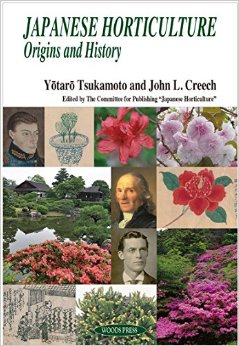
There are many books in the Miller Library on Japanese gardens and even more on Japanese-style gardens outside of Japan, but very little about the history of Japanese horticultural practices. A new book, “Japanese Horticulture: Origins and History” by Yōtarō Tsukamoto (1912-2005) and John L. Creech (1920-2009), helps fill this gap.
We are very fortunate to have this book at all. Although Tsukamoto and Creech had long planned this collaboration, the manuscript was not completed before their deaths, and it was only through the work of a group of Japanese editors that the book was published in 2015.
The authors begin their study by looking at the rich (over 6,000 species) native flora of Japan, introducing the plant communities by reviewing 26 sites in the national park system. This is an important starting point, as few of the plants used in early Japanese gardens were non-natives. A chapter follows on the iconic plants of Japan, including ornamental cherries, iris, and azaleas, plus a few introduced plants, especially chrysanthemums and peonies.
The book concludes with the long history of visiting horticulturists to Japan, and especially the exchange between that country and the United States, such as the partnership that led to this book. “Among the complexities of Japan/United States relationships, plant have played a singular but often ignored role in fostering a harmonious social environment.”
This book is a rare, new treasure in the Miller Library collection, and as such is not available to borrow. However, for all who are interested in the history of Japanese gardening, or perhaps after attending a tea ceremony at Seattle’s Japanese Garden, I recommend seeking it out when visiting the library.
Excerpted from the Spring 2017 Arboretum Bulletin.