The Seattle Department of Construction & Inspections administers and enforces regulations related to development that affects trees. Whether at a major construction site or just in your backyard, if you are considering cutting, removing or preserving trees, this website will help you identify applicable tree and landscaping regulations in Seattle.
Royal Botanic Gardens/Kew Databases
Databases, publications, bibliographies, catalogues and interactive keys from the leading international center of botanical research.
Plants for a Future Species Database
The Plants for a Future Species Database contains details of over 7000 plants, all of which are either edible, have medicinal properties or have some other use such as fibers, oils or soaps. For each plant the database contains details of the uses of the plants, as well as information of the environment it will grow in and cultivation details.
Plant Identification: Examining Leaves
An article by Pat Breen, Oregon State Univ., Dept. of Horticulture describing common characteristics of plants that are useful in identifying them.
King County DNR: Native Plant Nurseries for the Pacific Northwest
This listing of retail and wholesale nurseries and stores was compiled by the Water and Land Resources Division of King County, Washington for your convenience. The list draws in part on the Hortus West Native Plant Directory and the journal Hortus West.
Interactive Keys – Descriptions, Illustrations, Interactive Identification, and Information Retrieval from DELTA Databases
This site makes available numerous data sets of plants and animals that work with a free program called IntKey. First download and install this small program, then download a data set such as Grass genera of the world or Flora of China, which will trigger the program to run. By selecting certain traits, such as leaf shape, non-conforming taxa are eliminated.
Flora of North America
FNA’s mission statement reads: “FLORA of North America (FNA) is a project undertaken by North American botanists to provide authoritative, up-to-date information on the names, relationships, characteristics, and distributions of the approximately 21,000 species of plants that grow outside of cultivation in North America north of Mexico.” This extensive database of North American plants is organized by family, then down the line by genus and species. The information provided includes a detailed botanical description, citations to selected references, line-drawing images, which can be enlarged to positively identify the plant, and relevant links.
Flora of Oregon. Volume 1.
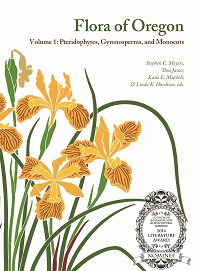
The first comprehensive flora of the state of Oregon in over 50 years is in progress with the first of three volumes released this summer. This volume is focused on ferns and their kin, conifers, and monocots, but in addition to the expected and detailed plant descriptions and range maps, there is an excellent introduction to the wide diversity of ecosystems in this state, including the Siskiyou Mountains. “Rare plants in the region are concentrated on serpentinite and dunite and soils derived from these heavy-metal rich rocks. Many of these plants are narrow endemics of only southwestern Oregon, but several have ranges that extend into adjacent northwestern California.”
Taking a cue from field guides, “Flora of Oregon” includes a list of recommended places throughout the state to see the greatest number of plant species. Highlights in the Siskiyou Mountains ecoregion include the Table Rocks (although beware, there are geographical features elsewhere in Oregon that also go by this name), the trail through the Rogue River canyon downstream from Grants Pass, and the Mt. Ashland-Siskiyou Peak ridge that “is home to a unique flora that is transitional between California and Oregon floras.”
If you’d prefer to explore nature from the comfort of your couch (or one of the comfortable chairs in the Miller Library), you might vicariously go botanizing by reading the biographies of a dozen or so prominent Oregon botanists included in the introduction. I found the story of Lilla Leach (1886-1980) most interesting, especially her discovery of the Siskiyou Mountains endemic and monotypic genus Kalmiopsis leachiana.
In 1930, she was walking ahead of her husband John Leach, who was also an active field botanist, and their pack burros when “‘suddenly I beheld a small patch of beautiful, low growing, deep rose-colored plants. Because of their beauty, I started running and dropped to my knees.'” May we all have such exciting moments when exploring for our native plants!
Excerpted from the Winter 2016 Arboretum Bulletin.
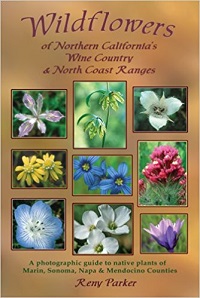
Wildflowers of Northern California’s Wine Country & North Coast Ranges
In defining the Pacific Northwest for the purposes of collecting books for the Miller Library, we have included the portion of California north of the San Francisco Bay area. That inclusion was confirmed for me when visiting Mendocino County this past summer where I especially enjoyed the Mendocino Coast Botanical Garden, which includes an arboretum of conifers and a closed-cone pine forest.
A new book in the Miller Library collection, “Wildflowers of Northern California’s Wine Country & North Coast Ranges,” highlights the herbaceous natives of this area and fills in another gap in the field guides to our defined region.
Author Reny Parker has solid northwest credentials, having learned to love the outdoors from outings with her father in central Oregon and British Columbia. She is primarily a photographer and this book includes an elegant collection of close up photos arranged by colors and ordered so that species that resemble each other are together for easy comparison. At the end, there is a section for ferns, grasses, and woody plants and maps of “Hot Spots for Wildflowers”. Since this book includes Marin, Napa, and Sonoma counties, it would be the perfect companion for a winery tour, giving you a chance to clear your head between tastings.
Excerpted from the Winter 2016 Arboretum Bulletin.
Mount Shasta Wildflowers
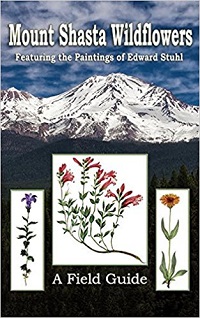
Mount Shasta in Northern California has an interesting flora, and also has one of the most interesting field guides to that flora. “Mount Shasta Wildflowers” uses the watercolor paintings of Edward Stuhl (1887-1984) for its images. Stuhl was born in Budapest and studied art in Austria and Germany before coming to the United States to work in stained glass. He quickly left that pursuit and ended up in northern California where he spent the rest of his long life painting the native flowers that he grew to love.
Four authors combined forces to bring this book into being, it appears primarily to make the Stuhl art collection, housed at California State University Chico, better known. They have also spent considerable effort to make this a worthy field guide by ensuring the taxonomy is up to date, providing a comprehensive and updated plant list for Mount Shasta, and giving guidance – through a series of recommended hikes – to finding each of the subjects.
A detailed visual index, with roughly inch-square reductions of the images arranged by colors, is a charming way to find your way through the book, but my favorite feature is the illustrated glossary with examples of numerous flower and leaf parts all taken from Stuhl’s paintings.
Excerpted from the Winter 2016 Arboretum Bulletin.