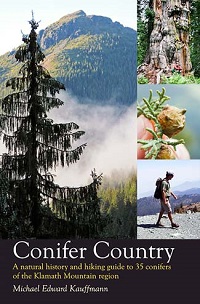
Michael Edward Kauffmann presents an excellent introduction to the ecology and the geology of the Klamath Mountain region in his book “Conifer Country.” He also helped me understand the names of the mountains. The Klamath Mountains include nine distinct sub-ranges beginning in the north with the Umpqua Valley of Oregon and reaching south to the Yolla Bolly Mountains west of Red Bluff, California.
The Siskiyou Mountains sub-range is by far the biggest, and includes all of the Oregon portion of the Klamath Mountains and a sizable part of California, especially closer to the coast. But to complicate matters, the coast has its own, separate mountains (the North Coast Range).
Confused? The maps that Kauffmann has drawn for his book will help tremendously. The main take-away is that this is an extremely rich area for botanists. “The Klamath-Siskiyou Ecoregion is world renowned for being a crossroads for biodiversity, representing one of the most species rich temperate coniferous forests on Earth.”
Following this engaging introduction, the author profiles the 35 conifer species of this region, including excellent range maps and photos, along with text that is suitable for the amateur to tell these often similar trees apart. These are followed by a series of suggested hikes, all geared for seeing the most of conifers, the richest being the so-called Miracle Mile. This square mile near Little Duck Lake, about 50 miles west of Mount Shasta, has over 400 vascular plant species including 18 different conifer species!
Excerpted from the Winter 2016 Arboretum Bulletin.
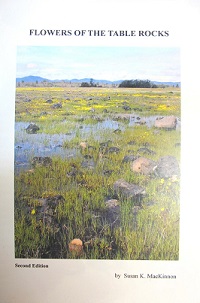
If you have enjoyed a hike up one of the Table Rocks in Southern Oregon, you might be interested in “Flowers of the Table Rocks” by Susan K. MacKinnon. These distinctive geological features in the Rogue River Valley just north of Medford are the likely remnants of a lava flow some seven million years ago. Erosion has left two plateaus standing well above the surrounding valley, and the mostly open and grassy tops are home to over 300 plant species, including 200 wildflowers.
This self-published book primarily speaks through its numerous close-up photos, with enough detail to engage the serious field botanist, but presented by the author/photographer to help anyone who just wants to know the names of the flowers. “I hope that some of the photos will inspire in even the casual reader the sense of awe, excitement and discovery that I experienced in studying the flowers.”
Much of the text discusses recent changes in nomenclature and a table in the appendices records these changes. Other tables show times of flowering, common names, and – perhaps the most interesting – the meaning or source of the scientific names.
Excerpted from the Winter 2016 Arboretum Bulletin.
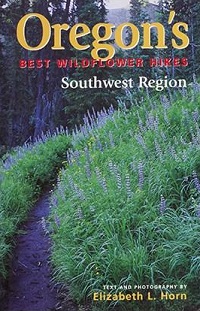
The author of three more conventional field guides to wildflowers, Elizabeth L. Horn makes “Oregon’s Best Wildflower Hikes: Southwest Region” about hikes to see wildflowers. Throughout she uses only common names, but this helps move you along the trail.
“Both Table Rocks are known for their colorful displays of springtime wildflowers. We hiked the area in both early April and early May and found the wildflowers breathtaking.” Lest this sound a little too idyllic, she warns that the trail rating is “strenuous” and that “poison oak and ticks are plentiful, so stay on the trail.”
While this is not a field guide, many prominent species are highlighted with close-up photos (all by the author) with interesting facts that make each distinctive. Detailed directions and GPS coordinates will help you find the trailhead while close-up maps will help along the trail.
Excerpted from the Winter 2016 Arboretum Bulletin.
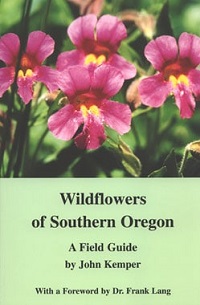
“Wildflowers of Southern Oregon” was written by John Kemper, a natural history writer who settled in Medford, and recognized the need for a simple guide to the native and naturalized flowers of the region. He’s also a skilled photographer, and even though each entry has only a single image, this will work well for most readers. Plants are divided by color and by families within colors.
In the forward, Frank Lane, retired chairman of the Biology Department at Southern Oregon University in Ashland, writes that until this book was written, “there was no book for beginners covering all of Southern Oregon.” The author includes a short list of best hikes and to help with planning, each image includes a description of the location and time of year when the photograph was taken.
Excerpted from the Winter 2016 Arboretum Bulletin.
University of Massachusetts at Amherst’s Soil and Plant Tissue Testing Laboratory (relatively inexpensive)
A pamphlet by the US Forest Service on preventing, identifying and caring for tree wounds.
“The Green Seattle Partnership coordinates restoration projects to care for our urban forest and bring people into the parks to build community through hands-on volunteerism.” The website has a database with map to find volunteer opportunities.
This publication from University of Illinois Extension covers the basics of growing plants in pots, and also includes sections on topiary, “blueprints” for container designs, and how to make a hanging basket.