SSW MSW Blog

Winter 2025 Elective on Indigenous Planning
MSW students, please consider this 3-credit Winter 2025 course for your Out-Of-Department Electives. Find more details below.
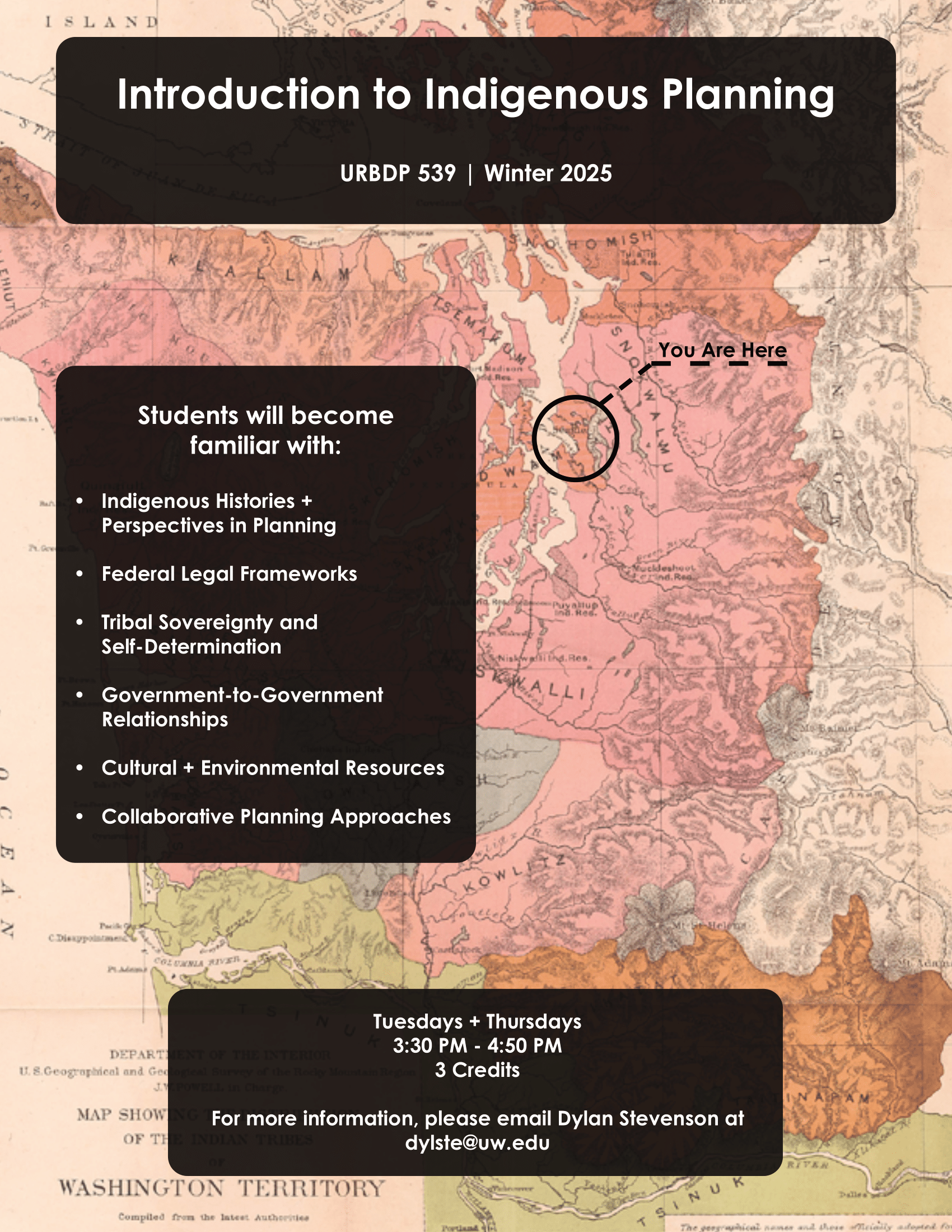
URBDP 539 Introduction to Indigenous Planning
SLN 21896, 3 credits, Winter 2025
Tuesdays and Thursdays, 3:30 – 4:50 PM, GLD 440
Instructor: Prof. Dylan Stevenson, dylste@uw.edu
Short Description: This course introduces students to key concepts within Indigenous Planning and the logistical considerations that are necessary for conducting planning activities by both tribal and non-tribal governments in the United States. Students will understand how planning mechanisms such as property rights and zoning can support Tribal Self-determination and Sovereignty in ongoing efforts. The course will examine case studies to analyze how planning projects impact topics such as Tribal Housing and Tribal Economic development, and their relationship with Tribal, State, and Federal law.
Relevant Fields: Urban Planning and Built Environments fields, Environmental Fields, Public Administration and Policy, Anthropology, History, Geography, and Political Science.
Prerequisites: None. This course is open to students without specific training in urban planning, health and wellbeing. Open to undergraduates upon agreement with instructor.
Learning Objectives:
- Describe the history and formation of Native American Reservations, characteristics of tribal governments, and their relationships to the U.S. Federal Government and State Governments.
- Identify issues facing Tribal Lands and challenges Native communities may experience such as land/water rights, economic development, and housing, among others.
- Understand and explain how said issues facing Tribal lands are interrelated.
- Develop an understanding of multicultural perspectives, specifically between Native American and non-tribal viewpoints. This includes perspectives among different tribal groups and how cultural contexts affect approaches to solving issues on reservations and tribal nations.
- Develop problem-solving and critical-thinking skills.
- Develop the ability to perform preliminary research for planning projects and write professional written/visual documents.