This interview first appeared as an episode of the Science Positive podcast. You can check it out here on Youtube or here on Spotify!
Emma: All right! Welcome to another episode of Science Positive, or SciPos, for short. I’m your host, Emma Guerrini-Romano, and today, we’re joined by the wonderful Elissa Khodikian. Thank you so much for joining us, Elissa.
Elissa: Thanks for having me. This is great.
Emma: Welcome to the studio. So here on SciPos, we talk about everyone’s journey to grad school, in grad school, and advice for grad school. So, let’s start off and ask you, how did you get where you are? What was your path through science? And how did you end up at UW?
Elissa: Good question. I feel like people always ask me that, or they always talk about their road to grad school or their road to biology, and I feel like I don’t really know how it happened, to be totally honest. As a kid, kind of like what Tori was saying, I really–I don’t know, I kind of liked insects, I guess. I was super into ants for some weird reason, especially in Lebanon. And then coming to Canada, my mom never liked animals, so we only had fish, so I was really into that kind of world of stuff, but not really.
In school, I really liked math and physics. I liked biology, but I was like, meh, whatever. And then I think getting into undergrad, I think it probably was one of my first cell and molecular biology courses that I was like, wow, this is super cool. I can’t believe our bodies can do this. And that was probably the first step into it. And then I just got into undergrad research. And it was– yeah, I don’t know. And that’s history, I guess.
Emma: What was your undergrad research? And are you doing anything very similar to that now?
Elissa: Cool. I did quite a bit in undergrad. So I did my undergrad, and then I did my master’s, and now I’m doing my PhD, so I kind of have a lot that I’ve done. I started doing some aging work with hydrogen sulfide producing enzymes and kind of the molecular evolution of those enzymes among vertebrate species, and that was really cool. It was more like a like dry computer project, I guess. It was looking at genomes and stuff, and yeah, it was really fun. I did phylogeny stuff. That was really cool. I didn’t love it, but I loved my supervisor. She’s the most incredible woman in the world. And she asked me if I wanted to come back the following year. And I was like, yeah, whatever you have, I’m happy to do it. So that was my first honors project was with the aging. And then the next one was on olfaction and crabs. And I really, really liked that. So, I stayed to do my master’s with that as well. I spent two years, did field research, kind of like dipped my toes in some fish work because the lab was doing that as well. And yeah, and then I kind of made my way over to mosquitoes, I guess, after that.
Emma: So, when you said olfaction and crabs, what is olfaction?
Elissa: OK, cool. Yeah, I should have probably used an easier word. Basically, just like the sense of smell, so show they’re able to sense their surroundings. We were more curious about food cues, but a lot of people do a lot of different work with pheromones, alarm cues. So, you have really cool stuff, especially in an aquatic environment, because you can do a lot more behavioral work. I mean, I’m sure you can do that with mosquitoes and air stuff. But to be honest, I don’t really understand how. I don’t really know how that works. I guess I only know the aquatic stuff. But yeah, how the molecules move through the water, how they’re able to take them in the receptors.
Emma: So, I know that from our conversations in the past, you had a lot of big crabs that you would inject with specific things. What were those things that you would inject? What was the kind of setup for that? And you also said you did fieldwork, right? So, what was the kind of balance between fieldwork and lab work for you?
Elissa: Yeah, that was actually really really, honestly, like, a blurry part of my life I think because fieldwork is a lot. And the way we used to do it, basically, was that we were there for six to eight weeks at a Marine Sciences Center, which was so, so, so beautiful. It was in Victoria, British Columbia. Or near Victoria, it was actually Bamfield, BC. We would go there for six weeks. The first couple days, we’d go collect, and then we had an internal lab environment that we would expose our animals, do behavioral recordings, and then take tissues and samples for analysis back in Toronto. So, it was kind of like a really, really go, go, go six to eight weeks that we would do fieldwork. And then after that, it was not really off time, but we had wet lab work. But it was a bit slower, and you could kind of take your time with that, which was kind of really nice.
Yeah, I did some injecting. We did injecting with BRDU. Don’t ask me what it’s called. Broma– broma something uridine. Basically, it’s like a marker for cell proliferation. And the only reason we really cared about that was because we were noticing that their nuclei were smaller. So we were like, are they just dividing more, or are they actually going through like, hypotrophy? Yeah, and then I did a bit of that, which was kind of fun.
Emma: That makes sense. So after your master’s, you went straight into your PhD. What was the transition like for you? I know that you came from Canada to the United States. How was that transition, and what are the big differences that you’ve noticed between Canadian science and American science?
Elissa: OK, I think, well, coming over to the US, I think, was great. I think there’s a lot more money that comes in to the universities here. I think there’s a lot more money that gets pumped into research here. I think the biggest difference I’ve noticed is that in Canada, my PI would always refer to us as trainees, and that was the whole point, is that it’s a training program. And that was the way that I think about it, and that I think I’ll think about it for the rest of my life. Master’s and PhD, whatever it is, you’re basically being trained as a researcher. It’s not so much about the technique you’ve learned, or the papers you get out, or whatever. It’s more about literally just getting trained to ask the right questions and think about things in the right way, so I think that was the biggest difference. Whereas here, it feels more like they really do still see you as students, versus I feel like in Canada, it was more like you’re a trainee, and you’re learning. I mean, it’s weird, because I guess both words are interchangeable, but to me, they’re really not. Here, it feels like they are really, really– you have advisors and stuff, versus we don’t really have any of that. It was just like, go do your research, learn your science, and call it a day. Versus here, it’s a lot more elaborate, I guess.
Emma: Yeah, there’s a lot of systems set up for us here.
Elissa: Yeah, which, I mean, it’s great, and to be honest, it probably helps with well-being and stuff. But I guess I just never was used to it, because I was– I don’t know. Just having an advisor here was like, I don’t really know what the point of this is. Just give me a book. We had a handbook that just had all the dates, and I was just like, follow this, and you’re good to go. So, I don’t know. I’m sure it’s great, but no, I’m sure. It is nice, but it’s different, for sure.
Emma: Yeah, totally. And so speaking of different, what you’re doing now is very different than what you were doing before. What are you researching? And I know you’re working with mosquitoes, so tell us a little bit about that.
Elissa: Cool, yeah. I’m kind of in love with my project. I think I’ve grown to love it, and I think, just because it was really novel in the beginning, that was really cool. So less than 5% of mosquito species are salt tolerant, and I’m studying the salt tolerant mosquito species. There is quite a lot of work on how freshwater species, osmo- and ion regulate, so how they maintain their water and ion balance. But there is basically nothing short of one paper that recently came out about how saltwater species are able to do that, so my first chapter is really focused, and I think where I’m putting most of my eggs is the cellular mechanism for salt secretion in salt tolerant mosquito species. So how are they able to use their gills, “gills,” and their rectum to really maintain their water and ion balance in an environment that’s completely not conducive to their, I guess, hemolymph levels.
Emma: So really briefly, what is hemolymph?
Elissa: Cool. Hemolymph is the blood of an invertebrate.
Emma: Perfect. Just to make sure. And it’s– fun fact, it’s purple when you take it out. And for the salt tolerant species of mosquitoes, where are these salt tolerant mosquitoes found, and why is it of importance to understand the mechanism of salt secretion in them?
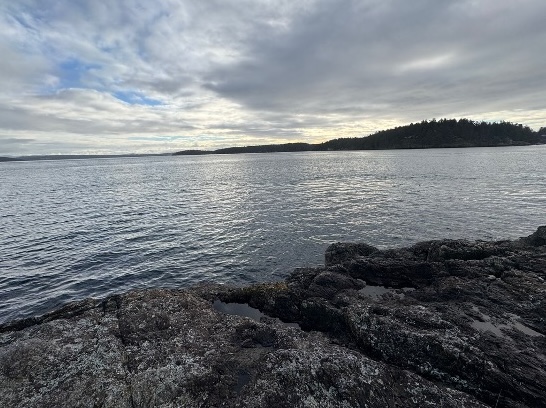
Elissa: Cool. So there is– one of the species that I’m working with is native to Pacific Northwest. They’re found in rock pools basically right off of the coast. And then another species that I’m working with are a marsh species. So they’re from Florida, so in the salt water marshes, they’re found there. So– sorry, what was your other question?
Emma: Why do we care about how they excrete salt?
Elissa: Yeah, for sure. I’m more of a fundamental, foundational physiologist. I care because I think it’s cool. And I think that the cellular mechanism behind that is very interesting.
Emma: Totally.
Elissa: I think when I try to pitch it, I always pitch it as the evolution of salt tolerance is really important, which is also true. And it seems like there has been, so far, it looks like there’s some kind of convergent evolution. So salt tolerance has evolved multiple different times among Diptera, or the two-winged flies. So I think that’s really important, because if we’re seeing them gain mechanisms to basically inhabit different areas, then we’re going to have mosquitoes in areas that we weren’t having mosquitoes before. So that’s kind of what I say when I’m writing a grant or something.
Emma: That makes sense.
Elissa: Kind of sell it, I guess.
Emma: So, throughout your thesis work, specifically your first chapter, what are some of the methodologies that you’re using? And what are some of the issues that you’ve run into with those methodologies?
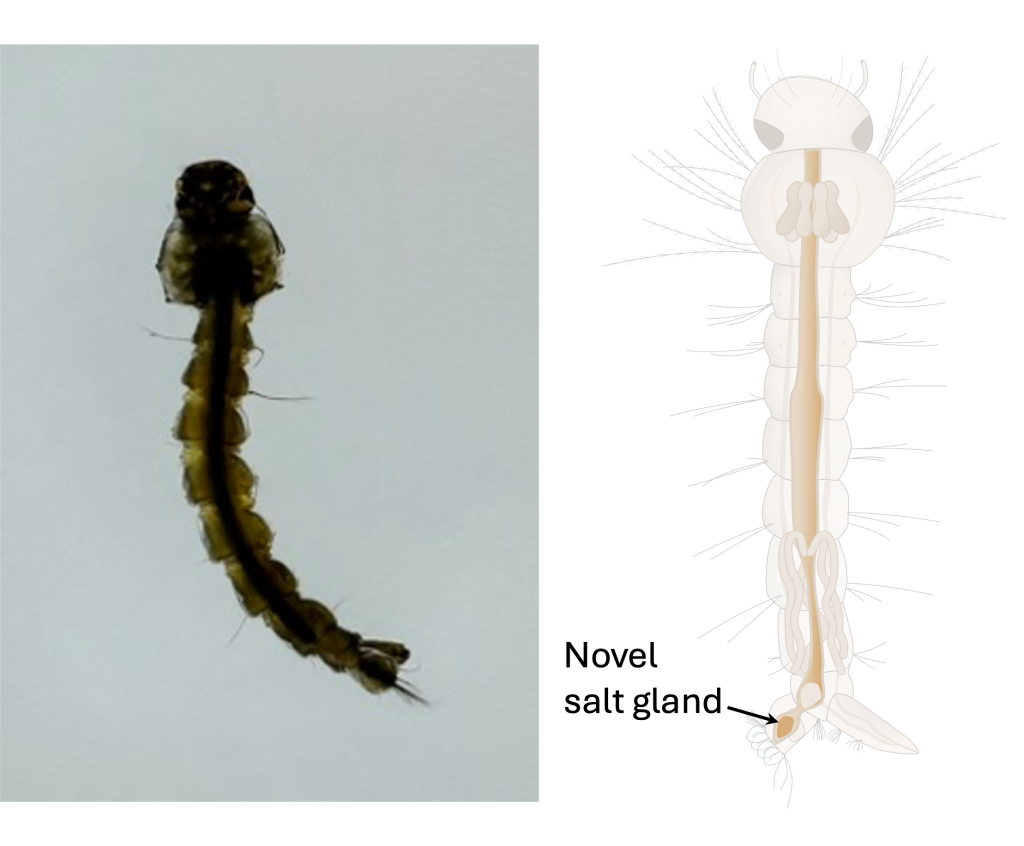
Elissa: Yeah, so what we’ve kind of started doing was we’ve started with immunohistochemistry. So basically, just to look at the different ion channels and transporters that they have and see where they’re localized among the body. And then also doing some– oh my god, I’m trying to think, oh, transcriptomics, obviously. So, looking at sequencing data, especially because they have a novel organ. So, looking at the novel organ and then also their papillae or their gills and seeing what type of transcripts are being expressed there, so differentially expressed in freshwater and saltwater. And then also doing some flux with selective ion microelectrodes, which basically you’re just measuring the difference in millivolts basically at the tissue surface, at the membrane surface, and then back. And then kind of using that to figure out if they’re absorbing or fluxing out ions.
Emma: Interesting. So, you said novel organ. What is the novel organ in the saltwater mosquito?
Elissa: So, for the salt marsh mosquito, so the one from Florida, they’ve kind of written them down as like anterior and posterior rectum versus freshwater species would just have a rectum. For the one in the Pacific Northwest, it’s so novel that we don’t really have a name for it yet. So, something we’ve been tinkering with is because it’s basically just an enlarged anal canal, so we’re like anal canal papillae complex. But I think to call it a complex, we have to decide if they are working together. So, I think once we know, we’ll figure out, put together a name.
Emma: Totally. I mean, that’s pretty awesome that you get to name the specific organ of a saltwater mosquito species.
Elissa: I will say it’s like, who knows when it’ll ever be looked at again. So, it’s definitely, yeah.
Emma: So, when you were talking about your methodology you said you’re doing, spanning from immunohistochemistry, looking at certain channels to ion selective microelectrode technique, or ISME, and looking at specific ion concentrations. Together as a whole picture, what is that that’s telling you about the flux and secretion of salt for the cellular mechanism? What does that tell you about the whole system and what’s happening there?
Elissa: Yeah, so I’ll be doing some more work with the different organs as well to kind of build a picture. But in my head, or I guess how I feel like it’s looking like, it’s that the tubules are functioning the exact same way. Their ordinary rectum is functioning the exact same way. And they’re kind of supplementing this, they’re supplementing, I guess, salt secretion, or they’re able to kind of go about that using their gills and their kind of novel rectal segment. And basically, I think the biggest problem they have in salt water is the loss of water, gaining water is really hard for them. So, in salt water, they drink a lot of water but when you’re drinking that much water, you’ve got to get out all that salt. So really, it’s figuring out what is the cellular mechanism that they’re using. What are the channels? What is the movement of ions that’s happening that is allowing them to survive in salt water?
Emma: And so, this is comprised as mostly your first chapter of your thesis. What are some of the subsequent chapters that you’re looking at? Are the questions the same, or do they change a little bit throughout those?
Elissa: They change almost completely.
Emma: 180.
Elissa: Yeah. I think it builds pretty well, but I do think it’s quite a big difference. So that’s my first chapter. And then my second chapter is looking across, and that convergent evolution topic I was talking about, looking at different Diptera species and how they evolved salt tolerance and looking at salt tolerance between the different species. So, what’s really cool is we get to use a midge species, which actually lives in the same rock pool as the salt tolerant coastal rock pool species. So, it’s going to be really cool to see they’re literally in the same environment. They’re experiencing the same winter, summer, spring temperatures. And they’ve just evolved separately to be in salt water. And because they’re a midge species, they’re kind of completely out of the picture, evolutionarily wise. So, it’s like, how do they figure it out?
Emma: Midge, for people who might not know, are colloquially called gnats sometimes in the United States. Midge is like, anyways, they’re interchangeable.
Elissa: Any type of really, really, really, really tiny fly is a midge.
Emma: The ones that fly in your face when you’re biking.
Elissa: Which makes it so hard, too, because the ones we have, I still don’t even know what genus they are. It’s tough, there’s a billion of them and sometimes the differences between them is that you have one extra segment somewhere. Yeah, that’s really hard.
Emma: Yeah. So that comprises your second chapter? And so then your third chapter is?
Elissa: Is modeling. Yeah, basically modeling, kind of using those– the different– how do I put this? Kind of looking at their energy, looking at their ability to live life in saltwater, or their success in saltwater, and kind of modeling that for the Pacific Northwest, specifically.
Emma: Awesome. So throughout these three chapters, you have a variety of techniques. You’re modeling, you’re doing a lot of computer work. Chapter two, you’re working with two different species. Chapter one, you’re working with a bunch of different protein and ion-focused techniques. What are some issues that you’ve run into throughout the past two years that have really bogged you down and that you’ve had to pivot for?
Elissa: Good question. I think working with saltwater is really, really hard. One, rearing is– and Tori talked about it. Rearing is hell on earth. Oh, sorry. Rearing is basically building a colony of mosquitoes. So, I guess, yeah. And saltwater is just a pain to deal with, because you have to make it up all the time. But saltwater is also really hard to record in, because it’s so ion-heavy. Any recording I’m basically doing is taking me, I don’t know, 50 years more than it probably should. It feels like I’m troubleshooting every single day of my life, which is hard. But I also– that was one thing that I really appreciated having my master’s experience, was just like, that’s life. And that’s like 90% of science, probably. So yeah, hopefully I’ll get through it. But saltwater has just been a pain in the ass to deal with.
Emma: Yeah, and also, saltwater, just generally for facilities, you have so many restrictions as to where you can have it, because saltwater erodes all metal.
Elissa: Yeah, I think CLR is my best friend right now.
Emma: What’s CLR?
Elissa: It’s a rust cleaner.
Emma: Oh, OK, cool. There you go. Shout out to Home Depot or Lowes. So, you said 90% of your work is troubleshooting. During that 90%, I’m sure there’s times where you’re going absolutely crazy. What is something that you tell yourself when you’re really in the thick of it that’s just like, I need to keep going?
Elissa: Yeah. I mean, Rin, an undergraduate researcher that I’m working with, I think I’ve probably said it to her maybe a million times, “It’s just not that serious. It’s really, really, really never that serious. Nobody’s going to die. Nobody’s going to live because of what we’re doing.” You know what I mean? In the grand scheme of things in life, no one’s losing a limb. We’re fine. It’s honestly just never that big of a deal. And it will feel like that in the moment. But I think just remembering that it’s literally a mosquito. It’s OK. And life will move on. And tomorrow the sun will rise. It’s honestly– the world will keep turning no matter what we’re doing. So, it’s OK. I don’t know. I think it’s easier to say than it is to do. But I think the more you tell yourself that, the more you’re like, yeah, it’s actually not that serious. And I think I do that all the time.
Emma: That’s great. I think also a big part of the PhD is we take ourselves so seriously. And we’re the experts of our project. So, we go about our life thinking about salt-tolerant mosquitoes or any sort of plant species that other people have talked about and think that that is the world to us. So yeah, that’s a good mentality to keep yourself sane, I guess. So, pivoting towards more about how you cope with being a grad student, what is something that’s really helped you outside of your mindset of this doesn’t really matter in the grand scheme of things? What is something that’s really helped support you throughout the past year and a half of being in your PhD?
Elissa: I’m going to go back and just say it sounds so bad. But I think it’s really, really important. Because I think your work can be part of your life, but it cannot be your whole life. Because then when something goes wrong or something’s not working or you’re troubleshooting for three months straight, you take it out on yourself. And then you feel insecure. And then it’s just such a bad cycle. So, I will double down on it’s not that serious, only because I’ve seen people put themselves in a hole, because they do think it’s that serious and it’s not that serious.
But bringing it to the other point. I think the gym has really helped, actually. I think any kind of physical activity is probably really good. But I think the gym, running, has just really, really helped. I think getting some kind of stress relief. I think– oh, I don’t even want to say this story. But there was one day where I was just like, something happened. I was upset. And I was like, damn, this is the worst day of my life. And then I went for a run. And I was like, you know what? It’s not that serious. It’s fine. But I think sometimes there’s pent up feelings and stuff. And it doesn’t have to be the gym. It doesn’t have to be running. But I think really just going outside, touching grass, again, seeing that there’s other things in life besides your one small organ and your one small mosquito will help you live.
Emma: Totally. I guess this is also probably a mentality, like you said, that you adopted throughout your masters. It’s something that really you had to work on. Who is someone that really helped you in this mindset, or even was super impactful for you to be able to be successful in your PhD?
Elissa: Yeah. I think this is a tough question, because I kind of want to say everyone. I think we’re the product of our environment. So, we’re kind of the product of all the people we love that are surrounding us. Yeah, probably my family, my mom, my dad, my sister, I think they’ve always been super supportive. I think half the time, they don’t understand what I’m talking about or what I’m doing, but to them, any time they talk about me, it’s always the most positive. And I think that has only helped me talk about myself in the most positive words. My mom is especially really good at this. I don’t think there’s been one single bad thing she said about me my entire life. She is always like, you are perfect, the best. Which, I mean, whatever. You can say that that’s maybe like an opposite problem. You can have the opposite problem if you keep going. But I think it’s just really– I don’t know. I think everyone. This is a hard question.
Emma: You’re set up with love.
Elissa: Yeah, yeah.
Emma: That’s great. And then also, as you progress through the next three chapters of your PhD and the next three or so years of your degree, there’s going to be so many snafus that occur here and there. What are you telling yourself? I mean, other than the mindset we’ve already talked about, how are you preparing yourself for this? And what do you foresee being a struggle that you’re going to face?
Elissa: Yeah, I think, one, really remembering that you’re supposed to be learning. It’s a learning point in your life. Even if I am an expert, I think the more you learn, the more you realize the little you know, actually. So, I think, yeah, it’s a training program. It’s a learning program. I don’t need to know everything. And that’s fine. I think things will happen again. It’s not that serious. But also, I think taking things– taking it seriously sometimes, or being like, OK, well, I do need to figure this out. And being more internally motivated, I think, is really important. I think that’s something that I also learned. Nobody’s going to make you like your project. Nobody’s going to make you care about your project. Nobody’s going to make you curious about it. That all has to come internally. So, if you really, really don’t like it, then five years is going to be really, really hard to deal with. So, I think that was really important for me. It’s probably picking something or also learning to love something that’s new and making it exciting for yourself is really important as well.
Emma: Awesome. In our last couple minutes, just for people who are probably– who are starting to get into grad school, want to get into grad school, or even just get into STEM, what is a piece of advice that you have for them?
Elissa: I think you can do it. It’s not that difficult. I want to say, I don’t think anything that we do is that difficult. I’m probably one of very few people that will say that. But I think anything in science can be learned. Half the time, it’s just a recipe or a set of instructions. Honestly, as long as you can bake, you can probably do what we’re doing, to be totally real. So, one, anyone can do it. But also, all you really need to do is set out a couple emails. I mean, you might have to send out like 100, but someone will get back to you. And even if it’s not something you like, you’ll probably learn a couple things and then it’ll be the experience you can bounce off. But that initial experience you get is so important, just because once you have something written down, you can say, oh yeah, I did do this and then it’ll just look better.
Emma: Yeah, snowballs.
Elissa: Yeah, exactly.
Emma: Well, we’re wrapped up. Anything else you want to say to the viewers, your fam, anyone watching?
Elissa: It’s not that serious, guys.
Emma: And with that, thank you so much, Elissa, for joining us. We’ll hopefully check back in with you after your general exam and see how things are progressing.
Elissa: Definitely, thank you.
Emma: Thank you.
Check out the previous SciPos Podcast interview with Tori Armitage here!