





The YRC is a NIGMS Biomedical Technology Research Center based at the University of Washington in Seattle. Click to learn more about us.
Learn more about the technologies being developed by the YRC and how they are being applied to biomedical problems.

Learn how to collaborate with the YRC–leveraging our technology and expertise in your research.
Active Projects
Collaborators Since 2011
Annual NIH Dollars Impacted
YRC Publications
New Research
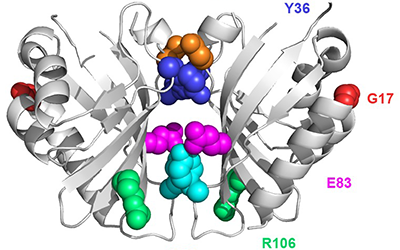
We are developing technology to produce biosensors based on a ligand-binding domain (LBD) that may, in principle, be applied to any target molecule. The power of this method is illustrated in this paper by development of biosensors for digoxin and progesterone.
Read more in eLIFE or in PubMed Central.
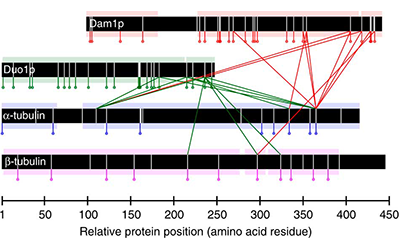
In this work, we combine the results of protein cross-linking mass spectrometry with iterative structural modelling to determine the molecular architecture of the 10-member Dam1p protein complex in S. cerevisiae. Using this technique, we can model conformational changes resulting from binding with microtubules.
Read more in Nature Communications or in PubMed Central.
Latest Publications
Zelter, A et al. (2026) Identification and characterization of a novel aldehyde metabolite of WIN18,446 and associated WIN18,446-ALDH1A2 protein adducts using mass spectrometry. Drug Metab Rev :1-22. PubMed PMID:42124481
Quezada, A et al. (2025) Lysosomal permeabilization by Group A Streptococcus releases proteins into the macrophage cytosol. bioRxiv :. PubMed PMID:41279162
Lu, S et al. (2025) TDP-43 skein-like inclusions are formed by BAG3- and HSP70-guided co-aggregation with actin-binding proteins. Nat Cell Biol 27 (11):1925-1937. PubMed PMID:41174004
Vicente, JJ et al. (2025) The kinesin motor Kif9 regulates centriolar satellite positioning during interphase. Curr Biol 35 (21):5119-5135.e4. PubMed PMID:40975050
Berger, S et al. (2025) Computational design of potent and selective binders of BAK and BAX. Sci Adv 11 (36):eadt4170. PubMed PMID:40911686