| Overview Conversion
of grasslands and meadows to woodlands and forests is occurring
globally, with profound consequences for biological diversity and
other ecosystem services. In the Pacific Northwest—as
in much of western North America—mountain meadows are
increasingly threatened by the encroachment of conifers as a result of fire suppression, release from grazing pressure, and changes in climate.
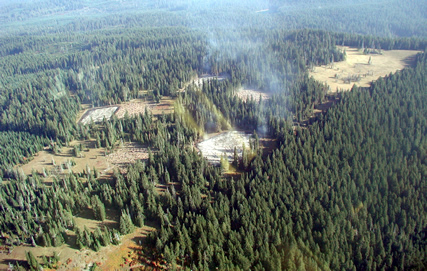
In the western Cascade Range, mountain meadows are key habitat elements in a landscape dominated by coniferous forests. They comprise <5% of the landscape, but serve critical ecological and societal functions: creating natural fire breaks, supporting distinctive communities of plants, providing habitat and food resources for pollinators and other wildlife, and offering unique recreational opportunities. Since the 1940s, the extent of meadow loss may be as high 50% in some areas.
Our
program of research, education, and outreach is devoted to the ecology,
dynamics, and restoration of western Cascade meadows. Our work is
centered at Bunchgrass Ridge, a 100-ha mosaic of dry montane meadows
and encroaching forests in the Willamette National Forest, Oregon.
Observational and experimental studies at Bunchgrass Ridge address
a variety of questions including:
Our
studies bring together university scientists and federal resource
specialists, building on a long history of collaboration between
the HJ Andrews Experimental Forest LTER and the Willamette National
Forest. Key
participants include the USFS McKenzie River Ranger District, University
of Washington, Oregon State University, University of Victoria,
and the USFS PNW Research Station. |

Willamette
National Forest |

H.
J. Andrews
Experimental Forest |

Joint
Fire
Science Program |
|


