CENTC Logo
Center for Enabling New Technologies Through Catalysis
A NSF Center for Chemical Innovation


  Home Research People News Education Research Opportunities  
 
 
Information For
 
Researchers
Educators
Students
Industry


Announcements

2010 CENTC Summer School Accepting Applications
CENTC is sponsoring a summer school to be held July 19-22, 2010 at the University of Washington in Seattle. The four-day in-residence summer school program will emphasize purposes, techniques, challenges and career opportunities in catalysis as the 21st century progresses. Advanced Ph.D. students, post-doctoral fellows, early-career researchers and faculty members from primarily undergraduate institutions who are interested in deepening their understanding of organometallic catalysis are encouraged to apply.
more...

What is CENTC?

The Center for Enabling New Technologies Through Catalysis (CENTC) is a National Science Foundation Phase II Center for Chemical Innovation. CENTC brings together researchers from across North America to collaboratively address the economic, environmental and national security needs for more efficient, inexpensive and environmentally friendly methods of producing chemicals and fuels from a variety of feedstocks.

Through catalysis, CENTC researchers can lower the energy costs to transforming chemicals, use inexpensive, abundant and nontoxic starting materials and generate less waste. Fundamentally new technologies are needed to reduce our dependency on foreign oil both for fuels and for chemicals. The production of chemicals including plastics and medicines from petroleum can be made more efficient through catalysis. Novel catalytic methods are also needed to develop alternatives to petroleum for fuels and chemicals. Coal, shale and biomass may all be viable as starting materials for the production of fuels.
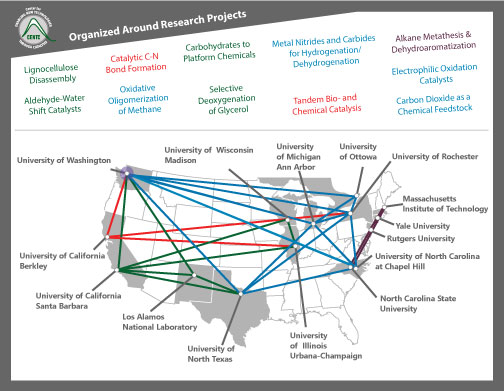
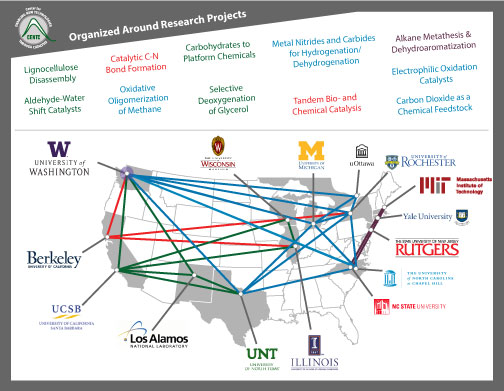
University of Washington University of Illinois - Urbana-Champaign University of Wisconsin University of Michigan University of Ottawa University of Rochester MIT Rutgers University North Carolina State University University of North Carolina University of North Texas Los Alamos National Laboratory University of California - Santa Barbara Map of CENTC Institutions

CENTC Partner Institutions

Learn more...

CENTC News

New insight into the conversion of methane to ethane by palladium-based catalysts
CENTC investigators James Mayer (University of Washington) and Melanie Sanford (University of Michigan) have reported a better understanding of the way certain palladium-based catalysts release methane to form ethane.

Melanie Sanford Named Esquire Magazine's Chemist of the Year
CENTC investigator Melanie Sanford has been named Chemist of the Year in the December 2009 issue of Esquire Magazine.

Alan Goldman and New Rutgers "Signature" Energy Course Benefit from CENTC Outreach Experience
A new "signature" course at Rutgers University was the subject of a write-up in the New Jersey newspaper The Star-Ledger. The course was co-developed by CENTC investigator Alan Goldman largely as an outgrowth of his participation in CENTC outreach activities.

Melanie Sanford Receives BASF Catalysis Award 2009
CENTC investigator Melanie Sanford was recently awarded the BASF Catalysis Award 2009 for her research seeking new catalytic reactions for cleaner systems and greener processes in chemistry.

CENTC Researchers Characterize Methane-Metal Complex
CENTC researchers at the University of North Carolina and the University of Washington have described the first observation of a metal complex that binds methane in solution. The finding is reported in the October 23 issue of Science.

Karen Goldberg Interviewed by EarthSky
CENTC Director Karen Goldberg was interviewed by EarthSky recently on the topic of converting methane to methanol. You can listen to the interview and read the transcript at EarthSky:
http://www.earthsky.org/interviewpost/energy/karen-goldberg-trying-to-make-natural-gas-more-accessible-fuel-option

What is Catalysis?

Catalysis changes how a chemical reaction happens. This process usually speeds up a reaction, and can also make new reactions possible that allow different starting materials to be used. The chemical that causes these changes is called a catalyst. The catalyst is not used up in a reaction.

Catalysis schematic figure


Catalysis is extremely important to our economy. Nearly all industrial production of fuels, plastics, drugs and other chemicals relies on catalysis to be possible. Development of new catalysts is critical for the development of more efficient, economic and greener technologies.


Quick Links
 
Summer School Info
About CENTC
Research Opportunities
Contact CENTC
NSF Website
CENTC Advisory Board
CENTC SharePoint Site
Publications
 
  NSF Logo The Center for Enabling New Technologies Through Catalysis is a National Science Foundation Center for Chemical Innovation
CENTC Partner Institutions

© 2009 Center for Enabling New Technologies Through Catalysis

Contact: centcweb@u.washington.edu