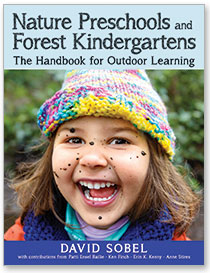
 Reading David Sobel’s latest book feels like attending a national conference on outdoor early childhood education. Each chapter draws on the expertise and experience of key decision-makers working with young children in nature programs all over the country. The format also gives a sense of history and progress over time, with Sobel’s journal entries from his work in outdoor education in the 1970s and his personal parenting journals from the 1990s presented alongside his contemporary research and observations from visits to today’s outdoor preschools.
Sobel first distinguishes forest kindergartens from nature preschools, explaining how they differ in genesis, mission, philosophy, curriculum, and focus, and how both types of programs in North America differ from the European Waldkindergarten schools which arose in the late 1960s in Germany and have influenced similar programs in Scotland and other European countries.
A central theme is the developmental case for a style of outdoor education where instructors act as mentors and guides as children experiment, choose activities and learn to work together, not only solving their own problems but deciding for themselves what questions they will ask and what games and projects to invent on the spot. These experiences, he argues, lead young children to develop initiative, perseverance and creativity as well as a richer vocabulary, a love of nature, and social skills that will serve them (and their communities) well in later life. Sobel’s reasoning is persuasive and the examples he gives are diverse and fascinating.
The chapter entitled “The Dollars and Sense of Business Planning and Budgeting,” contributed by Ken Finch, covers factors to consider when starting or expanding such a school. This detailed information seems particularly useful in a field that is growing quickly and likely attracts idealistic people who aren’t predisposed to draw up balance sheets and strategic plans. Whether a school is a non-profit organization or a for-profit business, it will be essential for founders to understand how to budget, how to attract staff, donors, families, and investors, and what rules and regulations affect such schools.
Sobel and his coauthors use stories, photos, and dialogue gathered from fledgling and more established nature preschools and forest kindergartens around the United States to highlight best practices in curriculum, focus, staffing, administration and funding. The book closes with a chapter by Erin K. Kenny, the cofounder and director of Cedarsong Forest Kindergarten on Vashon Island. Kenny details the events of a fall day there to illustrate some of the ways the school supports scientific inquiry, language learning, and emotional development for the children who attend. This book will intrigue anyone with an interest in outdoor education for young children.
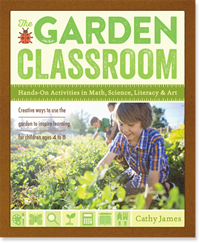 “Anything you can teach in an indoor classroom can be taught outdoors, often in ways that are more enjoyable for children.” This bold assertion opens Cathy James’ new book, and she proves her point with simple steps anyone who teaches children can take to enhance the curriculum outdoors. The projects are flexible, affordable and practical for small or large groups, aged 4 to 8. An invaluable resource for early education!
 Parents of enthusiastic young gardeners, and farmers’ market shoppers alike will love this useful guide to home-growing and cooking. It features easy, photo-illustrated recipes grouped by their main ingredients, so that chocolate zucchini cake is right next to zucchini salad and stir fry, allowing cooks to choose a recipe based on what they have on hand. Better yet, each chapter begins with step-by-step instructions for growing children’s favorites like herbs, peas, beans, and berries.
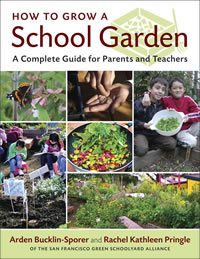 The authors, who are members of the San Francisco Green Schoolyard Alliance, recognize a fact that is becoming clear in schools across the country: if we are to have school gardens in this era of tightening budgets, increased academic testing and expanding class sizes, parents must step up and offer their time and energy to establish and maintain them. My own personal experience with this process as a volunteer in the garden at my neighborhood elementary school indicates that while a few parents at each school might have the necessary time and energy to devote to this, it is rare to find anyone at all with the practical knowledge, patience and understanding that are necessary to make such a garden flourish. That’s why this book is so important and useful. Not only does it empower parents and teachers to get something growing, it educates them about the planning, funding, building, maintenance, use, and enjoyment of such a garden. Valuable topics include dealing with vandalism, training students in basic garden tasks, preparing for garden lessons, scheduling class activities in the garden, and planning for summer watering. This book is a must-have for any gardening library.