“The National Gardening Association (NGA) is a Vermont-based national nonprofit leader in garden-based education. NGA supports KidsGardening.org, a provider of grants and free materials for educators and families so that they may use gardening as a resource for learning.”
Keyword: Children's gardens and programs
The Outdoor Classroom in Practice, Ages 3-7 : A Month-by-Month Guide to Forest School Provision
![[The Outdoor Classroom in Practice, Ages 3-7] cover](https://depts.washington.edu/hortlib/graphix/outdoorclassroominpractice.jpg)
How are we going to save the world? Focusing on forests is a step in the right direction. In education, the forest school has been defined in the UK Forest School Research Summary as “an inspirational process that offers children, young people and adults regular opportunities to achieve and develop confidence through hands-on learning in a woodland environment.”
UK expert Karen Constable provides teachers with a wealth of ideas and experiences for outdoor learning by cycling through the year month by month. The Outdoor Classroom in Practice, Ages 3 – 7; A Month-By-Month Guide to Forest School Provision demonstrates how a forest school-style learning experience can be introduced and used in an everyday early childhood educational environment.
Although developed in the UK, the activities are meant to be adjusted to blend with existing curricular plans to fit the needs of children anywhere in the world. Entries cover managing the site, preparing resources, working with parents, and making evaluations. Risk assessment is an ongoing concern. Activities described in this book include muddy fun, looking for landmarks, creating camouflage, building fire safety, making a tabletop garden, staying dry on rainy days, and much more.
Fiddleheads Forest School in the Washington Park Arboretum is one of Seattle’s innovative outdoor preschools. Forest school programs help to build self-esteem, confidence, independence, and happy young people. Creating a love of the outdoors in real time in all weather in all seasons is best started early to last a lifetime.
Given our environmental concerns today, there is urgency to the purpose of this book. It will help to prepare children with a voice to act for preservation of our common environment. It’s our shared future, especially theirs.
Published in The Leaflet, Vol. 7 Issue 4, April 2020
Toxic plants lists
We are a fairly young landscape design company, and we are trying to come up with a protocol for dealing with projects that include families with children who want to plant non-toxic plants. In doing some research on the topic, we have discovered that the definition of “toxic” can vary. Some toxic plant lists include plants that others do not, and different kids are allergic to different plants, etc., so we are trying to come up with the best way to handle these types of projects and the best information to give those clients. It seems that these lists can be fairly extensive, leaving us to wonder what is left to plant that is COMPLETELY safe?!
This has been an issue of concern for me as well, as I supervise volunteers in planting and maintaining a school garden. Concerns often arise about toxic plants, some founded and some not. For instance, playground supervisors “erred on the side of caution” (and hysteria) by warning students that our evergreen huckleberries and saskatoons, carefully chosen for their edibility, were “poison berries,” while some parents expressed concern about foxgloves that reseeded from neighboring gardens, knowing that they are toxic. A common sense approach seems to work best. It is easy enough to exclude the plants which seem most likely to cause problems, such as nightshade, yew (the lantern-like berries are attractive and toxic), vetch, sweet pea (the seed pods resemble peas but the seeds are not edible), castor bean, and digitalis from your garden plans, while encouraging parents to supervise their children and provide some edible plants (mint, chives, raspberries, etc.) that children can easily identify and enjoy eating. Toxic plants such as daffodils and rhododendrons seem to me less likely to cause problems because children are not likely to eat them.
We have a good book on this topic, Plants for Play by Robin C. Moore. He points out that the age of the children is an important consideration in choosing which plants to omit. Where babies and toddlers will play, it’s important to “avoid placing highly toxic plants, particularly plants with poisonous fruits and plants that can cause dermatitis, within reach of these age groups.” He also says, under the heading of Educational Benefits, “children will come across poisonous plants at some point during their childhood. If they are unaware of what those plants look like and the dangers they represent, there is a greater possibility that they may expose themselves to those dangers.” Education of the individual child and early supervision are really key.
Our State Poison Control agency has the following fact sheet on this issue. They also keep statistics about which toxic substances cause the most problems locally (plants are not high on most lists). I understand that actual deaths from toxic plants are extremely rare (“It is very rare for plants to cause life-threatening symptoms,” as the fact sheet says), but the worry is something one wants to eliminate.
gardening with children and children’s gardens
I am interested in information about gardening with children and gardens designed for children. Can you recommend some relevant web sites and articles?
Below are some useful web sites about children’s gardens. They include actual children’s garden web sites which may have garden maps or plans as well as information about how the garden was designed, and horticulture sites with information about gardening with children.
Magnuson Park Children’s Garden
The Helen & Peter Bing Children’s Garden
Children’s Garden at the Morton Arboretum
The Midway Plaisance Children’s Garden
Each year, the National Children & Youth Garden Symposium, takes place at varying locations.
You may wish to visit the Miller Library and search the Garden Literature Index, which has an article about past years’ symposia (see abstract here: 2006 Youth Garden Symposium. Robbins, Heather American Gardener; Sep/Oct2006, Vol. 85 Issue 5, p12-15
The article presents the highlights of the 2006 annual American Horticultural Society’s National Children & Youth Garden Symposium held in Saint Louis, Missouri. It cites the implications of the high number of participants in the event. The issues discussed at the educational sessions in the symposium include building children’s gardens and community gardening. Attendees were given the opportunity to explore the Missouri Botanical Garden, the event’s host garden.)
Below is just a sampling of other articles from the “children’s gardens” search results:
1. Gardening on the curriculum? Why not? By: West, Cleve. Garden, Jan2007, Vol. 132 Issue 1, p13-13, 1/2p; (AN 23649207)
2. Lewis Ginter Botanical Garden. By: Day, Susan. Birds & Blooms, Oct/Nov2006, Vol. 12 Issue 5, p54-55, 2p, 1 map, 4c; (AN 22575160)
3. SCAPE’S GARDEN OF DISCOVERY. HD: Hospital Development, Mar2006, Vol. 37 Issue 3, p6-6, 1/4p; (AN 20303088)
4. The Best Backyard In The World. By: McGuire, Leslie. Landscape Architect & Specifier News, Mar2006, Vol. 22 Issue 3, p58-65, 8p, 1 map, 8c; (AN 20532564)
5. THE ACTIVITY MATRIX. Landscape Architect & Specifier News, Mar2006, Vol. 22 Issue 3, p60-63, 4p, 8c; (AN 20532565)
6. Children’s Garden Consultants: A New Model of Engaging Youth to Inform Garden Design and Programming. By: Lekies, Kristi S.; Eames-Sheavly, Marcia; Wong, Kimberly J.; Ceccarini, Anne. HortTechnology, Jan-Mar2006, Vol. 16 Issue 1, p139-142, 4p, 2 charts; (AN 20620955)
7. Duke Garden. By: Stewart, Joann. Daylily Journal, Winter2005, Vol. 60 Issue 4, p414-415, 2p, 4c; (AN 19479979)
8. Cultivating gardeners. By: Benson, Sally D.. American Nurseryman, 9/1/2005, Vol. 202 Issue 5, p4-4, 2/3p; (AN 18031480)
9. Fall for Fun: New Children’s Garden. By: Sherman, Marilyn. Chicagoland Gardening, Sep/Oct2005, Vol. 11 Issue 5, p78-79, 2p; (AN 18096223)
10. Kid’s paradise. By: Patrick, John. Gardening Australia, Apr2005, p22-26, 5p, 9c; (AN 16593169)
There are also articles available in landscape architecture and urban planning publications which we do not have in our library, but which you might find at the University of Washington Libraries. I searched the Avery Index to Periodicals and came up with quite a few potentially useful results. Here are some examples:
Child’s play: the Ian Potter Foundation Children’s Garden is a new component of the very successful observatory precinct at the Royal Botanic Gardens Melbourne [Australia] / Bruce Echberg. :photos., site plans. Landscape architecture Australia 2006 Nov., n.112, p. 49-52, ISSN 1833-4814.
Footprints of school gardens in Sweden / Petter kerblom. photos., drawings, plans, site plans. Garden history 2004 Winter, v.32, n.2, p.[229]-247, ISSN 0307-1243.
We also have many books available here at the Miller Library on gardens for children. Our annotated booklist (154 pages)may be of interest.
resources for garden crafts
Our grandchildren want to make a fairy garden in our front yard. They saw the one down the street which is full of tiny plastic geegaws on astroturf. I’d like to help them do this, but without introducing more plastic into the environment. Can you recommend any resources?
My first suggestion is to invite them on a collecting adventure—in the garden itself, or further afield. They can collect fallen twigs and bark, loose moss, acorns or horsechestnuts (I have fond memories of furnishing a doll’s house with chairs made out of these, with pins for legs and ladderbacks woven with multicolored yarn), interesting seed pods (how about oculus/bull’s eye windows made from translucent Lunaria seed pods?), stones and beachglass—whatever captures their imagination.
There are quite a few books in our Parent/Teacher Resource Collection that have garden craft projects for children, including making dwellings for woodland fairies and trolls (Woodland Adventure Handbook by Adam Dove, 2015), making fairies from flowers and creating houses for them out of twigs, moss, stones and other natural materials (The Book of Gardening Projects for Kids by Whitney Cohen and John Fisher, 2012), making elves, hedgehogs, and tree spirits from clay (Forest School Adventure by Naomi Walmsley and Dan Westall, 2018), and more.
Pacific Northwest author Janit Calvo’s two books (Gardening in Miniature, and The Gardening in Miniature Prop Shop) are aimed at adult readers and include some (but not exclusively) natural materials. Both are worth looking at for ideas that incorporate big-garden design principles scaled down to tiny size. Depending on how much you want to invest in the fairy garden, Calvo also has an extensive plant list. You could even learn bonsai techniques—but that is not really a child-focused approach. It might be best to allow the fairy garden to be as ephemeral and gossamer as its mysterious inhabitants. There are always fascinating materials in nature that may be used to rebuild and remodel the fairy garden as it changes over time.
An aside: if your grandchildren would enjoy a foul-weather indoor fairy garden, they might want to help you design a terrarium. There are quite a few good books on this topic, including Terrarium Craft by Amy Bryant Aiello and Katie Bryant (2011), Plant Craft by Caitlin Atkinson (2016), and The New Terrarium by Tovah Martin (2009).
Play the Forest School Way
![[Play the Forest School Way] cover](https://depts.washington.edu/hortlib/graphix/playtheforestschoolway.jpg)
Time in the woods refreshes your spirit and opens your mind. It cultivates appreciation, discovery, and possibilities.
In a woodland setting, Play the Forest School Way: Woodland Games, Crafts and Skills for Adventurous Kids offers hands-on learning experiences for a wide range of children from preschool to about 11 years of age. The Forest School philosophy strengthens confidence and builds self-esteem and social skills through connecting with nature. The movement developed in the 1990s was initially inspired by the play-based, nature-centered teaching of Scandinavia, known in Denmark as friluftsliv (‘free open-air life’). In addition, it draws on the learning theories of Rudolf Steiner and Maria Montessori, as well as British Scouting and Woodcraft Folk in the United Kingdom.
Chapters include Nature Explorers, Forest Arts, Survival Skills, and Wildlife Team Games. Inventive and fun activities include making a journey stick, traditionally made by Aboriginal people in Australia to record their travels and help retell their stories. Headdresses can be transformative. Creating natural headdresses from leaves, twigs, acorns, feathers and other finds relate to ceremonial headdresses such as those worn by ancient kings and queens or those worn at carnivals or other celebrations. Survival skills include essential knots, a prehistoric skill that is certainly still important today – even for tying one’s shoelaces, for example. Wildlife team games can be ice breakers, helping to build relationships, confidence, and a sense of belonging. The historical references throughout the book give an ancestral link to interacting with the environment.
Peter Houghton and Jane Worroll in the UK are particularly well qualified as authors of Play the Forest School Way. Peter is an artist in woodwork and other media as well as a leader of Forest School sessions. Jane has degrees in ecology and environmental conservation, and as a Countryside Ranger has managed habitat, monitored protected species, and led volunteers.
Play the Forest School Way helps to keep holistic learning in nature alive, reminding us anew about life experiences that are rooted in the real world.
Published in the May 2018 Leaflet Volume 5, Issue 5.
Let Your Kids Go Wild Outside
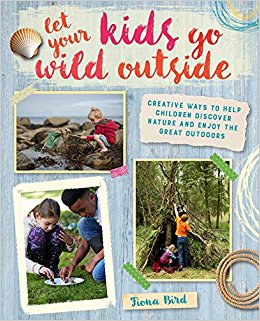 Fiona Bird is a true champion of appreciating the wild outside world. Her work inspires deeply breathing fresh air, opening up the mind, and enjoying the excitement and mystery of the world we live in, starting early in life. Let Your Kids Go Wild Outside: Creative Ways to Help Children Discover Nature and Enjoy the Great Outdoors encourages children to appreciate their countryside. This Scottish author writes with strong feeling as a mother of six: “With encouragement a child will develop a personal relationship with our natural world, one that stretches way beyond facts assimilated in a classroom.”
The introduction of the book emphasizes the value of a mentor and highlights the importance of the environment. Chapters include: Into the Woods; Meadows, Hedgerows, and Hills; Seashore; Water and Wetlands; and My Wild Garden and Kitchen. Each chapter describes and explains the particular environment and the wild plants and animal treasures that can be discovered there. Activity suggestions are rich exercises that are realistic, local, and impress all the senses of young citizen naturalists – blossoming conservationists.
Published in the October 2017 Leaflet Volume 4, Issue 10
Seattle Youth Garden Works
“Seattle Youth Garden Works empowers homeless and under-served youth through garden-based education and employment.”
To Look Closely: Science and Literacy in the Natural World
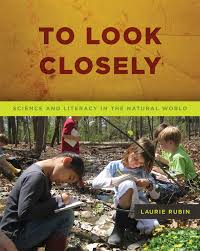
Teacher Laurie Rubin weekly features nature study in her elementary school classes in Ithaca, New York, in part based on an idea developed by Jon Young and instructors at the Wilderness Awareness School in Duvall, Washington. Rubin’s child-centered program integrates critical thinking skills in science, mathematics, and language arts across the seasons of the year in the great outdoors.
In her program, once a week the students investigate a particular place, in whatever weather, in the natural environment near the school – a creek. Students discover that the creek experience is never the same twice. They have grown and developed, and the creek environment keeps changing over time. They keep journals of their observations, looking closely at plants, birds, insects, weather, and more. Stewardship of the natural world inspired at an early age is destined to last a lifetime.
Growing a Life: Teen Gardeners Harvest Food, Health, and Joy
 For anyone who would like to understand more about the empowering effect of programs like Seattle Youth Garden Works and the UW Farm, I highly recommend Illène Pevec’s Growing a Life: Teen Gardeners Harvest Food, Health, and Joy. The author transcribes her face-to-face interviews with 90 youth gardeners participating in twelve different programs across the country. Her goal is to discover how growing food at their school, community center, or non-profit organization affects these teens’ health as well as the attitudes, job prospects, and hopes for the future they share. The result is inspirational!
Published in the December 2016 Leaflet for Scholars Volume 3, Issue 12.