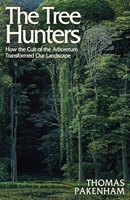
Beginning in the 18th century, collecting exotic trees became a national passion in Britain. Country gentlemen (yes, male landowners) strove to outdo each other in assembling trees from faraway sources. In The Tree Hunters, Thomas Pakenham takes the reader to visit the resulting arboreta and to accompany the tree hunters on the sometimes perilous expeditions to collect the seeds that grew into those arboreta.
Kew Gardens earns a substantial notice as an early site. Princess Augusta and her son George III supported efforts to make Kew a center for multiple varieties of trees. The first arboretum open to the public was not Kew but Glasnevin in Dublin. The Dublin Society opened the site by 1800. It included representatives of Linnaeus’s 23 botanical classes, as was thought appropriate, and in addition some examples of attractive variations of each, such as “all kinds of oddities among the fruit trees” (p. 126). Walter Wade, who selected them may have shocked purists by these choices, “but Wade knew when it was time to play to the gallery.”
Of the many tree hunters in this book, David Douglas may be the most amazing. He collected in South America, in the U.S. on both coasts, and finally in Hawaii. His seeds gave Britain the Douglas fir and the noble fir among many dozens of others. In searching he drove himself to exhaustion repeatedly. In the end, in Hawaii, he died by falling into a hidden pit designed to trap cattle. Or was he murdered? Pakenham tells stories well.
The Tree Hunters recounts many fascinating adventures; it also includes much specific information. The excellent index, for instance, has 19 subtopics under “oak.”
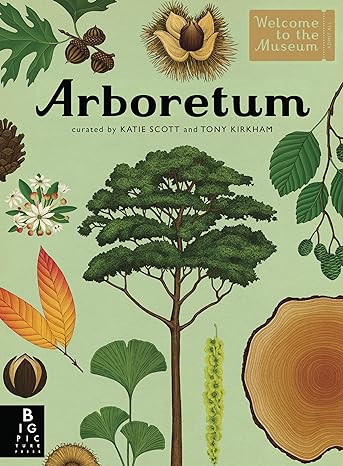 “Arboretum” is a new book this spring in the “Welcome to the Museum” series from Big Picture Press. The Miller Library has three titles in this series, all illustrated by Katie Scott, collaborating with different text authors.
 In the preface of
 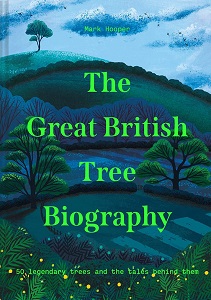 Read this book to have fun with tales, myths, legends, and historical facts about British trees. Mark Hooper says the book aims “to explore the space where social history meets natural history” (p. 9). Along the way he ties events familiar and unfamiliar to many individual trees.
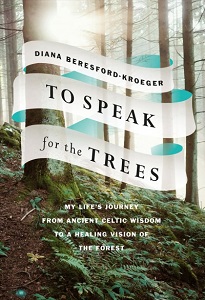 . Her second parent died when she was thirteen, and at first it seemed no one would care for her. Then Uncle Pat relented, leading to wonderful summers in the Irish countryside.
 John Albers has highlighted his garden of 20 years in Bremerton and his passion for sustainable gardening practices in two previous books. Now, he turns his attention to a favorite plant group: conifers, especially dwarf and small cultivars. He is very clear in his reasons for writing the book. “Given the horticultural and ecological importance of urban conifers, it is vital that all of us do our part to restore conifers to our urban environment.”
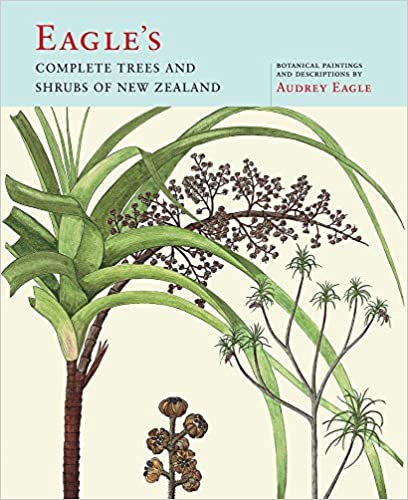 Audrey Lily Eagle (born 1925) was born in New Zealand, but spent her adolescent years in Oxfordshire, England. There she learned a love of plants and began to draw and paint them. She also took training in engineering drafting, a skill that is apparent in the precision of her later work. When she returned to New Zealand, it became her passion to illustrate almost all of the woody flora of New Zealand, “over 800 species, subspecies, and unnamed plants. It is assumed that the number of any new finds is certain to be small.”
 Michael Dirr is the guru of woody plants. Beginning in 1975, his “Manual of Woody Landscape Plants” – through six editions as of 2009 – has been required reading for any horticultural student. These books are very technical and rely on line drawings to illustrate their subjects.
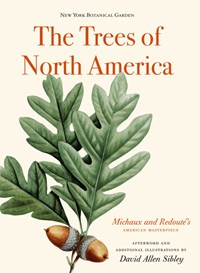 “The Trees of North America” is an excellent new book and winner of one of the three book awards given by the AHS in 2018. Who is the author? It’s complicated.