![[Emily Dickinson's Gardening Life] cover](https://depts.washington.edu/hortlib/graphix/EmilyDickinson'sgardeninglife.jpg)
Whether or not you are a fan of Emily Dickinson’s poetry, you will find much to enjoy in this book. McDowell gives context to a number of the garden-themed poems. But she also gives a wonderful portrait of a nineteenth century woman’s relationship with her garden.
Every aspect of Emily Dickinson’s Gardening Life deserves praise. From sturdy paper quality to admirably painstaking research, with much in between, the book is a delight.
In this revision of her 2005 book Emily Dickinson’s Gardens: A Celebration of a Poet and Gardener McDowell has organized the main body of the text around the seasons. Thus the opening section, “Early Spring,” includes background on the town of Amherst and the Dickinson family, plus description of early spring in Dickinson’s garden, with color plates and a page describing some spring bulbs. The well-written text is spare but sufficient on the poet’s life while lavish on her garden and her connections to it.
McDowell has mined multiple sources to get her telling details, such as noting in a thank-you letter to a friend who had sent Dickinson bulbs that she had “long been a Lunatic for bulbs.” Throughout, poems are included to expand a point and give context.
The color plates are by three contemporaries of Dickinson. One, Ora White Hitchcock, was a friend of the family, and another, Clarissa Munger Badger, published a folio of prints that Dickinson owned. McDowell includes, among many other photos, one showing the cover of the 1881 Bliss seed catalog, and the text quotes a Dickinson letter from January of that year that describes her sister Vinnie as “in Bliss catalog, prospecting for summer.”
After the final season section, “Winter: Requiem for a Gardener,” including Dickinson’s death, a last section, “A Poet’s Garden,” contains a marvelous 26-page list of plants: those in the garden, mentioned by Dickinson, or known to be local from other sources, plus notes describing the plant and/or noting how Dickinson used it in print or in the garden.
McDowell writes with clarity and elegance. I came away with a much broader sense of Dickinson’s life, seeing her as much more than a hermit who wrote great poems. Rather she was someone who lived a surprisingly varied life, enriched through her love for and labor with gardens. Don’t miss this book.
Published in the December 2019 Leaflet, Volume 6 Issue 12.
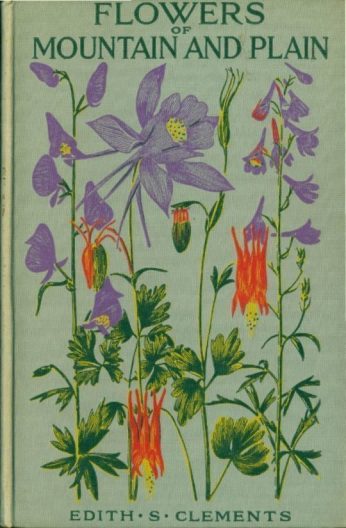 Unusual for her time, Edith Clements (1874-1971) had a formal botanical education; she received a Ph.D. in botanical ecology from the University of Nebraska, and spent her life in various academic and research pursuits. Typically this was in conjunction with her husband, Frederic Clements (1874-1945), who was also a plant ecologist. Together, they published “
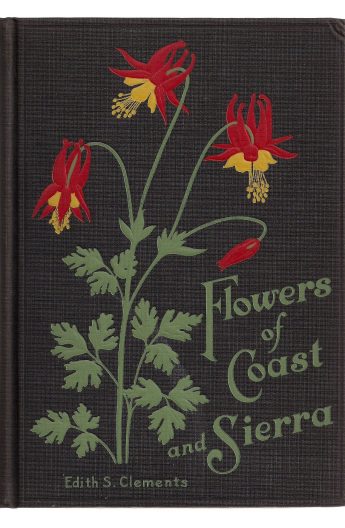 Unusual for her time, Edith Clements (1874-1971) had a formal botanical education; she received a Ph.D. in botanical ecology from the University of Nebraska, and spent her life in various academic and research pursuits. Typically this was in conjunction with her husband, Frederic Clements (1874-1945), who was also a plant ecologist. Together, they published “
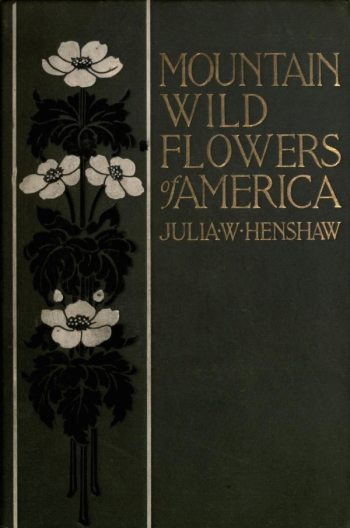 Photography was a major innovation for field guides in the early 20th century. Julia W. Henshaw (1869-1937) was an early adopter with her 1906 book “Mountain Wild Flowers of America.” While this title implies inclusion of alpine plants across Canada and the United States, she lived in Vancouver, BC and gives special attention to our regional mountains. The Miller Library also has a later edition (1917) under the slightly revised title of “
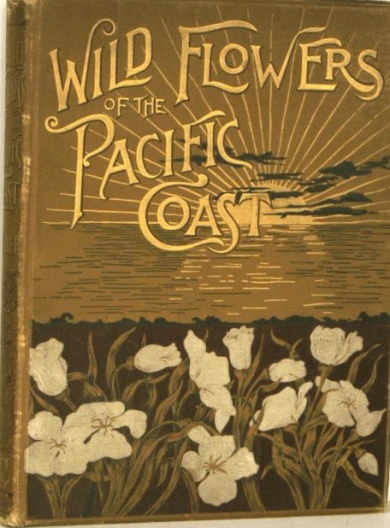 “On the very top of the mound grew this fine salmon blossom, and a few feet away a bed of tall pink grass, the finest I had ever seen. It waved and nodded in the warm breeze, as if inviting me to select its finest bunch to keep company with the pretty white blossoms that had been its neighbors, and from whom it was loth to part company.”
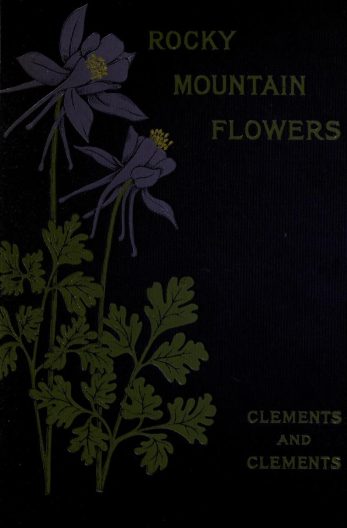 Unusual for her time, Edith Clements (1874-1971) had a formal botanical education; she received a Ph.D. in botanical ecology from the University of Nebraska, and spent her life in various academic and research pursuits. Typically this was in conjunction with her husband, Frederic Clements (1874-1945), who was also a plant ecologist. Together, they published “Rocky Mountain Flowers” in 1914, a botanically detailed flora of the flowering plants including trees, but no conifers or ferns. This is not a field guide, but the watercolor illustrations by Edith Clements are exquisite, typically showing several plants from the same family together. On her own, she later published “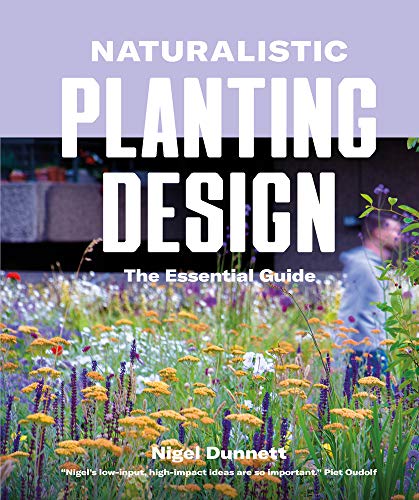
 O’Brien wrote “In The Footsteps of Joseph Dalton Hooker” about his trips to Sikkim, skillfully weaving his travel stories around a biography of Hooker’s trip. “Unlike Hooker, our mission was not to collect, but to study and compare places he visited and to record how they had fared and appeared over 160 years later. In some ways Sikkim has changed little over the course of time.”