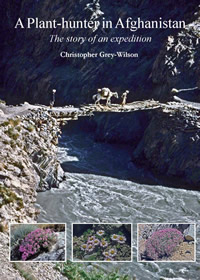
 Christopher Grey-Wilson is a major author in the Miller Library collection with twenty-four books he either wrote or edited. Many focus on a specific plant such as cyclamen, pasque-flowers, saxifrages, or poppies of the genus Meconopsis. Others are excellent guides to alpine and rock garden plants. As you read these books, you learn that he has considerable experience as a plant explorer. In “A Plant-hunter in Afghanistan,” he provides a detailed and fascinating account of his nine months of plant exploring through southern Iran and Afghanistan in 1971.
Why publish this now, almost fifty years after the events? The author claims other professional demands prevented him having the time, but he also reflects on the tragic changes to these countries, suggesting the need to document “the peaceful and welcoming country that I and my colleagues encountered in 1971.” In my reading, I certainly developed a greater awareness of the destruction caused by the upheavals that began just two years later.
Grey-Wilson’s writing is always quite accessible, but this book especially reads like a matter-of-fact journal. Some of the cultural clashes put the author and his colleagues in an unfavorable light, but they are left as written at the time in this self-published book. His photographs were all taken on film during the trip and although digitally enhanced, still evoke an earlier time.
In the Iranian city of Mashhad, Grey-Wilson was eager to photograph the golden dome of the tomb of Iman Reza and the turquoise colored dome of the nearby Great Mosque of Goharshad. He knew that as a foreigner, he was not allowed within the sacred area enclosing these buildings, but the boundary was unclear. “I unfastened my camera and was just about to take the photo of a lifetime when a hefty clout on my shoulder almost sent the camera spinning to the ground, fortunately undamaged.” A group of local students recognized his confusion and led him to a permitted, if somewhat farther away, rooftop to take his photo.
Of course, the main purpose of the trip was to find plants and Grey-Wilson and his companions were successful at that, finding 18 new species. Many plants are documented with photographs taken by the author, but this book is mainly a travelogue, and the photographs also effectively capture the often spectacular terrain, the human structures, the people, and the animals of this fascinating area. I recommend it to anyone interested in learning more about this region before the recent wars and terror; an interest in plants is not required. That said, this is a limited edition book, and does not lend, but I urge spending time with it in one of the Miller Library’s comfortable chairs.
Excerpted from the Fall 2019 Arboretum Bulletin.
 Taking a gap year between college and graduate school is often a time for young students to explore distant parts of the world, perhaps to donate their time to a devoted cause, or to learn a different culture. Very few spend the time botanizing. This is what makes Leif Bersweden’s story so interesting. At age seven, he found his first orchid: “Mum, this flower looks just like a bee.” From this simple beginning, a passion grew, and he decided to spend his gap year tracking down and photographing all 52 native species of Orchidaceae in Great Britain and Ireland. He relates his story in “The Orchid Hunter: A Young Botanist’s Search for Happiness.”
 I received at an early age a birthday present of a dozen gladiolus corms. The results – plants taller than I was, with brilliant colors – were enthralling and made me a life-long bulb (more accurately: geophyte) enthusiast. For author Chris Wiesinger, it started with a single red tulip bulb. He planted “his little rock” in his Central Valley of California home and forgot it. The next spring “something magical had occurred; my living rock had turned into the most striking red tulip.”
![[Outdoor Learning Environments] cover](https://depts.washington.edu/hortlib/graphix/outdoorlearningenvironments.jpg)
 Michael Dirr is the guru of woody plants. Beginning in 1975, his “Manual of Woody Landscape Plants” – through six editions as of 2009 – has been required reading for any horticultural student. These books are very technical and rely on line drawings to illustrate their subjects.
![[Pacific Northwest Medicinal Plants] cover](https://depts.washington.edu/hortlib/graphix/PacificNorthwestmedicinalplants400.jpg)
![[My Hair is a Garden] cover](https://depts.washington.edu/hortlib/graphix/myhairisagarden.jpg)
![[Elizabeth and Her German Garden] cover](https://depts.washington.edu/hortlib/graphix/ElizabethandherGermangarden.jpg)
![[Say Yes! to Kids with Disabilities] cover](https://depts.washington.edu/hortlib/graphix/sayyes!tokidswithdisabilities.jpg)
 I was surprised to learn that Art Kruckeberg co-authored “Best Wildflower Hikes Washington”, one of his last book publications (2004). His contribution is primarily found in “Art’s Notes,” extra tidbits on the floral treasures of the fifty hikes described.