


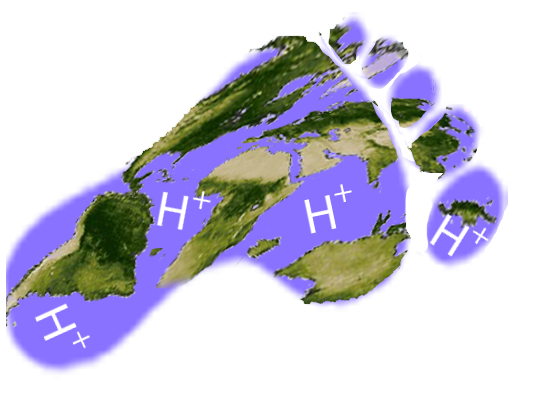
In addition to the famous impacts of atmospheric carbon on global warming, there is an equally worrisome effect of carbon dioxide on the oceans: ocean acidification (or OA for short). Here at I2SEA we have a series of resources about OA, including Our Acidifying Ocean, which is an introductory activity and virtual lab (note: now mobile compatible!).
A student suggested that we start a conversation topic about OA, and here it is! Have you heard about Ocean Acidification? If so, are you worried about it? How do you think we can best raise awareness about it among your fellow students and the general public? Have you seen particularly good links or films about OA that you would like to share? What are you doing to address the problem?
Ocean Acidification >
Dying Oceans

The ocean makes up about 71% of our earth. It’s a major carbon sink that absorbs the carbon in the air. With the major increase of industries that make Co2, we are making our ocean more acidic. We need to act now to save our ocean because all the life in both land and water are affected. What can we do? Stop emitting high amounts of Co2! We can also conserve our water by taking shorter showers and turning off the water when not in use. Lastly, we need to stop throwing away things like plastic and sewage in oceans.
I agree with most of your statements like taking shorter showers and turning off the water when not in us, will at least do something but will barely do anything. We need to focus on the bigger stuff like animal agriculture and the burning of fossil fuels that GREATLY increase our CO2 levels. It will take a while to stop fossil fuels and animal agriculture since they're very important to the daily cycle of life, so we will need to slowly transfer over to an organic alternative. So we will need to start soon before we kill our oceans and the living sources in it. When we kill out oceans it will include fish which is very important to lot of wild animals which will cause a domino effect and will maybe even cause multiple species to go extinct. So as you mentioned some actions we can start, it will be a good start to lower the amount of CO2 we put into our oceans.
I 100% agree with your statement about how we are the cause of our oceans acidifying. I feel that when we throw our garbage in the proper places and or go zero-waste. That can do so much for our oceans to stop being so acidic and for our earth to not be so dirty/polluted. I also believe that if we stop driving our cars to work, school every day we can make the carbon in our earth go way lower than it is right now. Instead we can carpool, take transit and walk and that can make a huge difference for our oceans to be more clean and less acidic. In addition, if we stop throwing garbage in the wrong places (littering in parks and the streets) that can have massive impacts on our earth and environment today.
I agree and disagree with that statement. I agree with most of what you are saying, but if we kill our oceans (which is what we are slowly doing now) it will do much greater than just make a few ocean species go extinct. The ocean is the life support system for the planet, providing 50% of the oxygen we breathe. Some of this oxygen is produced by seaweeds and seagrasses, but the majority of the oxygen is produced by phytoplankton. Phytoplankton is microscopic celled organisms that have the ability to photosynthesize. These tiny organisms live at the surface of the ocean and form the very base of the aquatic food chain. During photosynthesis, phytoplankton remove carbon dioxide from seawater and release oxygen. The carbon becomes part of their bodies. Providing oxygen and isolating carbon dioxide. So they are very important. Another thing that could potentially make us loose phytoplankton is ocean acidification. Many ocean phytos build calcium carbonate or other hard “tests” (like shells). They require these structures to survive and without them, they don’t do well. As the ocean becomes more acidic as the result of CO2 levels rising. Phytoplanktons are at great risk. Another very important organism that lives in the ocean is plankton. Plankton is the most important group of plants and animal species on the planet (excluding bacteria). Plankton populations have been made smaller by 40% since 1950. Norwegian and Japanese fishing corporations have been extracting millions of tons of plankton to convert to protein-rich animal feed. Every year 65 billion animals are slaughtered to feed humans and some 40% of all the fish caught are converted to fishmeal to feed pigs, chickens, domestic salmon, fur-bearing animals and cat food. With fish populations diminishing, the corporations are looking to replace fishmeal with a plankton paste. "The fish and animal-killing industries are robbing the seas of oxygen production for short-term profits". Other factors diminishing plankton is again ocean acidification, from excessive carbon dioxide, pollution, habitat destruction and the major decrease of whale populations. whales are the primary species that fertilize phytoplankton. For example, one blue whale defecates three tons of nitrogen and iron-rich feces a day, providing nutrients to the phytoplankton. In return, the phytoplankton feed the zooplankton, the fishes, and ultimately everything that lives in the sea. In order to restore phytoplankton populations we need to restore whale populations and we need to get rid of the industrialized exploitation of biodiversity in the ocean. We also need to have governments end all subsidization of commercial fishing operations.” Plankton is the base of the marine food web, without them all larger organisms will probably die. “No plankton=no fish= no food for millions of people” Without ocean life, millions (if not billions) of people will start to starve to death as some lower wealth countries significantly rely on fish as a primary food source. The reality is that there are simply not enough fish in the sea to continue to feed an “ever-expanding human population”. It is a simple concept to understand more humans eating fish, directly or indirectly, contributes to further decrease of fish. We need to return whale and fish populations to pre-exploitation levels. The focus must be on revitalizing bio-diversity in the sea in order to address climate change and the diminishment of phytoplankton oxygen production. “Will it cost profits? Absolutely. Will it costs jobs? Absolutely”. “But are jobs and profits really worth destroying the planet’s life support system?” The collapse of ocean bio-diversity and the catastrophic collapse of phytoplankton and zooplankton populations in the sea will cause the collapse of civilization, and most likely the extinction of the human species. The humankind is getting selfish. Even if we loose sharks the ecosystem in the ocean will collapse. At the rate we are killing sharks it's not looking good. To summarize we need are oceans.