


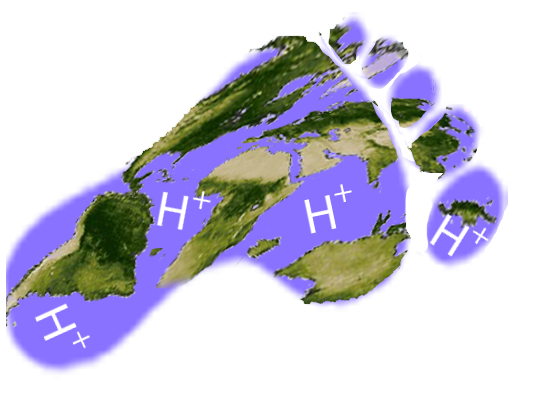
In addition to the famous impacts of atmospheric carbon on global warming, there is an equally worrisome effect of carbon dioxide on the oceans: ocean acidification (or OA for short). Here at I2SEA we have a series of resources about OA, including Our Acidifying Ocean, which is an introductory activity and virtual lab (note: now mobile compatible!).
A student suggested that we start a conversation topic about OA, and here it is! Have you heard about Ocean Acidification? If so, are you worried about it? How do you think we can best raise awareness about it among your fellow students and the general public? Have you seen particularly good links or films about OA that you would like to share? What are you doing to address the problem?
Ocean Acidification >
The Acid Ocean, and How it's Killing Marine Life

Our oceans take up 75% of the Earth, and we rely on it for all sorts of things. Yet, we don’t take very good care of it. Our oceans are heating up at an alarming rate, and this heating is affecting the ocean in drastic ways. Coral bleaching is one big thing that’s happened due to the ocean absorbing so much heat. Coral is being bleached in mass amounts all over the ocean. This means that coral is turning white, shrinking, and starving. These corals house many species of different ocean animals, but when their home is dying, where will they go? This leads to fish migrating to the poles. It’s cooler there, and the corals might not be dying off as much since there isn’t as much heating.
The ocean itself has absorbed 30% of the carbon dioxide emitted into the air from human activity. 30% of 150 billion tons of carbon dioxide, that is. This causes an increase in ocean acidity. This is what has been causing the coral to bleach, and now a variety of different species are in danger. Many oceanic species use calcium carbonate to form their shells and skeletons, but their proce ss is disrupted when the water is too acidic. Ecosystems in the ocean are failing, and soon, tons of more species. If you want to learn more about this, or even donate to a better future regarding change in the environment, you can go to https://www.edf.org/blog/2013/11/14/fiv … our-oceans.
You make a lot of interesting points! It's crazy that fish are migrating to colder waters, because they'd have to leave their habitat. I looked into the article you posted and they don't list non commercially fished fish but it seems like the migrating fish are ones that live in more open water rather than on coral reefs. I don't think the coral reefs closer to the poles would really be much better, aside from the lack of heat, because there aren't really too many coral reefs closer to the poles because corals like warmer water and heating oceans cause the water to rise everywhere, and corals need shallow water to their algae can photosynthesize.
Also warmer waters are causing a disruption to Arctic ecosystems, and I imagine introducing species would make it even worse!
Sources:
https://www.edf.org/blog/2013/04/04/arc … are-moving
http://coral.org/coral-reefs-101/coral- … o-survive/

Hello, I really like your post. It's true that ocean acidification would affect the size of oceanic species use calcium carbonate and the whole ecosystem in the ocean. In our AP Environmental Science class, we did a experiment about ocean acidification. We put shells in both water and vinegar solution, and found that shells broke down more quickly in higher-concentration vinegar solutions. Then we did some research and found out that the more hydrogen in the ocean, the less calcium carbonate can be formed and used by coral. So I think it's really important for us to reduce the amount of carbon dioxide globally and protect the ocean ecosystem.
Also, after reading the article you shared, I found one thing that I didn't know before. Global warming and ocean acidification are actually in a positive feedback loop, which would result a more disastrous effect on the ocean. I think people should really be aware of global climate, because it causes the problem of ocean acidification even more seriously.