


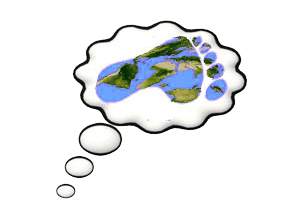
Students from around the world calculated their class mean and standard deviations for their footprints and posted them on our world map.
Do you see differences across the globe? If so, why do you think those differences exist?
Did you use the calculator to try to reduce your footprint down to the average from a citizen of another country? What changes would you have to make to lower your footprint in this way? Are you going to try and take some of these actions in your daily life?
Student Footprints >
Our Next Recipe for Carbon

The first thing most people associate with a carbon footprint is cars, and next probably trash. These two issues, however, are not the only pressing issues. Until the past decade, we have overlooked the impact of food; food production, food waste, and the impacts of livestock on our earth have been forgotten. In an article on Scientific American, scientist Nathan Fiala shares some facts (http://www.scientificamerican.com/artic … hamburger/). Fiala, speaking of UNFAO's report of carbon emissions from food, states, "Our diets and, specifically, the meat in them cause more greenhouse gases carbon dioxide (CO2), methane, nitrous oxide, and the like to spew into the atmosphere than either transportation or industry". This realization is huge; changing our diets could be the key to slowing climate change. This waste comes largely from meat; raising cattle and other animals not only utilizes resources, but it also leads to erosion, deforestation, and large amounts of methane being released into the atmosphere. Fiala states how, "producing half a pound of hamburge r for someone's lunch a patty of meat the size of two decks of cards releases as much greenhouse gas into the atmosphere as driving a 3,000-pound car nearly 10 miles".
These statistics alone should be enough to convince the world that meat should become less of a staple in our daily diet. For instance, I follow a healthy diet that consists of minimal meat; I do not eat red meat (such as cows, pigs, lamb, etc.) as they are so detrimental to the environment, but instead eat chicken once or twice a week, fish once a week, eggs from the chickens in my backyard, and a large amount of vegetables. When I answered the foot section of the carbon footprint questionnaire, I found my carbon levels produced by food were over seven times less then the average person in Oakland. If everyone committed to eating less meat, as I do, our environment effect due to food would drop dramatically.
Furthermore, meat is not the only problem we face with food. Food waste is not only wasteful considering the starving people worldwide, but is also one of the leading producers of methane gas. In a New York Times article (http://www.nytimes.com/2015/02/26/us/fo … .html?_r=0), author Ron Nixon writes how "it creates 3.3 billion metric tons of greenhouse gases annually". This makes up about 7% of the overall greenhouse gases; although the percentage does not seem large, reducing food waste could be one of the keys to stopping global warming.
In conclusion, it is obvious that food is something to be considered as we move forward in our fight against global warming; not only is it one of the easiest ways to reduce our carbon footprint, but it is also one of the most important steps toward building a healthier world.