


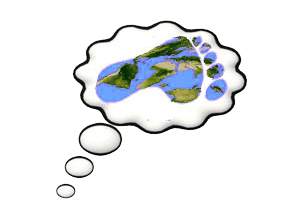
Students from around the world calculated their class mean and standard deviations for their footprints and posted them on our world map.
Do you see differences across the globe? If so, why do you think those differences exist?
Did you use the calculator to try to reduce your footprint down to the average from a citizen of another country? What changes would you have to make to lower your footprint in this way? Are you going to try and take some of these actions in your daily life?
Student Footprints >
Carbon footprint

A carbon footprint (CO2) is the sign people leave on the environment; the amount of greenhouse gases created which directly or indirectly support human activities. Everyday activities or things such as animals, driving, or cutting down trees can cause harmful gases to be released into the atmosphere causing problems such as climate changes. Trees and plants are necessary for the environment because they remove carbons from the atmosphere. Animals such as cows and pigs feces can emit a mixture of harmful greenhouse gases; ammonia, methane, hydrogen sulfide, carbon monoxide, cyanide, phosphorus, nitrates and heavy metals. Industrial animal farms are destroying lands, polluting water supplies, and wiping out biodiversity. Several years ago my household decided to become more environmentally friendly. We started by changed all of the lights bulbs in the house, wash clothes and dishes with cold or cool water, stopped buying bottled water and we recycle as much as possible. I believe our decision to change our ways is what led to my carbon footprint being 2,286 kg of CO2 less than average. While look into this topic I found these two videos with information that helped me better understand the effects that carbons have on our environment.
Simple show explains the Carbon Footprint http://www.youtube.com/watch?v=8q7_aV8eLUE
What’s the Deal with Carbon? http://www.youtube.com/watch?v=2Jp1D1dzxj8