SSW MSW Blog

ENTRE 543: Environmental Innovation Practicum – AUT22 Course
Posted under Courses and Registration on Sep 6, 2022
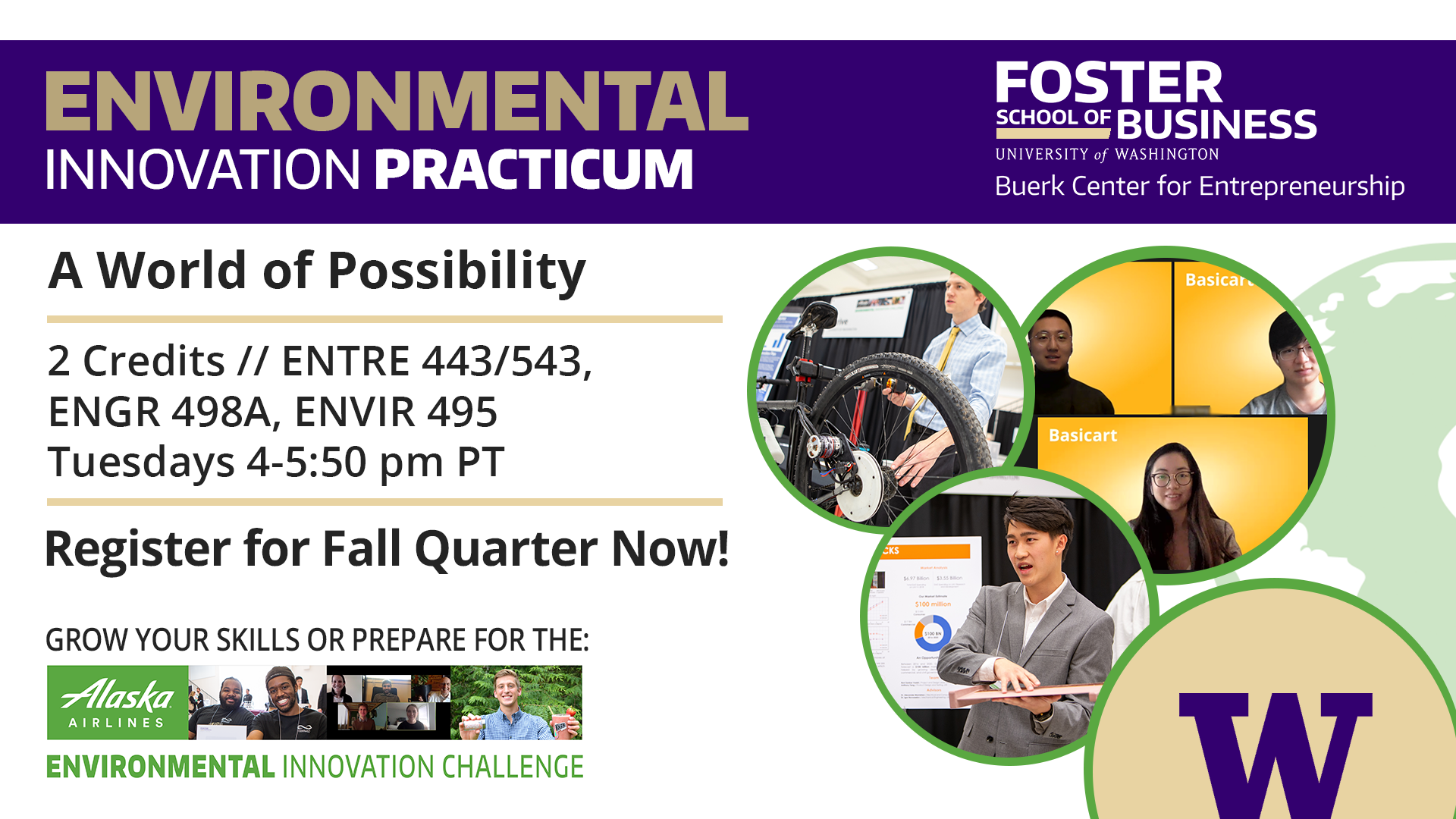
Environmental Innovation Practicum (ENTRE 443/543, ENGR 498, ENVIR 495)
2 credits | Tuesdays 4 – 5:50 pm
Open to BOTH undergraduates and graduate students
The environmental innovation practicum is instructed by Chris Metcalfe [linkedin.com], president and co-founder of Korvata [korvata.com], a company he was inspired to create as a student in this exact class! Each week you’ll fill your toolbox with new skills and problem-solving experience while also engaging with guest speakers from multiple industries. This 2 credit/no credit course is open to all levels of undergraduates and graduate students providing a great opportunity for these groups of students to connect. An idea you work on as part of the class could even gain enough traction to do well in the Alaska Airlines Environmental Innovation Challenge. Questions? E-mail Lauren Brohawn at brohal@uw.edu.
 Comments Off on ENTRE 543: Environmental Innovation Practicum – AUT22 Course
GEOG 581/HSERV 585: Seminar In Medical Geography – AUT22 Course
Posted under Courses and Registration on Sep 6, 2022
This autumn quarter, we are happy to share that GEOG 581/HSERV 585 Seminar in Medical Geography has space available for you to register! Please check out the details below:
GEOG 581/HSERV 585: Seminar In Medical Geography (5 credits)
Space, Place, Health and Addiction: The Geography of the Opioid Epidemic(s) in America
Instructor: Suzanne Withers
Meeting Time: MW 1:00pm – 2:20pm
Location: SMI 409
SLN: 23722
3-Credit Option: GEOG 595 C
Description: This graduate research seminar explores the geography of the opioid epidemic(s) in the United States. The course begins with the geography and epidemiology of pain (chronic through acute) and journeys through the production of prescription opioids, the geography of prescribing, the politics of monitoring, and the epidemiology of prescribing practices. The journey continues by exploring spatial patterns of addiction, overdose, death, and dying, the geography of illicit drugs and public health responses to overdose, and the accessibility of treatment for opioid use disorder. Students gain a rich understanding of the importance of place and space from this close study of the opioid epidemic(s).
In parallel, this course provides students with advanced training in GIS for geospatial health research. Analytical techniques such as mapping uncertainty, web mapping, proximity analysis, hot spot analysis, spatial/temporal analysis, colocation analysis, geographically weighted regression, and Bayesian smoothing techniques for rate stabilization are reviewed using hands-on exercises, primarily with ArcGIS. Prior GIS training is advantageous but not essential. Students gain a rich understanding of the geospatial techniques frequently applied in spatial health research.
Comments Off on GEOG 581/HSERV 585: Seminar In Medical Geography – AUT22 CourseWashington AHEC Scholars Program Recruiting – Deadline 9/9
Posted under Academic Resources, Courses and Registration, Student Resources on Sep 6, 2022
Dear Students:
The Washington AHEC Scholars Program (formerly WWAMI AHEC Scholars program), a FREE interprofessional elective opportunity, is recruiting applicants for Fall 2022.
Watch the video!
What is it?
- An interdisciplinary educational and training program focused on increasing the diverse, culturally competent healthcare workforce that specializes in rural and underserved areas.
- It provides you with skills and experiences to better prepare you for work in these areas.
- It especially seeks to help students from disadvantaged backgrounds, rural areas, and racial/ethnic groups that are inadequately represented in health care (identifying as one or more of these is NOT a stipulation for acceptance).
- The Health Resources and Services Administration (HRSA) will identify AHEC Scholar students that complete the program as having special training and experience with rural and underserved communities.
What is the structure?
- This is a two-year interprofessional program in which you will learn about other disciplines and develop team-based learning and skills that you can take into practice.
- Several information and networking social events will be hosted on UWSOM campus throughout both years.
- You can take the courses for elective credit if you are a UW student or no credit/no cost (option for both UW students and students from other institutions).
- Year One:
- Kick off event-Introduction to AHEC Scholars
- 40 hours per year of community/experiential/clinical work in rural or underserved sites
- Students may count clinical work from their primary program of study if it is completed in a rural or underserved setting
- 40 hours of didactics through Rural/Underserved Health Course I
- Synchronous online classes in the evenings to best accommodate your schedule
- Optional field trip
- Year Two:
- 40 hours per year of community/experiential/clinical work in rural or underserved sites
- Students may count clinical work from their primary program of study if it is completed in a rural or underserved setting
- 40 hours of didactics through Rural/Underserved Health II
- Synchronous online classes in the evenings to best accommodate your schedule
- Spring networking event and graduation ceremony with completion certificates
- Optional field trip
- 40 hours per year of community/experiential/clinical work in rural or underserved sites
- Year One:
What topics are covered?
- Interprofessional education
- Behavioral health integration – integrating primary and behavioral health (mental health and substance abuse)
- Social determinants of health and their impact on your patients’ health.
- Cultural humility training
- Practice transformation: goal-setting, leadership, practice facilitation, workflow changes, measuring outcomes, adapting organizational tools and processes to support new team-based models of health care delivery
- Current and emerging health issues such as COVID-19, opioid abuse, and geographically relevant health issues.
- Community Health Work
- Telehealth
Who can apply?
- You can apply if you are in a health professional program that ends in a certificate or degree
- Historically the program has graduated students from Medicine, Nursing, Dentistry, Pharmacy, PT/OT, Prosthetics and Orthotics, Social Work, PA, DNP and N.D.
- The long list of accepted disciplines is provided in the application
How do I apply?
- Visit the website for more information and to access the application!
Comments Off on Washington AHEC Scholars Program Recruiting – Deadline 9/9UCONJ 646: Interprofessional Advocacy for the Health Professions – AUT22 Course
Posted under Courses and Registration on May 23, 2022
Sign up now for Introduction to Advocacy for the Health Professions – UCONJ 646!
- Learn from advocacy and topic specific experts about fundamental elements of health advocacy.
- Develop hands-on skills for moving beyond witnessing health disparities to upstream action rooted in community-centered advocacy.
- See flyer for details (attached)
Course details:
- Fall quarter 2022
- One Credit, CR/NC
- Wednesdays 5:30-7:30pm
- Online only
Contact Rachel Lazzar, rlazzar@uw.edu for an add code or with questions!
Comments Off on UCONJ 646: Interprofessional Advocacy for the Health Professions – AUT22 CourseREHAB 566A: Disability and Health: Tensions, Intersections, and Future Opportunities – SUM22 Course
Posted under Courses and Registration on Apr 22, 2022
REHAB 566A: Disability and Health: Tensions, Intersections, and Future Opportunities (SLN: 14402)
Meets online, W 12:30-1:50, 1cr, CR/NC
Course instructors: Heather Feldner, PT, PhD, PCS; Silas James, MPA
Course Description
The goal for this online, one credit course is to use a disability studies framework to understand and interrogate disability and health within historical and contemporary healthcare practice and lay communities. Participants in this course will engage in critical analysis of multiple conceptualizations of disability and how tensions between various understandings of disability influence healthcare delivery, health professions education, and dominant social discourses of health and wellness. Systemic ableism and barriers to healthcare for disabled people will be addressed, and participants will consider future opportunities to promote health and access to healthcare services for disabled people while simultaneously working to counteract these issues. Course content will draw heavily from personal narratives and lived experiences of disabled people and their families, historical documents, and contemporary media.
Plain Language Course Description
The goal for this class is to work with students on learning and talking about different ways of thinking about disability and health in places like doctor’s offices or hospitals and in the community. People who take this class will think hard about their own beliefs about disability and health. They will also talk about how beliefs about disability may cause doctors, nurses, or therapists to think or act differently toward people with disabilities. Sometimes, it is hard for people with disabilities to get medical care because the equipment isn’t made for them, or it is hard to get a ride to go see a doctor, or doctors don’t listen as well as they should about what they need. Students in this class will also think about how to make some of these things better, as partners to people with disabilities. We will use videos and books that include people with disabilities and their families talking about what they like and don’t like about going to see a doctor, nurse, or therapist. We will also talk about the history of how people with disabilities are treated in this country. Finally, we will talk about how to treat people with disabilities better so they can always do the things they want, go to the places they want, and be with the people they want. The course will meet online once a week for an hour and a half, for 9 weeks.
Comments Off on REHAB 566A: Disability and Health: Tensions, Intersections, and Future Opportunities – SUM22 CourseSubstance Use Disorder Professional Accelerated Training
Posted under Academic Resources, Career information and Professional Development Opportunities, Courses and Registration on Mar 28, 2022
Substance Use Disorder Professional Accelerated Training
|
||||||||||||||||
|
||||||||||||||||
|
|
||||||||||||||||
|
Comments Off on Substance Use Disorder Professional Accelerated TrainingNSG 575 Leadership for Population Health – SPR22 Course
Posted under Courses and Registration on Mar 28, 2022
NSG 575 Leadership for Population Health (3 credits)
Course Description:
Analyzes and applies leadership literature and models for advanced nursing practice in population health. Explores skills in organizational strategic planning and change, with emphasis on roles and responsibilities in advocacy, workforce development, operational management of organizations, and professional ethics. Emphasis on transforming organizations, communities, systems, and other contexts to advance the health of all populations. Prerequisite: NSG 571, or permission of instructor.
Course Learning Objectives:
By the end of this course, the student will be able to:
- Discuss leadership models and roles that promote high-quality performance of organizational operations and programmatic delivery.
- Apply systems thinking to strategic partnerships, assessment, planning, prioritization processes, and evaluation to promote health equity.
- Apply ethical principles and frameworks to decision-making about serving the health needs of all populations.
- Critique evidence-based approaches that facilitate professional development of others and influence organizational goals in support of population health in an evolving local and global context.
- Demonstrate using self-reflection to develop leadership effectiveness in population health practice.
Comments Off on NSG 575 Leadership for Population Health – SPR22 CourseNSG 554 Population Health and the Environment – SPR22 Course
Posted under Courses and Registration on Feb 28, 2022
NSG 554: Population Health and the Environment (3 credits)
COURSE DESCRIPTION
Introduces core concepts and principles related to the science and practice of environmental and occupational health. Examines historical cases and current issues to illustrate how environmental conditions contribute to injury and illness among human populations. Explores health professionals’ roles in actions that protect and promote healthy environmental and workplace settings.
Course Learning Objectives
By the end of this course, the student will be able to:
- Evaluate conventional models and perspectives that characterize the interface between human health and environmental and occupational contexts.
- Explain mechanisms of exposure to hazardous agents and circumstances that threaten health at the individual, group, community, and population levels.
- Apply strategies reflecting principles of injury and disease prevention, health promotion, and rehabilitation to address environmental and occupational health problems.
- Interpret research evidence in environmental and occupational sciences to inform interventions that protect population health.
Relate competencies and skills of health professionals to engage in actions that create safe, salutogenic, and just environmental and occupational conditions.
Comments Off on NSG 554 Population Health and the Environment – SPR22 CourseNSG 575 Leadership for Healthy Populations – SPR22 Course
Posted under Courses and Registration on Feb 28, 2022
NSG 575 Leadership for Healthy Populations (3 credits)
COURSE DESCRIPTION
Analyzes and applies leadership literature and models for advanced nursing practice in population health. Explores skills in organizational strategic planning and change, with emphasis on roles and responsibilities in advocacy, workforce development, operational management of organizations, and professional ethics. Emphasis on transforming organizations, communities, systems, and other contexts to advance the health of all populations.
Course Learning Objectives
By the end of this course, the student will be able to:
- Discuss leadership models and roles that promote high-quality performance of organizational operations and programmatic delivery.
- Apply systems thinking to strategic partnerships, assessment, planning, prioritization processes, and evaluation to promote health equity.
- Apply ethical principles and frameworks to decision-making about serving the health needs of all populations.
- Critique evidence-based approaches that facilitate professional development of others and influence organizational goals in support of population health in an evolving local and global context.
- Demonstrate using self-reflection to develop leadership effectiveness in population health practice.
Comments Off on NSG 575 Leadership for Healthy Populations – SPR22 CourseDrama 490A/599C: Acting Up: Teaching Theater for Change -SPR22 Course
Posted under Courses and Registration on Feb 24, 2022
Drama 490A/599C (Acting Up: Teaching Theater for Change) will be offered spring quarter 2022. This course is geared toward graduate students, seniors, and juniors. This course is open to students of all majors and disciplines. In this course “students practice using the language and methods of theater to challenge institutional oppression and advance community dialogue about power and privilege.” Please see the attached flyer for additional information.
Flyer can be found here: Drama 490A/599C
Comments Off on Drama 490A/599C: Acting Up: Teaching Theater for Change -SPR22 CourseEPI 585: Injury and Violence: A Public Health Approach – SPR22 Course
Posted under Courses and Registration on Feb 3, 2022
Injury and Violence: A Public Health Approach (EPI 585) will be offered spring quarter of 2022. Course material includes a unit devoted to studying child maltreatment as well as one focused on intimate partner violence. Co-professors Avanti Adhia and Vivian Lyons encourage anyone interested to enroll as they hope to “create a class with students from different schools and programs to focus on injury and violence prevention with a structural lens and a focus on translation of evidence into practice and policy”. More information about the course can be found here and in the course flyer found here.
Comments Off on EPI 585: Injury and Violence: A Public Health Approach – SPR22 CourseUCONJ 647: Antiracism in Action for Health Professionals– WIN22 Course
Posted under Courses and Registration on Dec 27, 2021
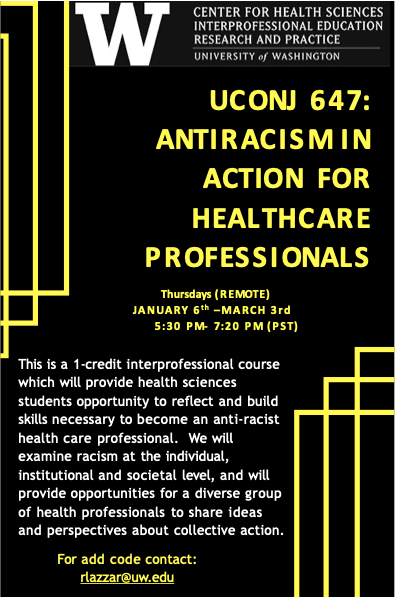
UCONJ 647: Antiracism in Action for Health Professionals – Winter 2022
Provides health sciences students opportunity to reflect and build skills necessary to become an anti-racist health care professional. Examines racism at the individual, institutional and societal level, and provides opportunities for a diverse group of health professions to share ideas and perspectives about collective action. Fully remote; 1cr. Credit/No credit. Thursdays 5:30 – 7:20PM. Lead Faculty: Jasmine Mangrum (pharmacy), Charlotte Sanders (social work), Tracy Brazg (social work), Tamara Cyhan Cunitz (nursing), Benjamin Danielson (medicine), Ashland Doomes (dentistry)
For questions/add codes, contact Rachel Lazzar: rlazzar@uw.edu.
Comments Off on UCONJ 647: Antiracism in Action for Health Professionals– WIN22 CourseGH/HSERV 544 Maternal Child Health in LMICs- WIN22 Course
Posted under Courses and Registration on Dec 27, 2021
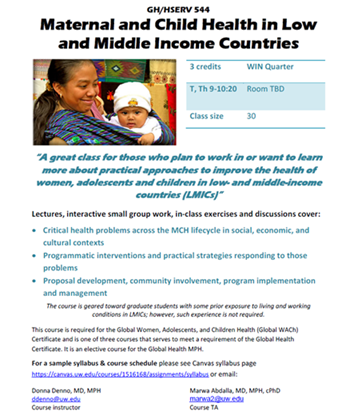
Registration is open for GH/HSERV 544 “Maternal and Child Health in Low and Middle Income Countries” in Winter Quarter 2022.
Comments Off on GH/HSERV 544 Maternal Child Health in LMICs- WIN22 Course2 New VIRTUAL Population Health Courses- WI22 Course
Posted under Courses and Registration on Nov 29, 2021
The School of Nursing is offering the following NEW Population Health courses for winter 2022. These courses will meet virtually, via Zoom. See detailed descriptions below.
NSG 573 Systems Thinking for Population Health (3 credits), SLN 18306
Meets via Zoom on Tuesdays 4:00-6:50pm ODD weeks of winter quarter
NSG 574 Program Development and Evaluation to Improve Population Health (4 credits), SLN 18307
Meets via Zoom on Tuesdays 4:00-6:50pm EVEN weeks of winter quarter
===============================================
Please consider signing up for this exciting new course! It will use a problem-based learning approach to actively develop applied skills in systems thinking!
This course is fully VIRTUAL and meets (via Zoom) on Tuesdays 4pm-6:50p on ODD weeks of Winter Quarter.
NSG 573 Systems Thinking for Population Health (3 credits)
COURSE DESCRIPTION
Develops systems-level thinking with emphasis on identifying, analyzing, and addressing factors relevant to improving population health. Reviews theories focused on approaches and actions to affect change for the utilization and delivery of health promoting services. Emphasis on developing a theory of action and multicultural considerations to transform the health status of underserved and marginalized communities.
LEARNING OBJECTIVES
- Describe interdisciplinary systems thinking frameworks and methods for practice implementation and systems change.
- Describe how prevention and health and social service delivery systems can function together to benefit population health.
- Apply systems thinking to analyses of population health problems and health improvement strategies.
- Summarize how policy decisions at multiple system levels influence population health status, health and social services delivery, and utilization.
===============================================
Please consider signing up for this exciting new course!
This course will focus on the development of community- and population-level interventions through the steps of assessment, prioritizing, planning, and evaluation. The role of stakeholders, use of assessment and planning models, and analysis of quality improvement mechanisms for improving community and population health will be emphasized.
This course is fully VIRTUAL and meets (via Zoom) on Tuesdays 4pm-6:50p on EVEN weeks of Winter Quarter.
NSG 574 Program Development and Evaluation to Improve Population Health (4 credits)
COURSE DESCRIPTION
Focuses on developing population health interventions and programs, including assessment, prioritization, planning, and evaluation. Appraises best practices and evidence to inform the execution of strategies that improve health. Examines the use of reliable data sources and value of stakeholder engagement, while considering ethical, political, and socio-cultural contexts.
Learning Objectives
- Describe program planning and quality improvement processes necessary for assuring effective community- and population-level prevention strategies.
- Formulate an assessment of a community or population group to plan and develop health program initiatives.
- Construct an evidence-based, health-enhancing intervention within a population health care system that considers ethical, legal, political, and socio-cultural contexts.
- Evaluate the effectiveness and quality of a population health intervention utilizing systematic methods that align with community goals and priorities.
- Use data from multiple information sources to inform decision-making, assessment, planning, and evaluation.
Comments Off on 2 New VIRTUAL Population Health Courses- WI22 CourseNMETH 595 Designing a Theory-Driven Behavioral Intervention- WI22 Course
Posted under Courses and Registration on Nov 8, 2021
NMETH 595 Designing a Theory-Driven Behavioral Intervention (3 credits)
Faculty: Frances Marcus Lewis, Professor
Winter 2022 | Thurs 8:30-11:20 am | Location HST T359
Pre-requisites: NURS 589 or equivalent or permission of instructor
Course description: Focuses on the design and development of a theory-and population informed behavioral intervention to enhance health behavior and outcomes. Examines selected theories of health behavior, including potential contribution to framing a behavioral intervention. Includes gaining an analytic process of “fitting” a theory onto an observed health-related problem in a specific population as well as research designs and methods to evaluate interventions.
Course content is relevant to multiple disciplines, including social work, nursing science, clinical psychology, global health, public health, dentistry, medicine, occupational therapy, physical therapy, educational psychology, among others
In-class time: 3 hours/week
This class is an on-site class with interactive exercises; it is not a hybrid nor a virtual learning class.
Non-instructional hours: 6 hours/week
Evaluation details:
20% Application of selected theory of behavior to health problem
20% Behavioral intervention is “mapped” to a theory and a population
20% Protocol [operational implementation plan] for theory-driven behavioral intervention
40% Final assignment: Design and proposed evaluation of a theory-based behavioral intervention
Learning objectives:
Following the course, the learner will be able to:
- Analyze the origins, conceptual elements, and applications of selected behavioral theories and the scope and importance of the health-related problems to which the theories are relevant.
- Apply selected theory(ies) of behavior to patients, dyads, communities that includes both the unique aspects of the theory and its relevance to health-related problem and population.
- Generate a new behavioral intervention that derives from health-related theory(ies) and knowledge of a specific population.
- Generate a research protocol for assessing the impact of the proposed behavioral intervention, including the measurement model, primary and secondary outcomes, methods to assess dosage and fidelity, and a data analytic plan to assess impact or efficacy.
- Analyze the limitations and strengths of the proposed behavioral intervention and research methods.
Comments Off on NMETH 595 Designing a Theory-Driven Behavioral Intervention- WI22 CourseNew 1-credit Course on Homelessness
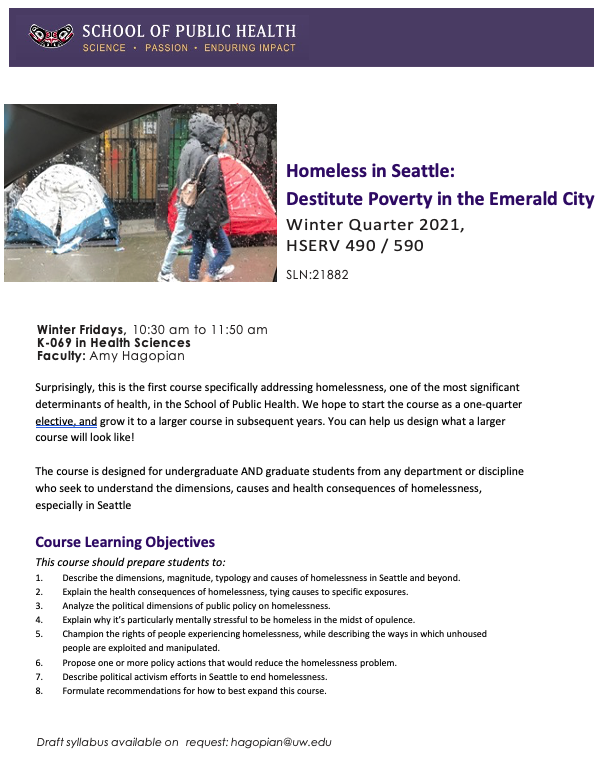
Posted under Courses and Registration on Nov 2, 2021
Comments Off on New 1-credit Course on HomelessnessLandscape Architecture Special Topics Courses- Fall Quarter Courses
Posted under Courses and Registration on Sep 13, 2021
AUT 2021: L ARCH 498C / GH 490/590– Interdisciplinary Frameworks for Health, Ecology and the Built Environment
Autumn 2021 | Thursdays 4:30 – 5:50 p.m. | Gould 208J
1 credit | SLN: 23703
Instructors: Coco AlarcÓn, Rebecca Bachman
What is the built environment? What is ecology? What is public health? What frameworks stem from these fields, and how have they been integrated to take a critical, holistic approach to complex problems facing our world? This seminar explores frameworks stemming from disciplines of the built environment, ecology, and public health/global health and the ways that they have been integrated throughout history. Students are familiarized with practical applications of interdisciplinary frameworks through exposure to current projects of researchers and professionals.
AUT 2021: L ARCH 498A – Therapeutic Design for Human Health: An Interdisciplinary Seminar
What if design was approached with a commitment to human health and wellness focused on the user and wellbeing? Designers, planners, healthcare, and public and population health practitioners each have their own unique perspectives and each typically practice siloed from the others. Reported rates of collaboration between these groups is low, while potential to design for health and wellness is high, particularly as we navigate through the current public health crisis and pressing issues of social and health inequities. By expanding awareness and creating opportunities to collaborate, this paradigm can change. As with most interprofessional collaboration, the respective professions profit; however, in the case of therapeutic design there is synergy and an even greater beneficiary: the end-user. This interdisciplinary seminar is timely and will provide students opportunities to learn about and engage in a conceptual collaborative therapeutic design project.
Comments Off on Landscape Architecture Special Topics Courses- Fall Quarter CoursesPHARM 579 The COVID-19 Pandemic: An Update on Science, Vaccines and Public Health- Fall Quarter Course
Posted under Courses and Registration on Aug 19, 2021
PHARM 579 The COVID-19 Pandemic: An Update on Science, Vaccines and Public Health (1 credit)
SLN: 20026
Meetings: Tuesdays from 1:30-2:20 pm (mix of hybrid and virtual class sessions)
Instructors: Sean Sullivan and Doug Black, School of Pharmacy, with a variety of guest speakers
Syllabus: Pharm 579 Au 2021
Comments Off on PHARM 579 The COVID-19 Pandemic: An Update on Science, Vaccines and Public Health- Fall Quarter CourseNUTR 511: Advanced Nutrition- Fall Quarter Course
Posted under Courses and Registration on Aug 19, 2021
NUTR 511 Survey of Advanced Nutrition (2)
Tuesdays from 830-1020 in GNOM S060
Taught by Cristen Harris, Associate Teaching Professor and Core Faculty in the Nutritional Sciences Program
Dr. Harris is a dynamic instructor who uses a flipped classroom approach to teaching that encourages participation from each student and promotes collaborative learning.
Using a topic each week to offer an advanced introduction to nutritional sciences, the course ponders deep questions, such “What is an ‘optimal’ diet?” and “How do we address food safety?” They take a short journey through the life course with maternal and child nutrition; briefly explore the gut microbiome and associated food allergies, insensitivities, and intolerances; and critically analyze nutrition-related recommendations for “obesity,” cardiovascular disease, heart failure, type 2 diabetes, chronic kidney disease, cancers, and neurological disorders such as Alzheimer’s disease.
Comments Off on NUTR 511: Advanced Nutrition- Fall Quarter CourseUCONJ 565: The Healer’s Art – Remote Fall Quarter Course
Posted under Courses and Registration on Aug 19, 2021
The Healer’s Art
UCONJ 565 Autumn 2021
*Do you sometimes feel too isolated during your health sciences education?
*Do you find it difficult at times to remember the reasons you chose to pursue a career in the health sciences?
*Have you found that it seems necessary to leave a good part of yourself outside the walls of health sciences?
*Are you determined to avoid the pitfalls and behaviors of “pessimistic clinicians”?
*How does one stay open to intrigue and awe within healthcare?
If these questions stir your interest, and you are a graduate/professional UW Health Sciences student, please join us for five Tuesday evenings from 6:30-8:30 PM on Sept 28, Oct 5, 12, 19, and 26. We will meet virtually over Zoom. We use a large group and small group format. This course is intended for students from all health professional training programs at UW.
The Healer’s Art elective (as developed at the UCSF School of Medicine by Rachel Remen, MD) is now offered in over 60 health professional (medical, nursing, physician assistant, veterinary, pharmacy, etc) schools in the U.S. and more than a half a dozen health sciences schools internationally. For more perspective on Dr Remen’s work, please take a look at her 1996 book of essays: Kitchen Table Wisdom: Stories that Heal and the Healer’s Art.
website: http://www.ishiprograms.org/programs/medical-educators-students/
Each week, students will be asked to engage in self-reflective work and to read Kitchen Table Wisdom. At the end of the course, students will be asked to submit a one-age reflection. There are no exams or graded assignments.
Finding meaning in one’s work is the antecedent to commitment and service. The course will help you to gain skills that facilitate the discovery of meaning in your work over the course of a career in health care.
To obtain your add code for registration please email Rachel Lazzar at rlazzar@uw.edu

Comments Off on UCONJ 565: The Healer’s Art – Remote Fall Quarter Course