SSW MSW Blog
1 Week Summer Field Course – Reading the Elwha
Posted under Courses and Registration on Apr 29, 2019
SUMMER COURSE, B TERM
READING THE ELWHA: TRACING THE DYNAMICS OF LANDSCAPE CHANGE
[Nature + Ethics – People, salmon, and the largest dam removal project in U.S. history]
Located on the Olympic Peninsula of Washington, the Elwha River and the watershed through which it flows is a rich, diverse, and dynamic place. With the recent removal of two major dams along the river system that stood for nearly 100 years and blocked salmon migrations upstream while hindering sediment flows downstream the river is rapidly adapting to its free flowing condition. This 5-day field-based course explores the system from headwaters high in the Olympic Mountains to the mouth on the Straits of Juan de Fuca. Each day consists of a hike to different locations in the watershed and meetings with restoration scientists, environmental planners, and tribal members actively engaged in monitoring and managing the river. The trip concludes with a sea kayak excursion in the Straits of Juan de Fuca near the mouth of the river.
INFO SESSION – Monday, April 29, 12- 1pm, Gould Hall, Room 100
If interested in learning more or to get an add code for registration, contact Ken Yocom, kyocom@uw.edu.
SLN: LA498, 12006 / LA598, 12011
Add Code: contact Ken Yocom, kyocom@uw.edu
Class Session: Monday, July 29th – Friday, August 2nd + one planning session prior to departure
Camping: Single site for 4 nights. Students provide camping gear and personal food.
 Comments Off on 1 Week Summer Field Course – Reading the Elwha
1 Week Summer Field Course – Reading the Elwha
Posted under Courses and Registration on Apr 26, 2019
SUMMER COURSE, B TERM
READING THE ELWHA: TRACING THE DYNAMICS OF LANDSCAPE CHANGE
[Nature + Ethics – People, salmon, and the largest dam removal project in U.S. history]
Located on the Olympic Peninsula of Washington, the Elwha River and the watershed through which it flows is a rich, diverse, and dynamic place. With the recent removal of two major dams along the river system that stood for nearly 100 years and blocked salmon migrations upstream while hindering sediment flows downstream the river is rapidly adapting to its free flowing condition. This 5-day field-based course explores the system from headwaters high in the Olympic Mountains to the mouth on the Straits of Juan de Fuca. Each day consists of a hike to different locations in the watershed and meetings with restoration scientists, environmental planners, and tribal members actively engaged in monitoring and managing the river. The trip concludes with a sea kayak excursion in the Straits of Juan de Fuca near the mouth of the river.
INFO SESSION – Monday, April 29, 12- 1pm, Gould Hall, Room 100
If interested in learning more or to get an add code for registration, contact Ken Yocom, kyocom@uw.edu.
SLN: LA498, 12006 / LA598, 12011
Add Code: contact Ken Yocom, kyocom@uw.edu
Class Session: Monday, July 29th – Friday, August 2nd + one planning session prior to departure
Camping: Single site for 4 nights. Students provide camping gear and personal food.

Comments Off on 1 Week Summer Field Course – Reading the ElwhaSummer class: Public Space, Public Life (UrbDP 498A / 598A) – posted 4/19
Posted under Courses and Registration on Apr 19, 2019
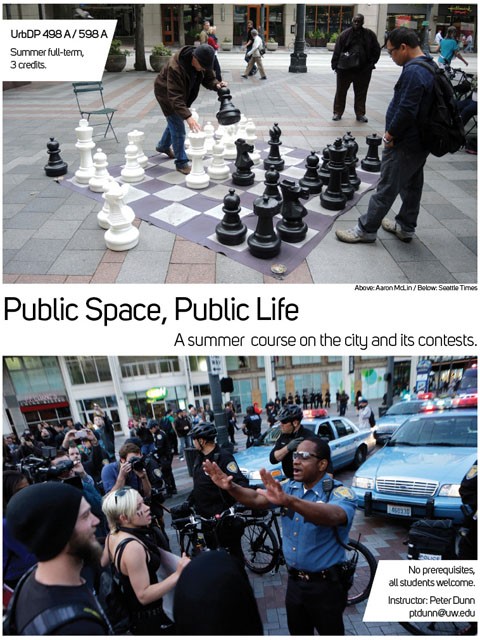
Public Space, Public Life
UrbDP 498A / 598A
Summer, full-term, 3 credits
M/W 9:30-11am, Smith 305
Instructor: Peter Dunn (ptdunn@uw.edu)
Who are public spaces for? And who are they made by? What role do city squares play in a democracy? What kinds of parks do we love, and which ones make us uncomfortable? How do strangers watch each other in the city? What are the rules of behavior, and how are they enforced? Is a mall or a coffee shop a public space? Does it matter if everyone is looking at their screens? Do protests belong in the streets? Do people experiencing homelessness? How can architectural design or programmed activities change the character of public spaces?
This summer class will explore these questions in two ways. First, we will read texts and examine cases that illustrate how public spaces have been theorized, created, and studied. Second, students will do their own creative fieldwork in Seattle spaces to practice looking at, inhabiting, and intervening in public space. Undergraduates should register for URBDP 498A, graduate students should register for URBDP 598A.
Comments Off on Summer class: Public Space, Public Life (UrbDP 498A / 598A) – posted 4/19Summer 2019 Course: Public Space, Public Life (Posted 4/16/19)
Posted under Academic Resources, Courses and Registration on Apr 16, 2019
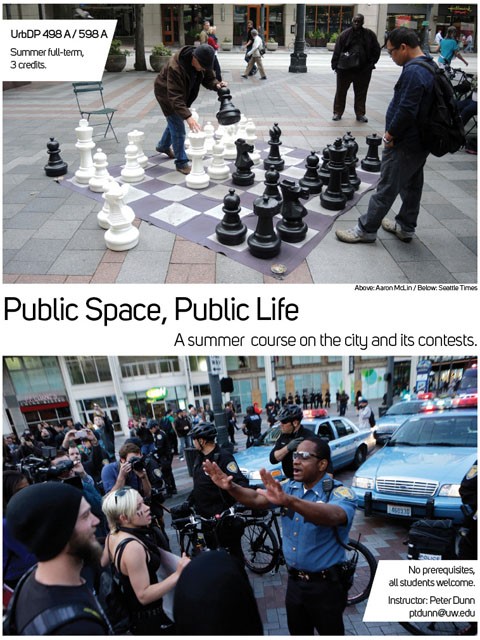
Public Space, Public Life
UrbDP 498A / 598A
Summer, full-term, 3 credits
M/W 9:30-11am, Smith 305
Instructor: Peter Dunn (ptdunn@uw.edu)
Who are public spaces for? And who are they made by? What role do city squares play in a democracy? What kinds of parks do we love, and which ones make us uncomfortable? How do strangers watch each other in the city? What are the rules of behavior, and how are they enforced? Is a mall or a coffee shop a public space? Does it matter if everyone is looking at their screens? Do protests belong in the streets? Do people experiencing homelessness? How can architectural design or programmed activities change the character of public spaces?
This summer class will explore these questions in two ways. First, we will read texts and examine cases that illustrate how public spaces have been theorized, created, and studied. Second, students will do their own creative fieldwork in Seattle spaces to practice looking at, inhabiting, and intervening in public space.
No prerequisites; all students are welcome.
Comments Off on Summer 2019 Course: Public Space, Public Life (Posted 4/16/19)Summer Course: Black & Indigenous Theories of Educational Liberation & Resurgence
Posted under Courses and Registration on Apr 1, 2019
Comments Off on Summer Course: Black & Indigenous Theories of Educational Liberation & Resurgence3 Spots in JSIS 540: Econ & Politics of Int’l Development Spring 2019
Posted under Courses and Registration on Apr 1, 2019
There are 3 spaces available in JSIS 540: Economics and Politics of International Development taught by Mary Callahan this spring 2019.
This course examines economic development in less-developed nations, with a focus on post-World War II development in sub-Saharan Africa and India. It explores possible determinants of economic growth, including foreign investment, international trade and foreign aid. Particular attention will be paid to the role that institutional factors, such as executive power and protection of property rights, play in determining economic outcomes. We will also analyze how the international monetary and financial system affects development, the role of globalization in economic crises, and how fiscal and monetary policy can affect growth in developing countries. We will conclude with an examination of how economic growth is affecting population and environmental issues in the developing world.
JSIS 540: Economics and Politics of International Development
Tuesdays, 2:30-5:20pm
5 credits
Comments Off on 3 Spots in JSIS 540: Econ & Politics of Int’l Development Spring 2019Space available- International Negotiation Crisis Simulation: South China Sea
Posted under Courses and Registration on Apr 1, 2019
A unique opportunity in Spring Quarter: International Negotiation Crisis Simulation: South China Sea.
This is an excellent opportunity to learn about how negotiation happens in the real world.
See Professor Robert Pekkanen’s description below.
Open to all students, this is a fee-based class offered through UW Continuum College and there is a separate registration fee of $1322.
How to register:
See the link below with instructions
http://www.washington.edu/students/timeschd/SPR2019/95jsis.html
You may also optionally choose to register for additional credit through your normal Seattle Campus registration:
JSIS B 431 5 cr. (undergrads)
JSIS B 531 5 cr. (graduate students)
“I want to call to your attention the unique opportunity to participate in a great simulation exercise through registering for JSIS 478 I this quarter. Students join one of seven teams representing China, Japan, the US, India, Indonesia, the Philippines and Vietnam for a two-day intensive negotiation. The simulation exercise is a wonderful hands-on experience for any student interested in international relations and diplomacy. I run the simulation in collaboration with the US Army War College, who send a team out to Seattle for the simulation. I don’t believe there is any other course or opportunity like this at UW and I encourage you to consider it.”
Professor Robert Pekkanen
Course Description:
The international strategic crisis negotiation simulation offers students a tremendous opportunity to role-play a complex diplomatic negotiation related to a real-world global conflict. Offered in conjunction with the US Army War College, this year’s exercise will simulate an Association of Southeast Asian Nations (ASEAN) summit convened to negotiate an end to the conflict in the South China Sea- a topic that has been very much in the news. Over the course of the quarter-long class taught by Prof. Robert Pekkanen, participants will learn about the politics of the region, as well as team leadership and diplomatic negotiation skills, in preparation for the 2-day simulation May 18 and 19.
Comments Off on Space available- International Negotiation Crisis Simulation: South China Sea2019 Spring Course: Global Laboratory Systems
Posted under Courses and Registration, Global Health, Health on Mar 29, 2019
Global Laboratory Systems
Course: GH 549/LAB M 549 (1 CR)
April 1- June 9, 2019
Wednesdays from 3:30pm- 4:50pm Health Sciences Bldg. T-478
Eligibility: No prerequisites are required to enroll in this course
The goal of this interactive seminar course is to educate students n the role that critical and public health laboratories play in a national public health system, both here in the U.S. and globally. Students that complete this course will have have a greater understanding of the functional components of a laboratory system and understand better the importance of quality laboratory information on public health policy making.
Comments Off on 2019 Spring Course: Global Laboratory Systems2019 Spring Course: MEDEX 580A
Posted under Courses and Registration, Social Justice on Mar 29, 2019
Homelessness in Seattle – 2019 flyer
HOMELESSNESS IN SEATTLE – MEDEX 580A (2 credits)
THIS COURSE WILL EXTEND UNDERSTANDING OF THIS COMPLEX SOCIAL JUSTICE ISSUE AND HOW THE HEALTHCARE SYSTEM CAN RESPOND TO THE NEEDS OF THOSE EXPERIENCING HOMELESSNESS.
WHEN: Tuesdays, April 2 – June 4 from 6pm – 8pm
The SLN for the course is 21532. It meets in the Health Science Room-Our MEDEX ROOM T-T 483-85
Comments Off on 2019 Spring Course: MEDEX 580AUrban Planning Course: Community Resilience
Posted under Courses and Registration on Mar 29, 2019
NEW COURSE: Community Resilience
(IPM 516/URBDP 598B, 3 credits)
This course will introduce you to a systems theory approach to resilience thinking and provide opportunities to apply resilience concepts to real world problems.
YOU WILL:
Apply resilience concepts to real world communities and infrastructures threated by real events.
Gain practice in supporting policies, programs and projects that enhance overall resilience. The course employs a case study approach to bridge the theoretical concepts and practical applications.
Develop a toolkit of approaches and strategies designed to enhance community resilience
You can attend this course in-person or on-line at a remote location. The course will be offered Mondays and Wednesday, from 4p – 5:20p.
Email kfishler@uw.edu for add code.
Comments Off on Urban Planning Course: Community ResilienceStudy Abroad in Paris Autumn Quarter 2019, Due April 15th
Posted under Courses and Registration, International, Study Abroad on Mar 29, 2019
Dear Students,
Imagine experiencing Paris in Autumn (2019) on a faculty-led program with two exceptional faculty: Professor Gary Handwerk and Professor Mikkel Borch-Jacobsen!
If you are interested in this program but have questions, please email us (contact engladv@uw.edu or the professors-emails below).
The extended program deadline is April 15th, so there is time to apply! Paris brochure 2019
FALL QUARTER IN PARIS 2019
The application deadline for the Comparative Literature Study Abroad Program in Paris (October 6 to December 7, 2019) has been extended to April 15, 2019.
This interdisciplinary program offers students a unique opportunity to earn 15 UW credits while living and studying in one of the most vibrant and beautiful cities in the world.
The program is open to all UW and non-UW students with an interest in the humanities and arts. There are no language requirements.
The program fee is $6,950. This includes tuition (waived), housing and board.
For program description and online application, see the attached brochure or visit the UW Study Abroad site: https://studyabroad.washington.edu/index.cfm?FuseAction=Programs.ViewProgram&Program_ID=10484
Questions? Contact Gary Handwerk at handwerk@uw.edu or Mikkel Borch-Jacobsen at mbj@uw.edu.
Comments Off on Study Abroad in Paris Autumn Quarter 2019, Due April 15th2019 Spring Course: America and East Asia in a Globalized World: Globalization, Nationalism, and Regionalism
Posted under Courses and Registration on Mar 29, 2019
America and East Asia in a Globalized World: Globalization, Nationalism, and Regionalism
JSIS 484 B /JSIS 584 A
Th 230-520 MGH 097
Professor Donald C. Hellmann
East Asia led by the continuing growth of China, will soon become the largest economic region in the world and, in due course, the Asian Century may succeed the American Century. Whatever the ultimate result, global affairs in the first half of the 21st century will focus on the challenges of evaluating Asian regionalism, integrating Asia into the world and the capacity and will of the United States to lead. The global political economy will be rapidly transformed by: 1) the digital revolution; 2) a dramatic shift in economic power; 3) new multilateral international institutions to mediate these changes; 4) new types of security threats, military cyber and economic; 5) a challenge to the U.S. and the universality of the democratic capitalist principles; and 6) developing a viable regional order with a hegemonic China; 7) erratic Trumpian nationalism.
The course discusses the historical forces that have given rise to these ideas globally and especially in East Asia and frames the questions facing this region in the increasingly inter-dependent but non-convergent 21st century world.
Graduate students will take a five to six page take home final and write a 12-15 page paper on a topic of their special interest, established in consultation with the professor.
Undergraduate grades will be primarily based on a take home final examination and two five-page papers on topics worked out with the professor. All students are expected to do the readings and participate in classroom discussions on the readings of the week elaborated by 30 minute lectures by the professor.
This course is open to all students.
For additional Spring Courses offered in Jackson School see:
https://jsis.washington.edu/course/
| Course Lists – The Henry M. Jackson School of International Studies
jsis.washington.edu Quarterly course lists divided by region for the Jackson School of International Studies. |
Linda Iltis Ph.D.
Lead Adviser & Assistant Director of Academic Services
Henry M. Jackson School of International Studies
Make an appointment at http://jsis.washington.edu/advise/
Comments Off on 2019 Spring Course: America and East Asia in a Globalized World: Globalization, Nationalism, and RegionalismPOST-SOVIET SECURITY COURSE – Spring 2019
Posted under Courses and Registration on Mar 20, 2019
Post-Soviet Security
JSISA 420/520 and POL S 420/520
M/W 2:30-4:20
Why did Russia try to influence the 2016 US presidential election? Why does Russia seem to be involved in wars on its borders so often? Why are corruption and autocracy so widespread across the post-Soviet region? This course will answer these and other questions by examining the international and domestic politics of Russia and its neighbors after the Collapse of the Soviet Union in 1991. It focuses on the many ways efforts to build new states and nations could go wrong. Topics covered include nationalism, organized crime, civil wars, revolutions, authoritarianism, international migration, the wars in Georgia and Ukraine, and the Kremlin’s efforts to help Trump win.
Comments Off on POST-SOVIET SECURITY COURSE – Spring 2019Spring Course MGMT 579: Women & Leadership
Posted under Courses and Registration on Mar 13, 2019
MGMT 579A Women and Leadership (4)
Women in Leadership –You see them in the media: fabulous females who are top executives and successful entrepreneurs and visionaries making a real difference in their communities and the world. You admire their accomplishments. But what you seldom see or hear is what these women felt like when they were your age and lacked experience. How did they get from that place to their current level of success? How have they developed effective leadership styles? Do they have children? How have they found ways to balance competing priorities?
In this class amazing local leaders will share their life and career stories to answer these questions and more. We will also learn from the stories of well-known women innovators and executives. After taking this course, you will know how to tap into your personal leadership values….and how to build on them to create a life and career worthy of your aspirations.
Comments Off on Spring Course MGMT 579: Women & LeadershipSpring Course: JSIS 487 / 587 “Comparative Multi-Sector Entrepreneurship: US and the Middle East” (Posted 3/13/19)
Posted under Courses and Registration on Mar 13, 2019

Comments Off on Spring Course: JSIS 487 / 587 “Comparative Multi-Sector Entrepreneurship: US and the Middle East” (Posted 3/13/19)Spring Course: COM 597 I: Interpersonal Health Communication (Posted 3/13/19)
Posted under Courses and Registration on Mar 13, 2019
COM 597 I: Interpersonal Health Communication, TTh 12:30-2:20pm, CMU 322 (John Crowley) 3-5 credits
This graduate seminar will investigate the biological underpinnings of interpersonal communication. Students will read chapters and articles by prominent interpersonal communication scholars on the ways in which biology can both influence and be influenced by our communication behavior. Moreover, students will discuss strengths and limitations for methods of collecting biological data and discuss various analytic strategies for measuring biological markers. Finally, students will consider how theories can be developed in ways that complement extant work on the physiology of interpersonal communication.
For more information, please contact Dr. John Crowley at jpcrow@uw.edu.
Comments Off on Spring Course: COM 597 I: Interpersonal Health Communication (Posted 3/13/19)Spring Course: JSIS 540: Economics and Politics of International Development (Posted 3/13/19)
Posted under Courses and Registration on Mar 13, 2019
There are 3 spaces available in JSIS 540: Economics and Politics of International Development taught by Mary Callahan this spring 2019.
This course examines economic development in less-developed nations, with a focus on post-World War II development in sub-Saharan Africa and India. It explores possible determinants of economic growth, including foreign investment, international trade and foreign aid. Particular attention will be paid to the role that institutional factors, such as executive power and protection of property rights, play in determining economic outcomes. We will also analyze how the international monetary and financial system affects development, the role of globalization in economic crises, and how fiscal and monetary policy can affect growth in developing countries. We will conclude with an examination of how economic growth is affecting population and environmental issues in the developing world.
JSIS 540: Economics and Politics of International Development
Tuesdays, 2:30-5:20pm
5 credits
This course is a part of the Master of Arts in Applied International Studies.
Comments Off on Spring Course: JSIS 540: Economics and Politics of International Development (Posted 3/13/19)Spring Course JSIS 487/587: Comparative Multi-Sector Entrepreneurship: US & the Middle East
Posted under Courses and Registration on Mar 12, 2019
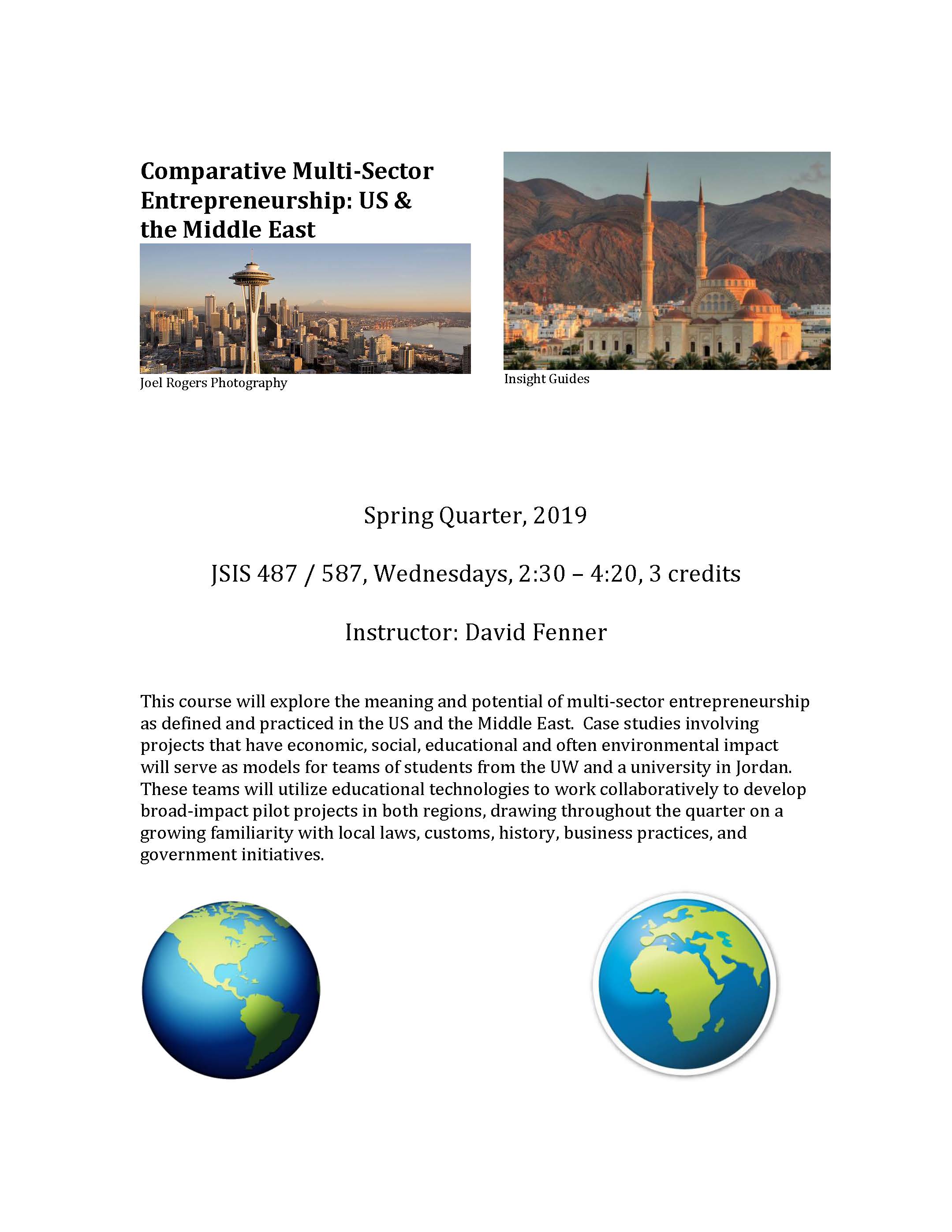
A quick note to let you know that the Middle East Center of the Jackson School is offering a unique course this spring where teams of UW students will work with teams of students in the Middle East on collaborative projects. A wide range of educational technologies will connect the members of the teams.
The course is JSIS 487 / 587 “Comparative Multi-Sector Entrepreneurship: US and the Middle East”, Wednesdays, 1:30 – 3:20, (3 credits), Smith 115
Despite its clunky title, the course promises to be a learning experience unlike any other on campus.
There are no prerequisites for this course that will explore the social, cultural, historical, economic and business realities of launching a “triple bottom line” project in the US, Middle East, and beyond.
Comments Off on Spring Course JSIS 487/587: Comparative Multi-Sector Entrepreneurship: US & the Middle EastSpring Course: L Arch 598 C Politics of Place (3 Credits)
Posted under Courses and Registration on Mar 7, 2019
L Arch 598C: Politics of Place (3 credits)
T/Th Noon-1:20pm
SLN: 15774
lmanzo@uw.edu for add code
This graduate seminar offers an opportunity to engage in discussion and debate around the ways that diversity, power, and marginalization play out spatially and the implications of these dynamics on democracy, participation and the creative responses of civil society to claim and use space. The spirit of the seminar is exploratory and experimental – it is an attempt for us to think together around these complex dynamics and consider ways forward toward more equitable environments and strategies. Topics will range from political ecology to the politics of urban public space, and how the very conceptualization, use and maintenance of space can be used to support a normative order or to catalyze change.
As an advanced seminar, this course will provide opportunities for active student participation through peer-led discussions, exercises and individual projects tailored to students’ interests. Students from diverse disciplines are encouraged to contribute their particular skill sets and frameworks.
Comments Off on Spring Course: L Arch 598 C Politics of Place (3 Credits)Spring Course HSERV 572: Planning, Advocacy, & Leadership Skills
Posted under Courses and Registration on Mar 7, 2019
HSERV 572: Planning, Advocacy and Leadership Skills
MWF 2:30-3:50; 4 credits
SLN: 15016
If class is closed, contact hservmph@uw.edu for waitlist (has plenty of spots at this time)
This class is an opportunity to master basic concepts, analytic tools, and skills for program and policy planning, advocacy, evaluation and leadership skills under the close mentorship of faculty and teaching staff. You’ll also learn from your peers in an interdisciplinary and applied setting. This unique course engages MPH and other graduate students with real-world public health problems, partnering with local community health organization clients. We will be building skills and competencies in a number of topics, skills, and processes to help you complete your project.
The course is suitable for graduate students from any school or college who want to deepen their understanding of how public health professionals lead program development, program evaluation and policy advocacy projects to advance population health. It is not open to undergraduate students.
Projects offered include:
- Work with the Seattle-area Yemen Relief & Reconstruction organization to develop an advocacy campaign
- Assess savings associated with serving homeless patients requiring post-hospitalization care in a respite facility at Harborview
- Work with Metro Transit to develop new (non-criminal) approaches to low-income fare violators.
- Analyze the causes of death of homeless people in King County and propose future options to better track & document
- Help SHARE develop its website
- Design a multi-campus state survey of university students regarding their challenges accessing health insurance
- Work with a Hanford watchdog group to gather evidence about how Washington’s new workers compensation law has changed the number of claims filed, accepted and rejected at Hanford nuclear reservation
- Evaluate the Nickelsville tiny house village site at North Lake Union, in conjunction with the UW Nursing School
- Work with Transit Riders Union to design a campaign to persuade some key large employers in Seattle to offer transit benefits to low-wage workers (think Starbucks, Amazon, etc.)
- Evaluate the Hepatitis Education Project’s new suboxone-on-demand clinic.
Comments Off on Spring Course HSERV 572: Planning, Advocacy, & Leadership Skills