October 2, 2025
Project Highlight: Balancing Fuels Reduction and Wildlife Conservation – Monitoring of Fisher and NSO Response to Fuels Management in Northern California Forests
By Kylie Baker
Fighting Fire with Science and Stewardship: Balancing Fuels Reduction and Wildlife Conservation in Northern California Forests
In Northern California’s fire-prone forests, land managers face the complex challenge of reducing the risk of catastrophic wildfire while conserving habitat for sensitive wildlife species. Pacific fishers (Pekania pennanti) and the federally threatened Northern Spotted Owls (Strix occidentalis caurina) are two such species whose continued survival is deeply intertwined with forest conditions, and both have faced increasing threats as wildfires become more frequent and severe.
To address this challenge, a long-running Pacific Northwest Cooperative Ecosystem Studies Unit (PNW CESU) collaboration between Oregon State University (OSU) and the U.S. Fish and Wildlife Service (USFWS) explores how forest fuel reduction treatments affect these two forest-dependent species. While the larger fisher monitoring effort began in 2006, the current fuels-focused phase of the work began in 2021 through a CAL FIRE Forest Health Grant.
This project receives support from a variety of additional partners, such as public and private landowners, the Quartz Valley Indian Reservation, Shasta Valley Resource Conservation District, FWS Forestry, the Oregon and California Departments of Fish and Wildlife, and the U.S. Forest Service. Together, the partners are working across ownership boundaries and knowledge systems to restore healthier, more fire-resilient forests that sustain both people and wildlife. With support from so many facets, this research is helping to generate the science needed to guide wildfire mitigation strategies that are compatible with biodiversity conservation goals.
A Two-Decade Legacy of Fisher Research
Impressively, the groundwork for this study was laid over two decades ago. In the late 1990s and early 2000s, private timber companies in Northern California began proactively studying fishers, anticipating the potential for an Endangered Species Act listing. Working with the USFWS and U.S. Forest Service, these early efforts used non-invasive techniques—like track plates, hair snares, and remote cameras—to estimate fisher distribution and abundance. OSU researcher Sean Matthews joined the project in 2011 as the California Department of Fish and Wildlife was implementing a fisher reintroduction to the northern Sierra Nevada.

This long-term data collection has proven invaluable, especially following the 2014 Beaver Fire, which burned approximately one-third of the study area. Because researchers had robust pre-fire data, they were able to measure a 27% decline in the local fisher population, attributing the loss primarily to high fire severity. While a devastating event, the findings emphasized the vulnerability of forest wildlife to increasingly intense wildfires and underscored the need to explore fuels management as a strategy for both fire risk mitigation and wildlife conservation.

Aligning Fuel Reduction with Wildlife Conservation Goals
Recognizing the growing urgency of these dual challenges, project partners OSU and USFWS—including the U.S. Forest Service, private timber companies, the Quartz Valley Indian Reservation, and the Shasta Valley Resource Conservation District—came together to apply for a CAL FIRE Forest Health Grant in 2021. The awarded grant supported the implementation of fuel treatments across approximately 1,000 hectares of forestland near Yreka, California.
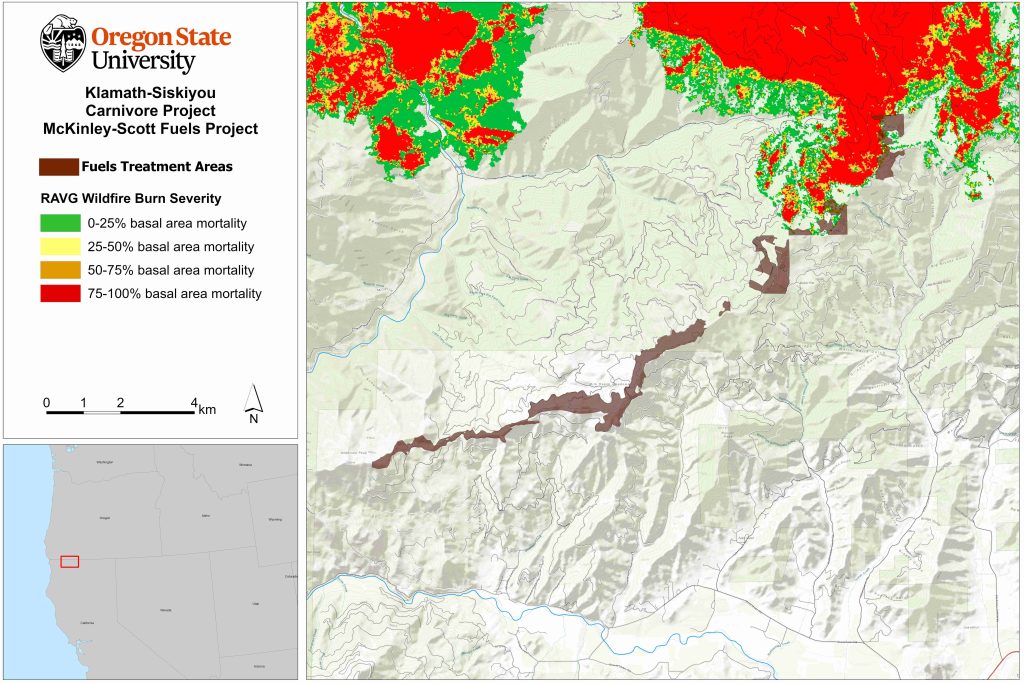
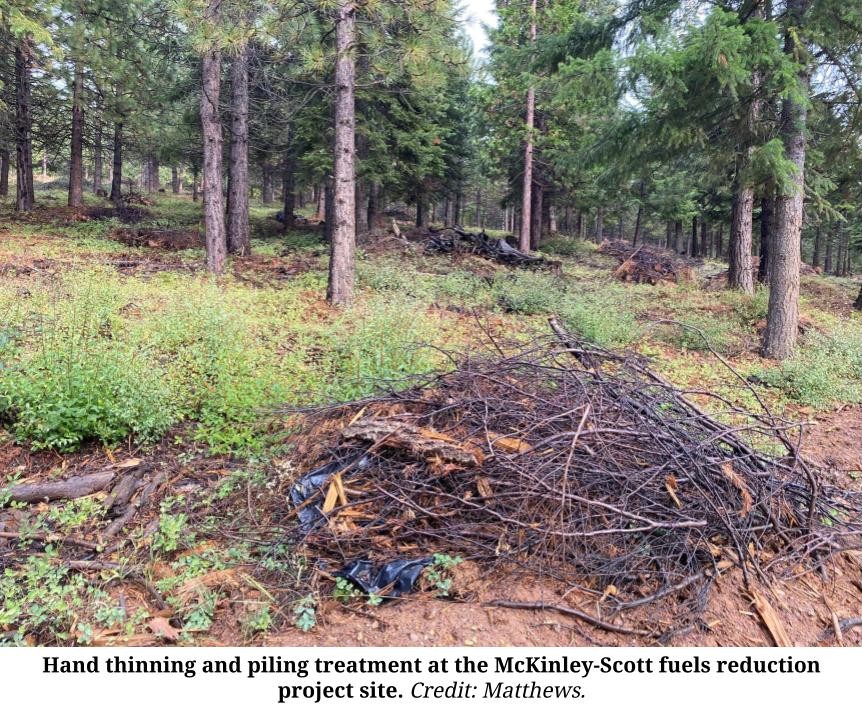
These treatments were designed to reduce ladder fuels and fire severity while preserving key habitat features. Strategies included mastication (mechanized chipping of woody vegetation), hand thinning (removing smaller trees and shrubs using chainsaws), pile burning, roadside fuel clearing (to improve firefighter access and establish firebreaks), and herbicide application. Treatments took place on both private and public lands, requiring strong coordination between partners and a shared commitment to ecological stewardship.
Monitoring Wildlife Throughout the Treated Forests
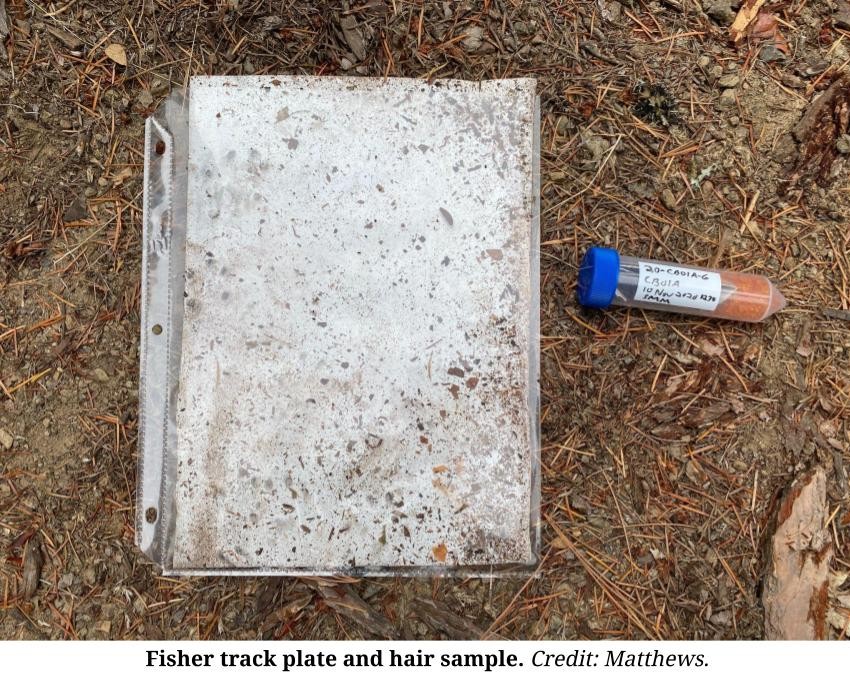
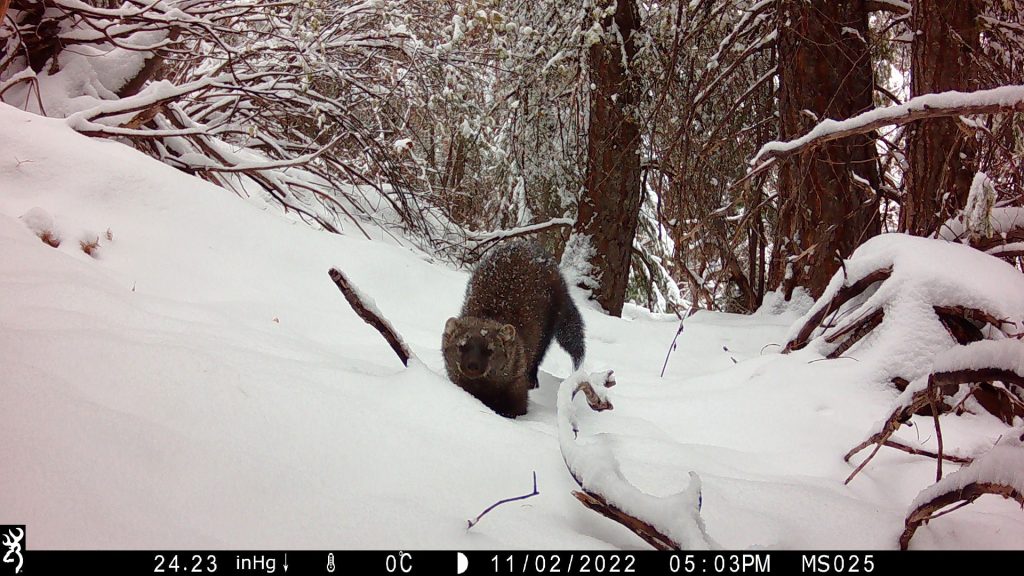
To assess the impact of these treatments on fishers and owls, the research team implemented a multi-faceted wildlife monitoring effort. For fishers, non-invasive remote cameras and unbaited hair snares are being deployed in and around treatment areas to track individual and population-level space use before, during, and after fuel reduction work. These methods allow researchers to detect fishers across large spatial areas without attracting them artificially to treated zones.
Northern Spotted Owls are being monitored using established survey protocols conducted by the U.S. Forest Service, relying on auditory call-back methods and territory occupancy data. While owl data is not as tightly controlled within the research team, the integration of Forest Service records provides a broader understanding of owl response to changing forest structure.

Although analysis is still ongoing, preliminary results suggest that fishers are continuing to use both treated and adjacent forest stands. Notably, animals were detected both before and during active treatment phases. The research team plans to revisit the field sites to re-deploy cameras and assess post-treatment responses, focusing on how fisher habitat use has changed—or remained stable—following the conclusion of active fuel treatments.
Inclusive Stewardship for the Betterment of Our Forests
Matthews notes that one of the most rewarding aspects of the project has been its deepening collaboration with the Quartz Valley Indian Reservation and broader tribal community. Members of the tribal community have played an integral role in the wildlife monitoring effort and in maintaining remote cameras across the treatment sites.
This partnership represents more than just logistical support. It’s a meaningful step toward integrating tribal voices and Indigenous knowledge into forest management conversations from which they’ve often been excluded. Community members bring intergenerational understandings of the land, rooted in long histories of cultural fire use and stewardship. These insights provide important context for interpreting the ecological shifts underway and support a more holistic vision of forest health. Field days spent co-learning and co-monitoring—where scientific expertise and traditional ecological knowledge intersect—have become some of the most powerful moments in the project.
Early Signals: Fishers Still on the Move
The team’s preliminary findings support cautious optimism. So far, it appears that carefully planned fuel treatments can be compatible with fisher habitat use, especially when treatments preserve large trees and snags, high levels of canopy cover, and large logs. These early results suggest that strategic thinning—rather than complete removal—can reduce fuel loads while maintaining sufficient cover and foraging habitat for sensitive wildlife.
The research also reinforces the importance of treatment diversity. By using a patchwork approach—leaving some forest areas untouched while thinning others—land managers may be able to create heterogeneous landscapes that support species with varying habitat preferences. Fishers and Northern Spotted Owls, for instance, both rely on older forest structures, but they may also benefit from the increased foraging opportunities found in younger, more open patches.
Looking Ahead: Science for Shared Forest Futures
Looking ahead, the research team will continue its field monitoring. The next round of camera deployments will provide key data on how fishers respond to the now-complete fuel treatments. These insights will help refine our understanding of how treatment type, intensity, and location influence wildlife space use over time.
Beyond answering scientific questions, the project is helping inform real-time management decisions. The U.S. Forest Service has expressed strong interest in the findings and is incorporating the data into its planning efforts for future projects, especially those that may affect sensitive species. Private landowners are also closely watching the results, aiming to align forest product goals with long-term conservation values. Ultimately, the team hopes this research contributes to a more resilient model of forest stewardship—one that integrates fire risk reduction with biodiversity protection, informed by both ecological science and tribal knowledge. And I would say, they’re already doing an excellent job.