
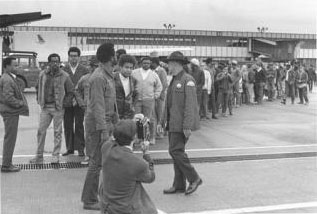
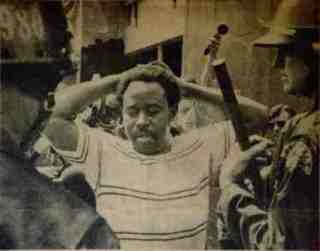
Tyree Scott talks to a police officer at Sea-Tac airport protest in November, 1969
Tyree Scott, far left, leads over 100 protesters onto the flight apron of Sea-Tac airport in September, 1969
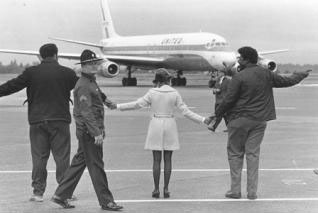
Protesters stop air traffic to protest lack of minorities on Seattle construction sites, September 1969
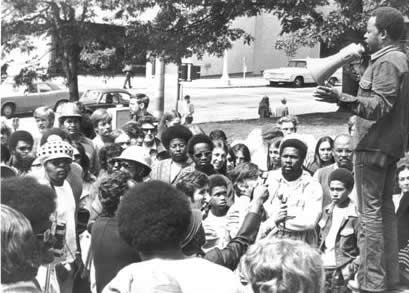
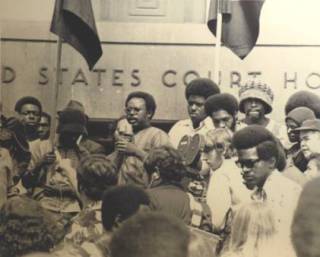
Tyree Scott speaks to crowd of supporters outside Federal Courthouse
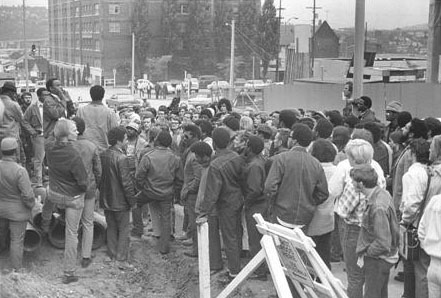
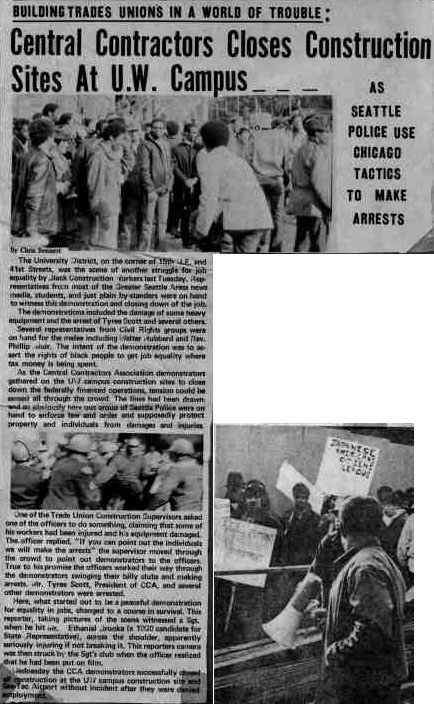
Tyree Scott addresses crowd of supporters at University of Washington construction site before closing it down, September 1969
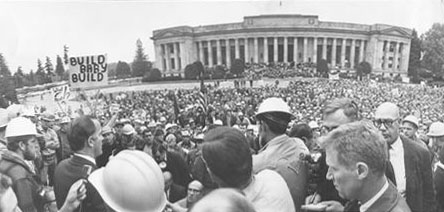
Thousands of building trades union members converge on Olympia to protest the support they believe Gov. Dan Evans has expressed for Tyree Scott’s protests. Evans, bottom left, tries to speak to crowd. October, 1969
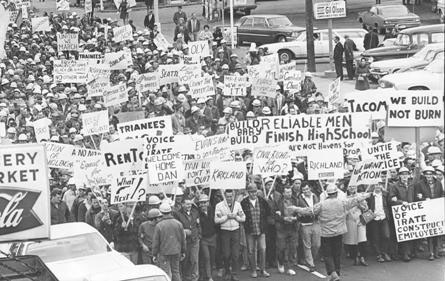
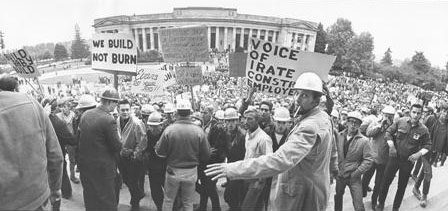
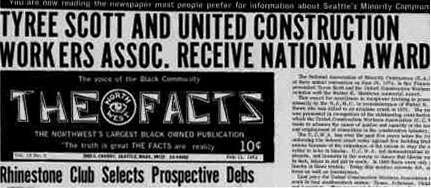
Tyree Scott grew up in Texas and served in the U.S. Marine Corps before moving to Seattle in 1966. When he arrived in Seattle, Scott worked for his father, who was an electrical contractor. When Model Cities, a federal antipoverty program led by local civil rights activist Walter Hundly, organized local black contractors to help them gain access to lucrative federal construction contracts in the Spring of1969, Tyree Scott emerged as the leader of this new group, the Central Contractors Association (CCA).
But the CCA had an uphill battle to fight. In 1966, the Washington State Board Against Discrimination found that Washington State’s 15 Building Trades unions, representing over 29,000 workers, had only 7 non-white apprentices. Despite years of complaints from CORE, the Urban League, the NAACP, and the Catholic Archdiocese’s Project Equality, little had changed in three years since that report. And the unions’ near-total control over the local labor market made it nearly impossible for both black workers and black contractors to find a way to benefit from large government contracts.
Frustration with unions’ refusal to work with them, as well as federal guidelines that made it difficult for black contractors to get work, inspired Scott and the CCA to shut down federal construction sites throughout Seattle to protest their impossible position and demand jobs for black workers and contractors.
Forsaking what they believed to be failed forms of negotiation, the CCA brought every major, federally funded construction site in the city of Seattle to a halt in late August and September of 1969. They did this— as other activists were doing in Pittsburgh, Philadelphia, and Chicago at roughly the same time— by disabling equipment, blocking workers from their jobs, and demanding that federal civil rights law be used to force unions to hire more black workers. The most dramatic actions included running a bulldozer into a large open pit at the University of Washington, and marching over a hundred protesters onto the flight apron of Sea-Tac airport to halt air traffic. See UCWA Timeline
The CCA’s direct action protests created a political firestorm that quickly pushed county, state, and federal officials as well as federal courts to take sides in the dispute between black workers and white unions. In Seattle, like many other cities around the country at the same time, these debates precipitated the first federal imposition of affirmative action upon local governments and industries.
UCWA FOUNDING AND AFFIRMATIVE ACTION, 1970-72
By December, 1969, debate within the Central Contractors Association (CCA) over how to negotiate with unions, contractors, and government officials divided the organization between those who wanted to advocate for more jobs for black workers and those who wanted more federal contracts to go to black contractors.
Tyree Scott, despite having worked as a contractor, left the CCA at the invitation of the Seattle Branch of the American Friends Service Committee (AFSC) to found the United Construction Workers Association (UCWA) in early 1970. With the AFSC’s financial and organizational backing, Scott shifted his attention away from contractors’ issues to make black construction workers’ struggles against union racism his sole focus.
The UCWA’s original mission of supporting black workers encompassed a number of specific tasks that fused activism, social work, and political advocacy. It facilitated worker support and study groups; negotiated with parties on behalf of black workers; initiated lawsuits; and led protests that included non-violent direct action. See “An Idea Whose Time Has Come: Minority Employment in the Seattle Construction Industry.”
Though founded before the Federal District Court officially imposed affirmative action on the Seattle/ King County Building and Construction Trades Unions, the UCWA grew to demand a prominent role as enforcer of federal law and judicial decrees.
The U.S. Justice Department filed suit against the unions in late 1969 following the CCA’s protests. On June 16, 1970, Federal District Court Judge William Lindberg’s ruling in U.S. v. Ironworkers Local 86 found Seattle’s building trade union hiring practices and apprenticeship programs in violation of Title VII of the 1964 Civil Rights Act. Lindberg further ordered the imposition of a broad affirmative action program on the construction industry to be implemented through a board representing all the parties in the dispute, called the Court Order Advisory Committee (COAC). Lindberg’s decision was, according to employment law professor William Gould, “the earliest, and at the time of its issuance, the most comprehensive Title VII decree rendered in any court.”
But a vote by COAC members to keep Scott and the UCWA from overseeing the day to day hiring of black workers mandated by the court order caused immediate rancor, with Scott accusing COAC of allowing union hiring halls to undermine the affirmative action program from the inside. When institutional confusion, foot dragging, divisive behind the scenes lobbying, and on the job conflict between white and black workers prevented unions from meeting their court-ordered quotas for minority hiring, UCWA members took to the streets in the summer of 1972 and led dramatic protests that closed down I-90, Seattle Central Community College, and construction sites around the area.
In response, on July 13th, 1972, Judge Lindberg made the UCWA party to U.S. v Ironworkers Local 86, gave it two representative positions on COAC, and gave it significant power over union apprenticeship programs. Scott served on COAC until it disbanded in 1978.
From this new position of power, Scott and the UCWA had the unusual power—compared to other affirmative action programs—to act as implementer, watchdog, and enforcer of a federal court order to desegregate one of Seattle’s most powerful collection of labor unions. This gave the black workers of the UCWA a voice and leadership role in Seattle’s civil rights struggles that they augmented through alliances with the U.S. Equal Employment Opportunity Commission (EEOC), the Washington State Manpower and Planning Council, the Seattle Urban League, and other government and non-governmental institutions.
UCWA EXPANDS ITS REACH, 1973-5
The UCWA expanded its organizing in 1971 to try to mobilize black workers in Denver to combat racial discrimination in the building trades there. Following its legal victories in 1972, Tyree Scott and the UCWA grew even more in their efforts to create solidarity networks in other cities, other industries, and other communities of color.
The UCWA’s end of year 1972 report, “A Proposal to Combat Employment Discrimination in the State of Washington,” made this shift clear with its emphasis on developing organizing strategies in Washington that could then be exported to other cities throughout the region.
In 1973, the UCWA founded a branch in Oakland, California. And with a federal grant from the EEOC, it continued its work in Denver as well as created the Southwest Workers Federation, whose headquarters were in Little Rock, Arkansas. From there, Tyree Scott and fellow UCWA activist Todd Hawkins tried to organize minority construction workers, with mixed results, in eight cities: Little Rock and Pine Bluff, Arkansas; Monroe and Shreveport, Louisiana; Oklahoma City and Tulsa, Oklahoma; and Austin, Tyler, and Waco, Texas.
In Seattle, the UCWA also provided the training, the seed money, and the organizing model for the Alaska Cannery Workers Association (ACWA). The ACWA was founded in 1973 by radical Filipino youth who had been involved in solidarity work with the UCWA. The ACWA fought racial segregation and inequality in Alaska cannery worker facilities through Title VII lawsuits and challenges to union elites that the young Filipino activists claimed were complicit in creating Filipino cannery workers’ poor working conditions.
Also in 1973, the UCWA, ACWA, and Northwest Chapter of United Farm Workers (UFW) joined forces to found the Northwest Labor and Employment Law Office (LELO). LELO pooled together legal resources and support for activist pro bono lawyers who had been pursuing Title VII lawsuits to aid these grassroots labor movements among workers of color. One of LELO’s lawsuits on behalf of the ACWA, Antonio v Ward’s Cove, went to the U.S. Supreme Court in 1989.
UCWA AND THIRD WORLD MARXISM, 1975-1980
Tyree Scott was influenced by and became a lead participator in Seattle’s vibrant Third World Marxism community in the early to mid 1970s. Third World Marxism varied in its specific ideologies, but was generally most influential in the way that its thinkers used the term “Third World” to unify very different peoples around the world into a singular movement for racial and economic justice.
Rather than organizing only African American workers, fighting a class struggle without attention to issues of race, or working to reform American society in exclusion from other countries, Scott increasingly came to see his and the UCWA’s activism as part of a global, grassroots, movement of “Third World” peoples against racism and imperialism.
From 1973 to 1980, Scott and a number of other UCWA leaders helped coordinate the Seattle Workers Group, which later became associated with the Organizing Committee for an Ideological Center (OCIC). OCIC facilitated the interaction of 20 Marxist worker organizations around the country from its founding in 1978 to its demise in 1981.
Scott was also a founding member of the Third World Coalition, a national racial justice organization begun by various American Friends Service Committee (AFSC) staff who were influenced by Third World Marxist ideas in 1971. From 1977-79, Scott served as the national organization’s co-chair.
The UCWA’s direction during this time reflected Scott and others’ ideological shift. From 1975 to 1978, it produced a publication “for the Third World Poor” called No Separate Peace. Archived in its entirety on this web site, No Separate Peace was an important part of the Seattle left press in the late 1970s, and sought to link Seattle’s local political issues to broader critiques of racism, sexism, and imperialism.
POSTSCRIPT
UCWA activists gradually shifted their energies to NW LELO in the late 1970s and early 1980s, allowing the UCWA to fade away sometime around 1980. A number of factors contributed to this shift: the transformation of COAC into the Vocational Exploration and Referral Service Center in December, 1978; the end of _No Separate Peace_ in 1978; and the curtailment of federal funds for UCWA organizers around 1979.
During this same time, LELO began to change its mission away from being merely a legal support agency. A growing backlash by federal judges throughout the 1980s against Title VII lawsuits made it increasingly difficult for plaintiffs to prove racial discrimination using statistics about minority employment. With this shift, LELO’s focus opened up to include worker solidarity organizing that seemed to carry on the spirit of UCWA struggles under a different name. For more information about LELO, visit their web site athttp://www.lelo.org.
Before passing away on June 19, 2003, Scott donated his personal and organizational papers to the University of Washington Archives, the contents of which are almost entirely open to the public. For more information about the content of those papers, refer to these finding aids: [LINKS TO GUIDE AND INVENTORY HERE]
OBITUARIES/ MEMORIES FOR TYREE SCOTT
“Minute of Love and Appreciation for Tyree Scott” from the American Friends Service Committee (AFSC), 6/26/03.http://www.afsc.org/pacificnw/tyree_scott.htm
Geov Parrish. “Tyree Scott, 1940-2003.” Seattle Weekly. July 2-8, 2003 http://www.seattleweekly.com/features/0327/news-parrish.php