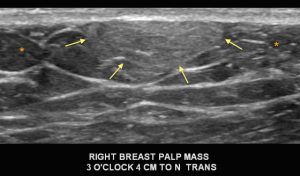
Contributed by: Steven J. Rockoff, MD and Diana L. Lam, MD – June 1, 2020
Question 1
A 58-year-old man presents with a palpable lump in his right breast.
What is the most appropriate imaging test to perform first?
A. Diagnostic ultrasound
B. Diagnostic mammogram
C. Screening mammogram
Answer
B. Diagnostic mammogram
Explanation: According to the American College of Radiology Appropriateness Criteria, for a male who is 25 years or older, the most appropriate imaging exam to perform first with a clinically indeterminate palpable breast mass is a diagnostic mammogram.
This patient has focal symptoms, so a screening exam is not appropriate. There are also currently no indications to screen males for breast cancer.
A bilateral diagnostic mammogram was performed. Images of the right breast shown here do not demonstrate any mammographic abnormality under the BB skin marker:
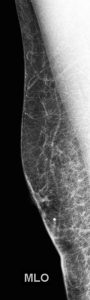
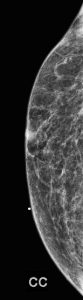
Question 2
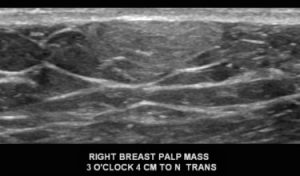
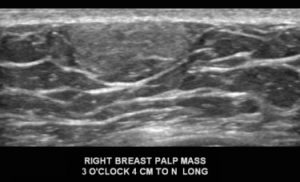
With the mammogram appearing negative, a diagnostic ultrasound was performed. What is the diagnosis?
A. Cyst; BI-RADS 2 (Benign)
B. Invasive ductal carcinoma; BI-RADS 4 (Suspicious)
C. Abscess; BI-RADS 2 (Benign)
D. Lipoma; BI-RADS 2 (Benign)
Answer
Explanation: This is a circumscribed, oval, hyperechoic mass, which is consistent with a lipoma. They have the same imaging appearance in males and females. They may appear as circumscribed fat-containing masses on the mammogram, particularly if the patient has a lot of fibroglandular tissue. Since this male’s breast is composed predominantly of fat density, the lipoma cannot be easily discerned on the mammogram. On ultrasound, a lipoma (arrows) is either isoechoic or slightly hyperechoic to the surrounding subcutaneous fat (*). Lipomas are benign and when correctly identified on imaging, they do not require further follow-up.
D. Lipoma; BI-RADS 2 (Benign)