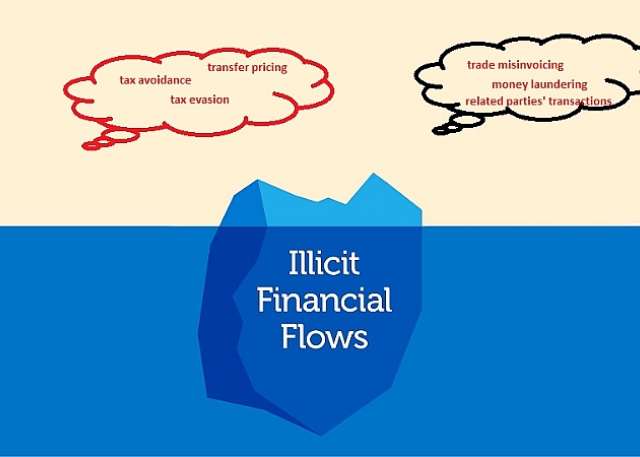
Philip Nyakundi and colleagues at Global Financial Integrity released a report on 28 January 2026 that quantifies the enormous financial loss to African countries due to rich country corporations’ mis-invoicing the value of commodity transactions. The loss of resources and capital flight comes at great cost to public welfare and overall development. The total losses by mis-invoicing alone matches the combined total annual inflows of Official Development Assistance (ODA) and Foreign Direct Investment (FDI) to Africa, meaning Africa loses as much in illicit outflows as it receives in aid and investment. The authors state that illicit financial flows represent a formidable barrier to Africa’s inclusive growth and economic sovereignty.
The report, “Trade-Related Illicit Financial Flows in Africa, 2013-2022” presents estimates for trade-related value gaps for all Sub-Saharan African nations from 2013 – 2022. They demonstrate how vast sums have been illicitly drained from African economies largely through manipulated trade transactions, making the continent, in effect, a net creditor to the world, a s cumulative illicit flight capital has exceeded Africa’s external debt stock in recent years. Moreover, these estimates are likely conservative given the hidden nature of illicit transactions; actual losses could be significantly higher.
Trade misinvoicing, the deliberate under- or over-statement of export and import values on invoices is widely recognized as a dominant channel for Illicit Financial Flows (IFFs). The total value gaps in Sub-Saharan Africa are estimated at $152.9 billion in 2022 – and that sub-Saharan nations averaged $112.97 Billion in trade value gaps during the 10-year period studied. No country in the region appears to have made much progress in limiting trade value gaps during the period,
Here is a link to the report. https://gfintegrity.org/report/trade-related-illicit-financial-flows-in-africa-2013-2022/