Centuries of enslavement and sustained violence have led to persistent, preventable disparities in illness and death that cannot be addressed by aid and development efforts alone. Meaningful recognition of harm and material redress are critical steps in the restorative justice process. Richardson et al. (2026) argue that reparative approaches should be context-specific, center affected communities, uphold dignity, and ensure non-recurrence. Acknowledgement is a critical first step in reparative justice frameworks for building healing processes and material redress for deep historical harms.
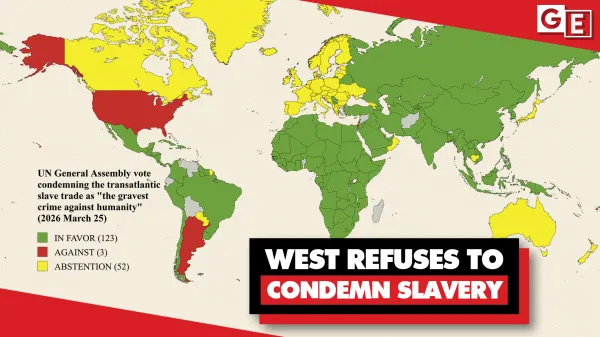
On March 25, 2026, the United Nations adopted a resolution declaring the transatlantic slave trade ‘the gravest crime against humanity,’ urging for reparatory measures. The Global North voted against it.
The landmark resolution was introduced by Ghana and was led by a coalition of African, Caribbean, and Latin American countries. It calls for the restoration of stolen property, formal apologies, and the consideration of reparations. The resolution passed with 123 votes in favor.
The United States, Israel, and Argentina voted against the resolution. U.S. Ambassador to the UN Dan Negrea said the U.S. “does not recognize a legal right to reparations for historical wrongs that were not illegal under international law at the time they occurred.” The United States’ position sits against a historical backdrop of enslavement, racialized violence against Black people, and segregation, as well as enduring economic advantages generated through enslaved labor.
Argentina was the only Latin American country to vote against the resolution. Its vote reflects the nation’s direction under far-right President Javier Milei, whose government has aligned with the United States and Israel in several multilateral forums.
The Israeli Embassy in Ghana shared that they reject the resolution’s phrasing attributing the transatlantic slave trade as ‘the gravest’ crime against humanity. They argued that hierarchical language undermines the significance of the Holocaust.
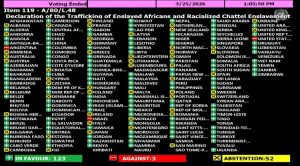
There were 52 countries that abstained from voting, including the entire European Union, the United Kingdom, Canada, Australia, and Japan. The EU and UK echo the US rejection of retroactively applying international law. Notably, most of these abstaining states are former European colonial powers that either directly participated in, or materially benefited from the transatlantic slave trade. Serbia, which is not currently an EU member, voted in favor of the resolution. Global South countries including Cambodia, Fiji, Oman, Palau and Paraguay also abstained.
Legacies of segregated access to high-quality medical care, chronic stress from racism, medical racism, and structural violence continue to shape the health of descendants of enslaved Africans today. Global health scholars argue that reparations are imperative to meaningfully address these entrenched inequities and build healthier futures. Beyond recognition, the decolonization of global health requires the countries who dominate global health funding and research willingness to give up power, resources, and comfort.
References
UN resolution urges reparations for slavery’s ‘historical wrongs’ | UN News
Landmark UN Resolution on the Slave Trade | Human Rights Watch
UN / SLAVERY TRANSATLANTIC SLAVE TRADE | UNifeed
Argentina votes against UN resolution on transatlantic slave trade | Buenos Aires Times
Israel explains why it voted against Ghana’s UN resolution on slave trade
Reparations and distributive justice in global health
Accountability in Global Health
Reparations as a Public Health Priority — A Strategy for Ending Black–White Health Disparities | New England Journal of MedicineReparations for Caribbean slavery and the potential impact on human well-being | BMJ Global Health
Header and in-text images from the Geopolitical Economy Report.