Awards
June 6, 2019
Dr. Christine McGrath co-leads new study on infant HIV, breast milk and gut health
Categories: Awards, Gut Health and Child Survival, Nutrition, Research
Congratulations to Principal Investigators, Dr. Christine McGrath (Assistant Professor, Global Health) and Dr. Grace Aldrovandi (Chief, Division of Infectious Disease at UCLA Mattel Children’s Hospital; Professor, Pediatrics, UCLA Geffen School of Medicine), who received a National Institutes of Health (NIH) R01 award for a new study entitled, “Effects of Human Milk Oligosaccharides and Gut Microbiome on Growth and Morbidity in HIV-Exposed Uninfected Infants.”
The study team includes investigators from the Department of Global Health, Drs. Grace John-Stewart (Global WACh Director; Professor), Donna Denno (Professor), Judd Walson (Professor), Barbra Richardson (Adjunct Research Professor) and from the Kenya Medical Research Institute, Dr. Benson Singa (Research Scientist; Affiliated Assistant Professor, Global Health). (more…)
May 29, 2019
Dr. Irene Njuguna awarded 2019 CFAR Award to improve adolescent and young adult health in Kenya
Categories: Awards, HIV, HIV and Co-Infections, Research
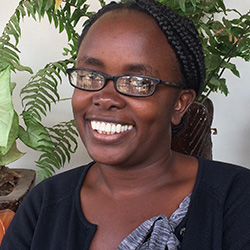
Congratulations to Dr. Irene Njuguna (PhD Candidate in UW Epidemiology; Infectious Disease Researcher, Kenyatta National Hospital) who is the recipient of the 2019 UW/Fred Hutch Center for AIDS Research (CFAR) Mentored International Investigator Award!
Dr. Njuguna’s new two-year project entitled, “Causes and risk factors for death in HIV positive adolescents and youth in Kenya,” aims to fill critical gaps in understanding cause-specific and underlying contributing factors to adolescent and young adult (AYA) deaths. Despite improvements in recent years to link HIV positive AYA to treatment and management to keep viral loads low, they remain at high risk of dying for reasons not well documented at many low-resource health facilities. (more…)
May 7, 2019
SEEMS-Nutrition seeks to measure costs and benefits of multi-sectoral food system interventions

Strengthening Economic Evaluation for Multi-sectoral Strategies for Nutrition (SEEMS-Nutrition), a new three-year project funded by the Gates Foundation and directed by Dr. Carol Levin (Health Economist and Associate Professor, Global Health), aims to fill an information gap on costs, cost-effectiveness, and benefits of scaling up food system strategies in resource-constrained areas combating malnutrition.
In the spirit of multi-sectoral collaboration, the SEEMS-Nutrition project is working in partnership with the Global Alliance for Improved Nutrition (GAIN), International Food Policy Research Institute (IFPRI), International Livestock Research Institute (ILRI) Helen Keller International (HKI), and Results for Development (R4P). Since launching in November 2018, the team is working hard to prepare the project for success.
Their findings will allow program implementers and policymakers to make informed decisions about which nutrition interventions to prioritize to address healthy food systems, dietary intake, and improved nutritional status. Such interventions can help improve maternal and child health outcomes by promoting optimal dietary and feeding practices during critical windows of time when nutritional needs are the greatest. (more…)
April 24, 2019
Can community pharmacies in Kenya improve early access to antenatal and HIV prevention care? Dr. Melissa Mugambi receives award to explore feasibility
Categories: Awards, Family Planning, HIV, Research
 In setting with high HIV prevalence, early antenatal care (ANC) visits are vital to optimize HIV testing and prevention services to reduce maternal and pediatric mortality and morbidity. Late ANC attendance limits timely identification and delivery of HIV prevention services including pre-exposure prophylaxis (PrEP) among pregnant women at high risk for HIV infection.
To fill this gap, researchers are looking for ways to encourage pregnant women to seek ANC early and improve maternal and child health outcomes. In Kenya, community pharmacies, also known as drug shops or chemists, are playing an increasingly important role as sources of over-the-counter sexual and reproductive health products, including urine pregnancy tests and HIV self-testing kits. These pharmacies offer important and under-utilized access points to ANC and HIV prevention care for women and have the potential to inform a new innovative PrEP delivery model.
Dr. Melissa Mugambi (Assistant Professor, Department of Global Health, Implementation Science Program) received a National Institutes for Health (NIH) Diversity Supplement Award to lead a study on the feasibility of engaging community pharmacy providers in the distribution of pregnancy tests and subsequent referral of pregnant women to ANC, in order to promote early access to ANC and PrEP. (more…)
March 11, 2019
Does the message matter? New award to characterize effect of Mobile WACh intervention
As more households in low-income countries own a mobile phone than have access to electricity or adequate sanitation, health care providers are progressively utilizing mobile health (mHealth) platform approaches to provide guidance and support to patients between clinic visits. Evidence shows mobile short message service (SMS) programs improve HIV and maternal-child health outcomes, but there is less understanding about the types of messages that engage recipients and the mechanisms that lead to changes in health behavior.
We are pleased to announce that Drs. Jennifer Unger (Assistant Professor, OB/GYN and Global Health) and Keshet Ronen (Clinical Assistant Professor, Global Health) are the principal investigator and co-investigator, respectively, of a UW Royalty Research Fund award to analyze participant messages, and yield an understanding of how recipients use these systems and how care seeking is impacted by SMS conversations. (more…)
March 7, 2019
Dr. Patty Pavlinac awarded UW Royalty Research Fund to examine antibiotic-resistance in enteric bacteria in children
Categories: Awards, Gut Health and Child Survival

Congratulations to Dr. Patty Pavlinac (Assistant Professor, Global Health) and her team of co-investigators, who received a competitive UW Royalty Research Fund award to study antibiotic resistance in E.coli, Salmonella, and Shigella among children in limited-resource settings. Dr. Pavlinac is co-director of Global WACh’s Gut Health and Child Survival scientific priority and is an emerging expert in pediatric enteric disease epidemiology. This new one-year project will be an extension of her ongoing research in diarrheal disease and antibiotic therapy in sub-Saharan Africa. This close examination of the genetic determinants of antibiotic resistance among recently hospitalization children in Kenya offers much needed insight into documenting the burden, risk factors, and transmission of antibiotic resistance in Kenya.
Antibiotics have revolutionized the treatment of common bacterial infections and currently play a crucial role in reducing childhood mortality. However, the alarming increase in antibiotic resistance among bacteria is becoming a global concern and it threatens to undo progress made in childhood survival. In this new project, Dr. Pavlinac and her study team will genetically characterize the antibiotic resistance patterns of bacteria isolated from the stool of Kenyan children who were recently discharged from hospitals, a population at high risk of death and re-hospitalization, as part of the ongoing NIH-funded Toto Bora trial (PI: Dr. Judd Walson). Information on prevalent resistance genes in E. coli, Salmonella, and Shigella could reveal transmission patterns of antimicrobial-resistant pathogens that spread to vulnerable communities and windows of intervention opportunities. The findings will be important to inform clinical management and strategic planning policies to reduce the burden of antibiotic-resistant infections in Kenya and across sub-Saharan Africa.
Dr. Pavlinac’s team includes a multidisciplinary team of investigators, Dr. Olusegun Soge (Assistant Professor, Global Health and Medicine), Dr. Judd Walson (Professor, Global Health, Medicine, Pediatrics, and Epidemiology [Adjunct]), Dr. Ferric Fang (Professor, Laboratory Medicine; Director, Clinical Microbiology Laboratory at Harborview Medical Center), Dr. Benson Singa (Research Scientist, Kenya Medical Research Institute [KEMRI]), and Research Assistants Stephanie Belanger (PhD Candidate in Epidemiology, UW) and Doreen Rwigi (MS Student in Microbiology, KEMRI).
February 7, 2019
New grant to discover immune mechanism responses in pediatric HIV and TB
Principal Investigators, Drs. Grace John-Stewart (Global WACh Director; Professor, Global Health, Epidemiology, Medicine, and Pediatrics) and Cheryl Day (Assistant Professor, Emory University School of Medicine, Microbiology and Immunology) received a NIH/NIAID R01 award that supports research to discover changes in immune mechanisms and markers of the Mycobacterium tuberculosis (Mtb), the pathogenic bacteria that causes tuberculosis (TB), in children exposed to or infected with HIV. (more…)
February 6, 2019
Drs. Anjuli Wagner, Irene Njuguna receive CFAR Int’l Pilot Award to engage hard-to-reach adolescents via WhatsApp
Congratulations Anjuli Wagner (Postdoctoral Research Fellow, Global Health) and Irene Njuguna (PhDc Epidemiology; Infectious disease researcher, Kenyatta National Hospital) for receiving a CFAR International Pilot Award for their project, “WhatsApp focus group and respondent-driven sampling: novel approaches to engage diverse adolescents.”
The new project will test new technology-based approaches to engage adolescents who do not typically seek HIV preventative and treatment services. This one year project will take place in Nairobi, Kenya in collaboration with Kenyatta National Hospital. (more…)
January 31, 2019
Dr. Sarah Benki-Nugent awarded UW Global Innovation Fund to launch environmental health research collaborative
Categories: Awards, Children, Environment
 Every year, the UW Office of Global Affairs’ Global Innovation Fund receives dozens of proposals from UW researchers and offers seed funding to the most outstanding projects that spark cross-continental and multi-disciplinary research collaborations, innovative study abroad programming, and more.
We are so pleased that Dr. Sarah Benki-Nugent (Clinical Assistant Professor, Global Health) and her team (listed below) is one of 20 awardees this year! (more…)
January 28, 2019
Global WACh Student Researchers Feature Posters at the 2019 Global Healthies
Categories: Awards, Research, students
On January 23rd, the University of Washington Department of Global Health held its annual Global Healthies Opportunities Fair and Poster Competition, which seeks to strengthen connections and start new collaborations for better global health impacts. It was an exciting evening with a large presence of Global WACh faculty, staff, students and colleagues engaging around our Center’s research and training opportunities.
This year, 12 Global WACh research assistants and Certificate students competed in the poster competition across four distinct categories (Discovery and Development, Education and Training, Implementation and Application, and Public Health Service and Direct Care). (more…)
Previous page Next page