


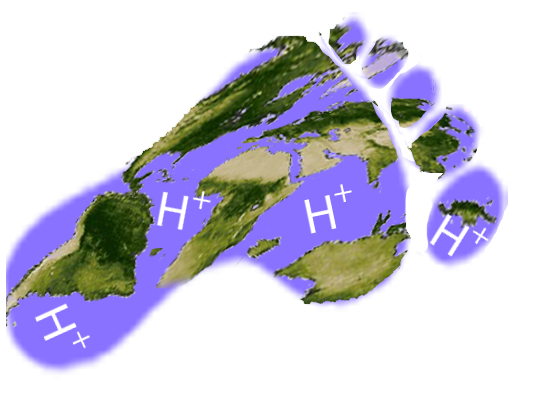
In addition to the famous impacts of atmospheric carbon on global warming, there is an equally worrisome effect of carbon dioxide on the oceans: ocean acidification (or OA for short). Here at I2SEA we have a series of resources about OA, including Our Acidifying Ocean, which is an introductory activity and virtual lab (note: now mobile compatible!).
A student suggested that we start a conversation topic about OA, and here it is! Have you heard about Ocean Acidification? If so, are you worried about it? How do you think we can best raise awareness about it among your fellow students and the general public? Have you seen particularly good links or films about OA that you would like to share? What are you doing to address the problem?
Ocean Acidification >
Ocean Acidification

Ocean acidification is a very big problem and is very dangerous for our marine organisms, such as coral, plankton and much more. Their shells and skeletons will start to dissolve in the oceans. Soon there will be no sea shells or any marine organisms. Ocean acidification is caused by carbon dioxide. Which means the more carbon dioxide the oceans absorb the more acidic the oceans get.

Hi! What you said was very interesting, I did not know all this about the ocean acidification. We really have to do something about this!!

Ocean acidification has emerged over the last two decades as one of the largest threats to marine organisms and ecosystems. However, most research efforts on ocean acidification have so far neglected management and related policy issues to focus instead on understanding its ecological and biogeochemical implications. While reducing CO2 emissions is confirmed as the key action that must be taken against acidification, some of the other options appear to have the potential to buy time, e.g. by relieving the pressure of other stressors, and help marine life face unavoidable acidification. Although the existing legal basis to take action shows few gaps, policy challenges are significant: tackling them will mean succeeding in various areas of environmental management where we failed to a large extent so far.
https://link.springer.com/article/10.10 … 013-0132-7
For the past 60 years, our atmospheric CO2 levels have been steadily increasing. Some of this CO2 gets into our oceans, and the byproduct, calcium carbonate, thins the shells of sea life. As well as creating calcium carbonate, the CO2 turns the ocean more acidic. The pH scale also happens to be logarithmic, much like the Richter scale. Stanford estimates that the ocean's pH level will drop to a bit under 8.0 in 30 years, an increase of almost 150%! The increase is occurring much faster than I had previously thought, and I'm hoping that awareness can be spread.
References:
http://i2sea.stanford.edu/AcidOcean/AcidOcean.htm
https://www.whoi.edu/oceanus/feature/sm … n-acidity/
I agree with you guys, Ocean Acidification is a huge problem that my generation, Gen Z needs to put our heads together to fight against the progression of this epidemic. I will be discussing this topic in two separate posts, the first is to explain the problem, and the second is to try and form a plan of attack. To start, let's answer the question of, "What even is Ocean Acidification?". Ocean acidification occurs when CO2 from the atmosphere is absorbed into the ocean. At first glance, scientist thought that this occurrence is a good solution to the greenhouse effect because at least one less greenhouse gas is being emitted into the atmosphere. In actuality this is a danger to the marine life in such oceans because when CO2 is absorbed into water it turns into acid. This acid pollutes the water harming sea life such as oysters, coral, clown fish and sea urchins. The acid dissolves the calcium in the shells of the shellfish and it damages the senses of some of the marine animals. This fatal for marine life because it is making many shellfish vulnerable to their predators. This results in the foodchain being disrupted. We have to make a move!(1/2)
https://oceanservice.noaa.gov/facts/acidification.html
Ocean Acidification is becoming an increasingly huge problem. In the years since the begin of the Industrial Revolution, according to National Oceanic and Atmospheric Administration, surface ocean waters have had a 30% increase in acidity. Due to the increase of carbon dioxide, mainly coming from the burning of fossil fuels, more of this carbon dioxide is getting trapped in the ocean leading to a higher amount of hydrogen ions. From the online lab, "Our Acidifying Ocean," these hydrogen atoms bonding with the carbon dioxide creates carbonic acids which break down carbonate- something necessary for calcifying organisms (organisms that have shells or exoskeleton) to make their shells. This makes it increasingly hard for these organisms that rely on it to make their shells as carbonate is getting harder and harder to find. This is so detrimental to our ocean life as many of them do need to use this carbonate to make their shells, leading to weaker shells and slower growth for them. It was said by the National Oceanic and Atmospheric Administration, "by the end of this century the surface waters of the ocean could be nearly 150% more acidic." Clearly, change needs to start as soon as possible as this is such a huge problem and is absolutely terrible for the organisms living in our oceans.
Sources:
https://www.noaa.gov/education/resource … dification
https://depts.washington.edu/vurchin/?view=acidocean
In addition to the explanation of Ocean Acidification, here is my plan of attack. Let's start of with naming the 3 most common human causes of Ocean Acidification. The main things humans do that result in CO2 emission into the atmosphere include, deforestation, the burning of fossil fuels, and car gas pollution. We can attack these problems by first finding an alternative to deforestation, enforcing a law/movement where people are required to recycle their paper, which could then be taken to a treatment plant to be recycled into newer paper. Another solution to this could be creating dedicated tree farms for paper so that we could manage how much is being cut down and try to lower it with fewer problems. The next problem includes the burning of fossil fuel. An example of fossil fuels being burned would be them being used to create power for your home or driving your car. An alternative to these things could be converting to solar power. Another alternative could be taking the city bus, riding a bike to school, or carpooling. All of these options lower the emission of CO2 by either sharing with each other to lower or completely eliminating the use of fossil fuels in the first place. Finally, the last problems is car gas pollution. To Americans, especially in my community, the Bay Area, cars are essential to life by getting around. The problem with this is that cars release bas gases such as CO2 into the atmosphere. An alternative to gas burning cars could purchase electrical cars such as a Tesla or a less pricey, BMW i3. By doing this, one is still able to use a car, just subtracting the dangerous and harmful CO2 emissions that come along with it. Thank you so much for reading and allowing me to post my ideas on this discussion. Don't be afraid to join too! We can all join hands together in helping stop Ocean Acidification!
https://cars.usnews.com/cars-trucks/che … ctric-cars
https://climateinterpreter.org/content/ … dification