Contributed by: Steven J. Rockoff, MD and Diana L. Lam, MD – June 1, 2020
Question 1
A 67-year-old woman presents for a screening mammogram:


Representative magnified images are shown here:
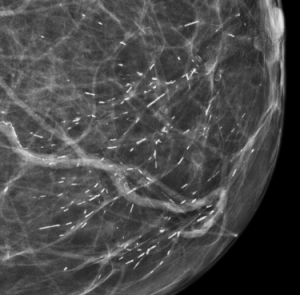

What is the dominant type of calcification that is present bilaterally?
A. Fine pleomorphic calcifications
B. Large rod-like calcifications
C. Vascular calcifications
D. Fine-linear branching calcifications
E. Skin calcifications
Answer
B. Large rod-like calcifications
Explanation: Large rod-like calcifications, also known as secretory calcifications, are benign calcifications associated with duct ectasia and are almost exclusively seen in post-menopausal women. They are often present in a bilateral diffuse distribution, as seen here. Large rod-like calcifications are thicker and larger than the similar-appearing fine linear or fine-linear branching calcifications, which are considered suspicious.
Note the difference between the large rod-like calcifications and the patient’s separate vascular calcifications shown here:
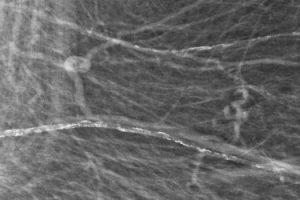
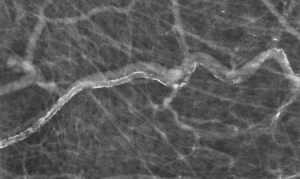
Also note the far posterior intramammary lymph node in the left image.