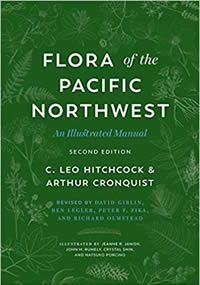
 For Pacific Northwest botanists of all levels, the one-volume book informally known as “Hitchcock” has been standard equipment since its publication in 1973. This work, “Flora of the Pacific Northwest: An Illustrated Manual” by C. Leo Hitchcock and Arthur Cronquist, was intended as a field version of the five-volume flora “Vascular Plants of the Pacific Northwest,” written by the same authors with two additional botanists and two illustrators from 1955-1969.
“No scholarly endeavors are immune to the advancing frontiers of knowledge.” This quote is from the introduction of the new, second edition of the one-volume “Flora,” expanded by a team of four editors with three new illustrators. Changes in taxonomy, especially from molecular studies, plus newly described taxa and the establishment of non-native species (which this flora includes) have created a long overdue need for an update.
In the 45 years between publications, there has been a nearly 25% increase in the number of taxa included, the biggest single reason being “the establishment, or detection, of additional exotic taxa within our area.” While this work does not introduce any new names or classifications, just keeping up with widely accepted taxonomic changes has resulted in over 40% of the listings in the first edition having a new genus and/or species name, or being placed in a different family.
Hitchcock was a long-time professor of botany at the University of Washington. He was also a gardener, and many references remain in the 2nd edition regarding the ornamental qualities and garden adaptability of the subjects.
These include the observation that the incense-cedar (Calocedrus decurrens) is a fine ornamental tree, and that “trilliums are rather easily grown, and T. ovatum in particular is an excellent garden pl [plant], but it is a shame to dig them in the wild, esp [especially] since they grow readily from seed.” This urging of conservation (as well as the use of abbreviations) is a repeated theme: “The lilies are a constant temptation to the avaricious gardener, but our spp. [species] rarely thrive in cult [cultivation] and should not be removed from the wild.”
Like the first edition, this book attempts to be comprehensive in its presentation of species, subspecies, and varieties throughout Washington, much of Oregon and Idaho, the western part of Montana, and southern British Columbia. The first edition introduced the new (at the time) idea of embedding the species descriptions and illustrations within the taxonomic keys. This proved to be a good decision. It has remained a best-seller for the University of Washington Press for the last four decades.
At 882 pages (the first edition had 730), it is perhaps a bit hefty for field work, but this is a must for your home garden library. The aforementioned use of abbreviations keeps it from becoming even bigger, and this is a bit of a challenge for reading at first. But after a while, this shorthand becomes familiar. The Miller Library has a lending copy of the new edition, and keeps non-circulating copies of both editions and the earlier volumes of “Vascular Plants.” Be sure to take a look at this new standard for our regional botany!
Excerpted from the Spring 2019 Arboretum Bulletin.
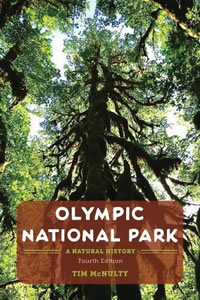 “Olympic National Park: A Natural History” was first published in 1996. Author Tim McNulty and University of Washington Press have now come out with the fourth edition (2018). It’s no wonder this book has been so popular. McNulty is an excellent essayist and the subject is a mostly unspoiled, large-scale ecosystem, from seashore to mountaintops, the latter easily seen on a clear day from Seattle.
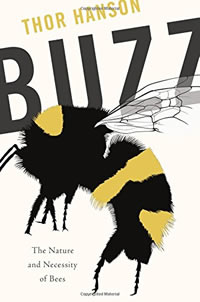 I was very impressed with the story-telling skills of Thor Hanson that I discovered when reading his “The Triumph of Seeds” (see review in the Fall 2015 issue of the “Bulletin”). He makes scientific research easy to understand and an adventure that’s fun!
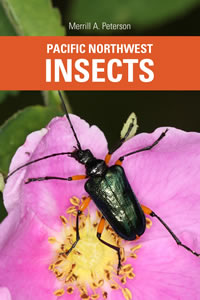 Fascinated by all the small life forms you find in your garden? Perhaps not, but it is still valuable for gardeners to know about them. “Pacific Northwest Insects” by Merrill Peterson will help. This excellent new field guide provides incredible color photos of over 1,200 species native to our region. The scope is the phylum Arthropoda, so this includes all the true insects (bees, beetles, butterflies, flies, etc.) plus centipedes, sow bugs, spider mites, and even spiders and ticks (yikes!).
![[The Brother Gardeners] cover](https://depts.washington.edu/hortlib/graphix/brothergardeners.jpg)
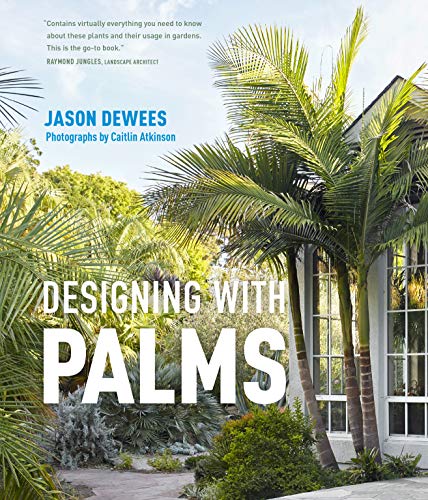 “Designing with Palms” by Jason Dewees is by a San Francisco based author, who profiles garden motifs evoked by palms across the country. For instance, Chamaerops humilis suggests a Mediterranean garrigue, an ecosystem with low shrubs, including rosemary and lavender, like one might find in a Seattle landscape.
![[The Organic Profit] cover](https://depts.washington.edu/hortlib/graphix/organicprofit.jpg)
![[Flora of Middle Earth] cover](https://depts.washington.edu/hortlib/graphix/floraofmiddle-earth.jpg)
![[Flora of the Pacific Northwest] cover](https://depts.washington.edu/hortlib/graphix/floraofthePacificNorthwestfull.jpg)