Anti-Chinese Violence 1850-1910 (maps and timeline)
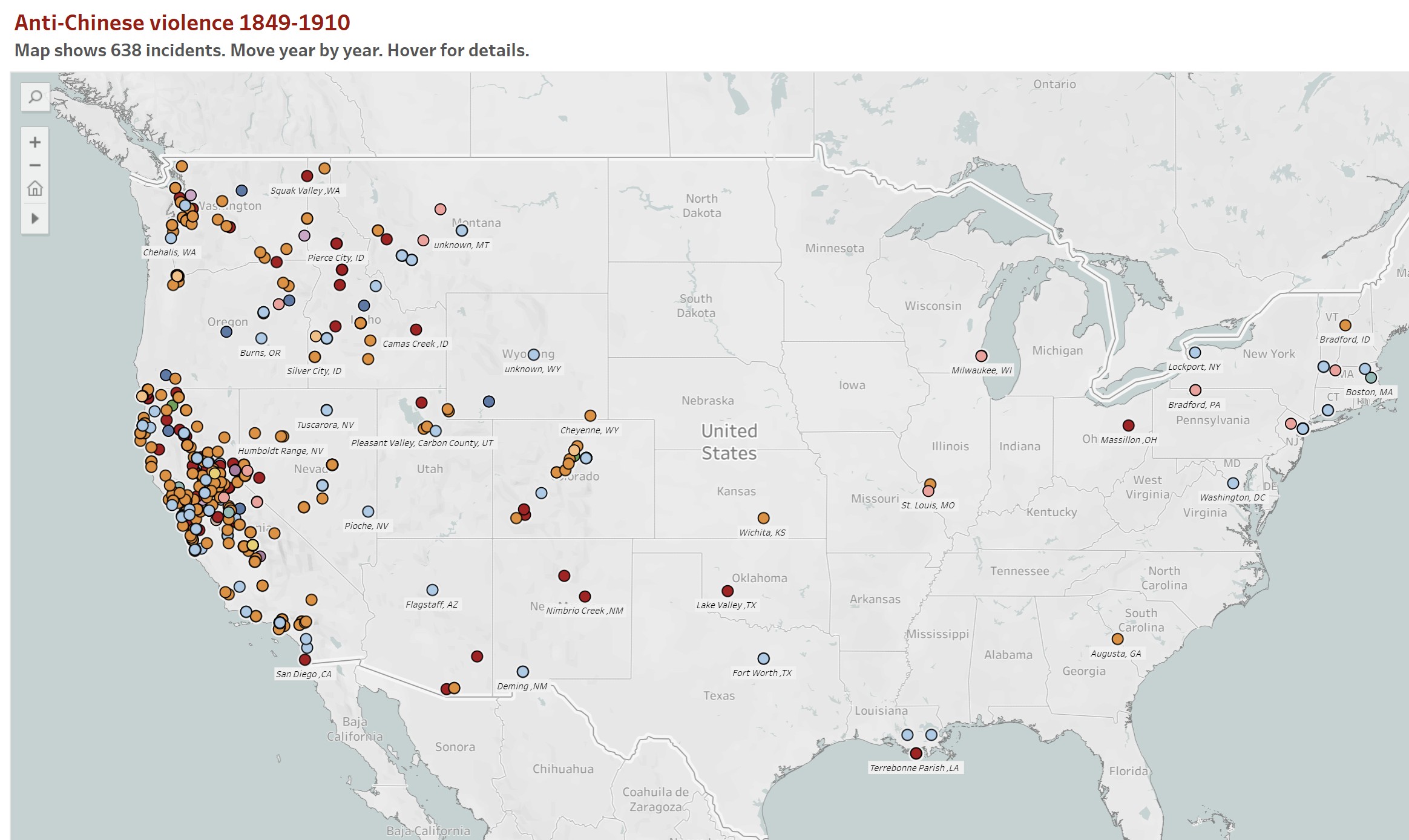
see searable map below
by Nicholas W. Mason, PhD
When the first Chinese immigrants arrived in the United States in large numbers during the California Gold Rush, they found not only abundant economic opportunity, but also violent racial hatred. Racism, nativism, and perceptions of economic tensions combined to produce a complex system of racial violence that spanned the region and the nation and culminated with lynchings, forced removals, and massacres.
This project maps and documents more than 600 episodes of anti-Chinese violence in the United States; incidents that claimed hundreds of lives. They feature research from the author's forthcoming book, The First Border: Anti-Chinese Violence in the United States, University of Illinois Press.
Mapping Lethal and Nonlethal Anti-Chinese Violence
The earliest cases of racial violence against Chinese immigrants in the U.S. and its territories known to this project occurred in the 1850s, almost immediately after the first large-scale wave of Chinese immigration began. Patterns of Chinese immigration and the resultant anti-Chinese violence changed after the early 20th century when the effects of immigration restriction became more pronounced. As such, although racial violence did not end after 1910, this project nevertheless focuses on the six decades between 1850 and 1910.[Continue introduction below maps]
These maps and charts allow you to filter for “lethal” and “nonlethal” incidents and move year by year through the timeline of violence. Click on each location for details.
Move between maps, timeline, and graphs using the tabs below
Data-Driven Insights
This project reveals a number of quantitative insights, including:
At least 815 victims killed 1850-1910
99.8% killed before 1900
likely at least 1% of the total Chinese population throughout this period
At least 518 separate incidents with surviving victims
More than 10% of the total Chinese population experienced physical racial violence
Violence generally increased up to 1880, and then decreased after 1890
At least 27 U.S. states and territories experienced at least one violent incident
More than 350 distinct locations identified
Furthermore, consideration of the project’s qualitative data reveals even more about this history. For example, many of these cases were forced removals, where perpetrators used physical violence to expel Chinese immigrants from their communities and industries. This is evidence that this historical system of violence was an exclusionary one, based not on racial subordination but on expulsion, which makes it importantly distinct from other contemporary systems of racial violence. Many cases were also motivated by economic tensions; this highlights the violent labor struggles between Chinese and white laborers that were often connected to violence.
Most, but not all of the victims killed were men. The biggest reason for this is that men made up most of the Chinese immigrant population, but as more women began to immigrate later on, they became victims of expulsions and murders as well. Gendered prejudices were a major part of anti-Chinese nativist philosophy that enabled historical violence.
Although many of the perpetrators of anti-Chinese violence were white or otherwise Anglo-European, many were also members of various Native American nations. This shows that even as the national Chinese exclusion movement was mounting, other violent conflicts were unfolding that, although their motivations were different, were no less systemic. The 19th century U.S. West was a violent place, and violent conflicts often unfolded along racial lines
Temporally and geographically, this history shows explainable progressions. As the Chinese immigrant population grew and spread eastward across the continent, so did the anti-Chinese movement and resulting violence. Likewise, as attitudes towards violence shifted around the turn of the century, violence both declined and transformed. Ultimately, this story is not one with a beginning and an end, but rather one of trajectories, transformation, and resistance.
Conclusion
Although the search for historical cases of racial violence may never end, it is the editor’s hope that illumination and exploration of these histories can provoke thought and inspire action among present-day readers. For further reading, please consult the editor’s forthcoming monograph, The First Border: Anti-Chinese Violence in the United States, University of Illinois Press.
Sources and methods
This project’s lethal data includes Chinese victims who perished as a result of racial violence, which this project defines as violence committed by non-Chinese perpetrators. Likewise, the project’s nonlethal data includes cases of racial violence with Chinese victims who did not perish as a result. Ethnicity is determined by primary and secondary sources; although it is possible that a source has misidentified a victim, the editor has determined the cases listed to be credible. The project attempts to take an approach that is both quantitative and qualitative, and lists cases that include white perpetrators as well as other ethnicities, including Native Americans. Although racial violence against Chinese perpetrated by whites was undoubtedly different in cause from that perpetrated by Native Americans, this spreadsheet does not separate them. Instead, it only seeks to provide these cases for readers to draw their own conclusions. Incidents that sources have included as an example of anti-Chinese racial violence but have not elaborated on perpetrators’ identities have been attributed to the generic “anti-Chinese nativists.”
“Lethal” data includes murders, fatal lynchings, and other incidents of racial violence where Chinese victims perished intentionally or otherwise. Cases that cannot be reasonably determined to have included Chinese victims who died or non-Chinese perpetrators have been omitted. “Nonlethal” data includes assaults, forced removals, property destruction, nonfatal lynchings, and other incidents of physical violence against Chinese in the U.S. Cases such as boycotts, anti-Chinese resolutions, and other incidents that the editor could not prove had a tangible, physical impact on Chinese individuals have been omitted. Cases where the existence of purposeful violence is unclear, such as fires on Chinese property that could possibly have been arson but cannot be reasonably determined, have also been omitted.
These datasets only include what might be called "popular" or "extralegal" violence. "Legal" executions or summary executions performed by the state or state actors, such as on-duty, formally-appointed law enforcement, have been omitted. Likewise, nonlethal cases such as "legal" police violence, arrests, imprisonments, and deportations or refused entries performed by the state or state actors have been omitted. Conversely, cases such as extralegal, off-duty police brutality have been included when possible. This list only includes cases known to the editor that fit the aforementioned qualifications, and should not be considered complete or exhaustive.

 see searable map below