
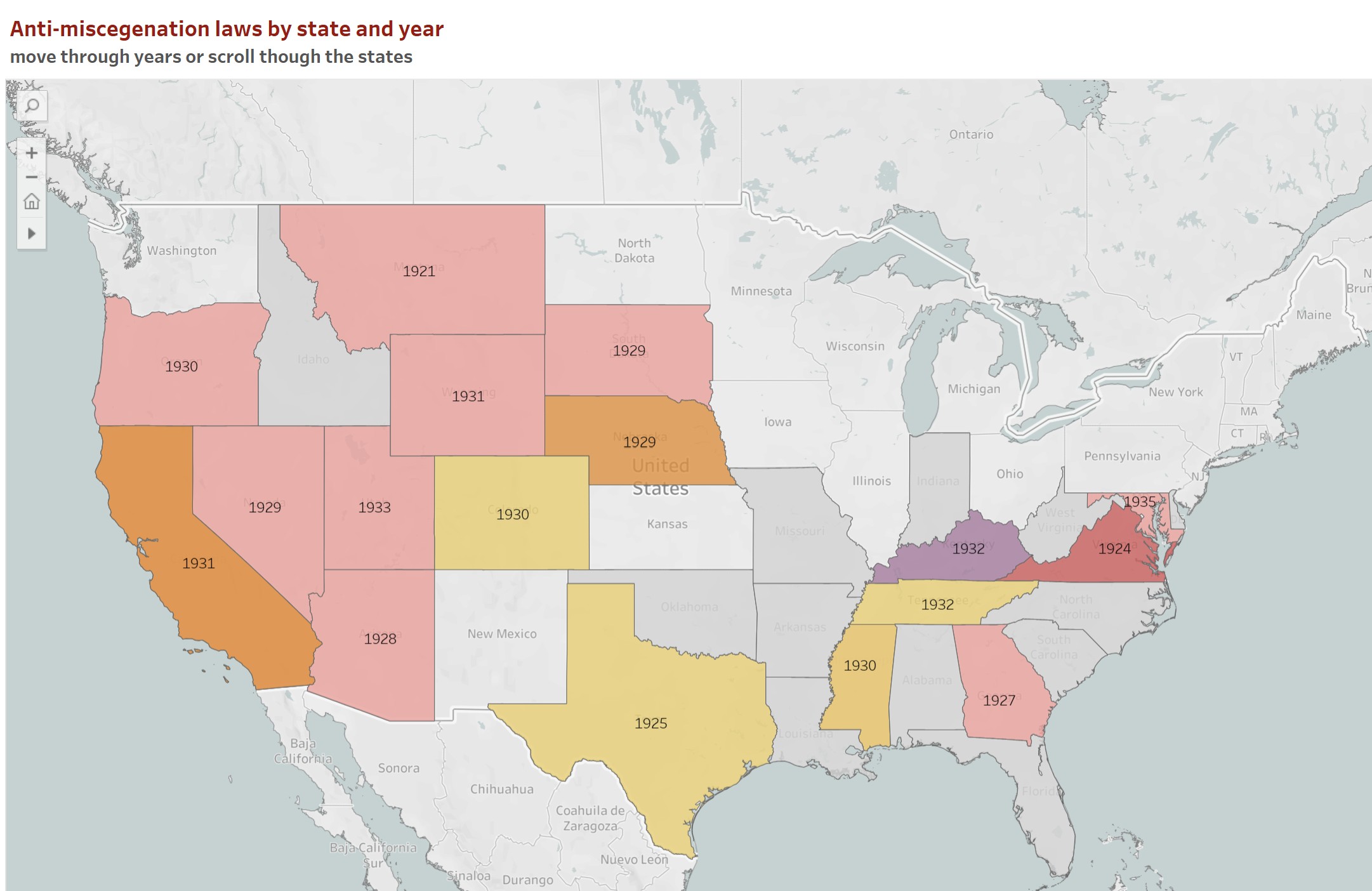
 New legislation enacted 1920-1939. See interactive map below
The colonies of Virginia and Maryland enacted some of the first laws banning marriages between persons deemed White and those deemed Black in the 1600s. Over the next three centuries, especially after the Civil War, anti-miscegnation laws were enacted in all but nine states. Not until the Supreme Court ruled in the 1967 Loving v. Virginia decision did the practice of restricting marriages on the basis of race end.
The interactive maps below trace the history and geography of anti-miscegnation legislation showing state by state and year by year, laws as they were enacted, modified, and repealed. They reveal some surprises. Most of this racist legislation was designed to prevent White and Black persons from marrying, but many states also banned white-Asian and White-Native American marriages, and the penalties for violation could be serious. Mississippi in 1865 threatned life imprisonment.
The maps and timeline show the rhythms of anti-miscegenation law-making as legislatures responded to waves of white supremacy and racial exclusion movements. Laws were sporadic before 1850 and then became popular in the newly opened western territories, including the anti-slavery states/territories of Iowa, Kansas, Nebraska, Colorado, Nevada, and Utah. The defeated Confederate states passed marriage laws immediately after the war then restored them after Reconstruction governments temporarily repealed them. By 1895, every state in the South and many states in the West had enacted tough restrictions, while in the same era many states in the Northeast and Midwest repealed theirs.
A new wave of legislation followed in the 20th century, much of it the West where anti-Asian movements sponsored new laws or broadened old laws to prohibit marriages between whites and Chinese, Japanese, South Asians and Filipinos.
Repeals had stopped in 1887 and did not resume until 60 years later when the California supreme court overturned laws that been in place since 1880. Other western states followed suit over the next twenty years, so that by 1966, anti-miscegenation laws remained in place in every state where slavery had been legal in 1860 and in none of the states where it had been illegal. The solid South resisted until the Supreme Court made them stop enforcing racist marriage bans in 1967.
Sources: This project honors the memory of Peggy Pascoe, whose pioneering book What Comes Naturally: Miscegenation Law and the Making of Race in America (2009) inspired the further research reflected in these maps. In addition to her book, data comes from Wikipedia’s “Anti-Miscegenation Laws in the United States” (accessed in May 2026). Other entries were drawn from Americans All, and The Loving Day project, state encyclopedias, and other online sources.
