
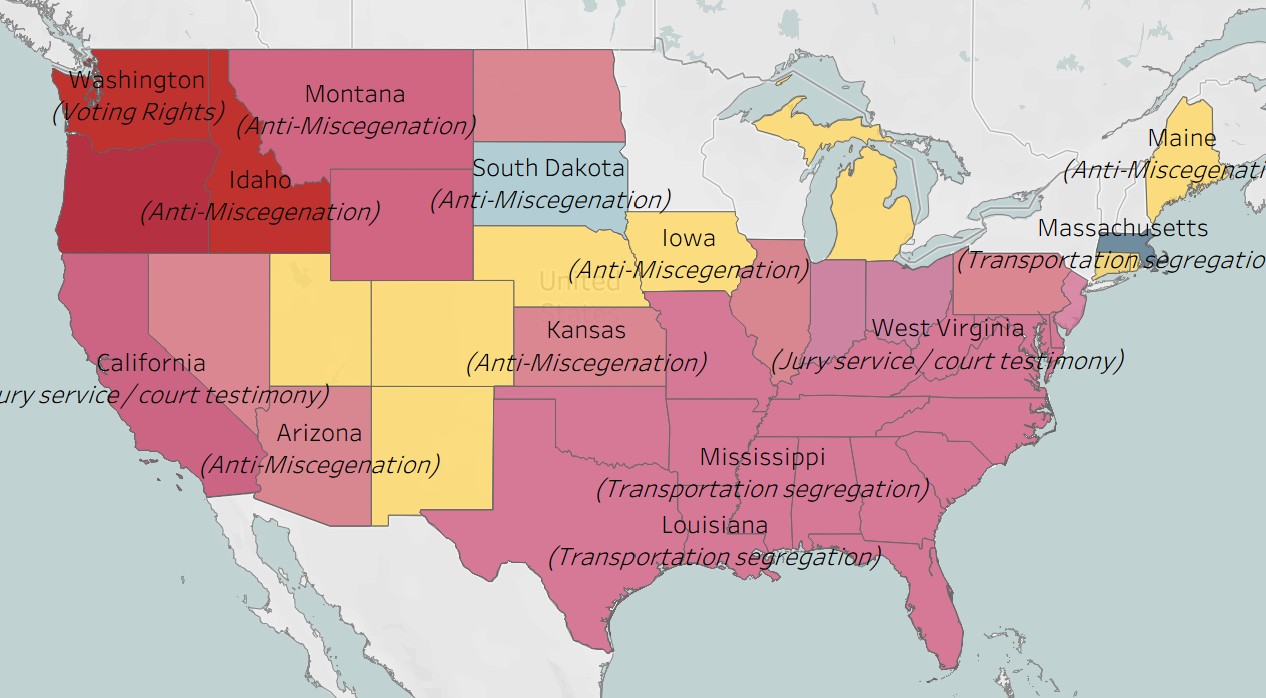
 see interactive map below
by Emma Mantovani
The term "Jim Crow" conjures particular images: separate water fountains, "Whites Only" signs, the Deep South in the decades after Reconstruction, as well as the notorious Jim Crow minstrel figure. These maps, however, broaden the definition of Jim Crow to encompass all laws intended to enforce White supremacy and subordinate non-White populations.
Behind these maps lies a dataset of more than 430 documented laws, statutes, constitutional provisions, and ordinances enacted by 43 states and the federal government, spanning from 1692 to 2000. The laws cover anti-miscegenation statutes that made interracial marriage a felony, school segregation codes that sorted children by race, alien land laws that stripped Asian immigrants of the right to own property, voting requirements designed to exclude anyone who wasn't White, and alcohol use laws that targeted Indigenous Americans. The victims were Black Americans, who appear in the data most frequently, but also Chinese, Japanese, Korean, Filipino, and South Asian Americans; First Americans; Mexican Americans; and others classified as non-White.
The geography alone contradicts the idea that these laws were a Southern problem. California enacted 18 documented racial subordination laws between the mid-nineteenth century and 1947, with more legislation aimed at Asians than at Black Americans, including a constitutional provision barring any native of China from ever exercising the right to vote. Oregon's original state constitution explicitly prohibited Chinese persons from owning land or mining claims, naming the ethnic group directly rather than using the coded phrase "aliens ineligible for citizenship" that other states preferred. Washington Territory passed an ordinance in 1865 banning Indigenous Americans from living within Seattle's town limits, on land those same peoples had ceded to the United States just ten years earlier. Montana, Nebraska, Wyoming, Utah, and Nevada all had anti-miscegenation statutes on the books. Massachusetts is where the term "Jim Crow law" was coined, in 1841, in reference to a railroad segregation statute requiring separate cars for Black passengers.
The timeline is equally difficult to reconcile with the standard narrative. Anti-Black laws in the North and West predate Reconstruction, and California barred Black, Indigenous, and Chinese residents from testifying in court against White men as early as 1850. A federal ban on selling alcohol to Native Americans had been in force since 1802 and remained on the books for twenty years after national Prohibition was repealed for everyone else in 1933. Laws banning interracial marriages were introduced in the several colonies in the 1600s and then reintroduced in more states after independence. Fourteen states had passed anti-miscegenation statutes before 1850, many of them in the North.
The laws in this dataset span 16 distinct categories, including anti-miscegenation, school segregation, railroad and transportation segregation, voting rights restrictions, public accommodations, property and housing, health care, employment, and criminal justice. Penalties ranged from fines to felonies carrying up to a decade in state prison. Some laws were struck down by courts well before federal action caught up. Others lingered long after they were legally unenforceable. Alabama did not remove its anti-intermarriage provision from its constitution until 2000, thirty-three years after Loving v. Virginia. West Virginia kept its school segregation clause in its constitution until a voter referendum removed it in 1994, forty years after Brown v. Board of Education.
Sources: These maps are mostly based on Wikipedia’s “List of Jim Crow law examples by state” and should be regarded as a companion to that valuable open access article. Data were accessed in May 2026. Other entries were drawn from Americans All, Hathi Trust, Ferris State University Jim Crow Museum, and other online sources. Two books were also important: Pauli Murray, States' Laws on Race and Color (1950); Peggy Pascoe, What Comes Naturally: Miscegenation Law and the Making of Race in America (2009)
