
This proof-of-concept research initiative evaluated the benefits, limitations, and tradeoffs of implementing Internet of Things (IoT) digital twin (DT) technologies for managing, maintaining, and operating bridge assets. Led by the University of Washington in collaboration with the Washington State Department of Transportation (WSDOT), the collaborative project included multiple industry partners.
A digital twin is a computational model of a real-world physical object, system, or process that serves as a digital counterpart of the actual object. By combining data from sensors, AI, and software models, it creates a continuous feedback loop that allows users to monitor performance, run simulations, and conduct testing and maintenance.
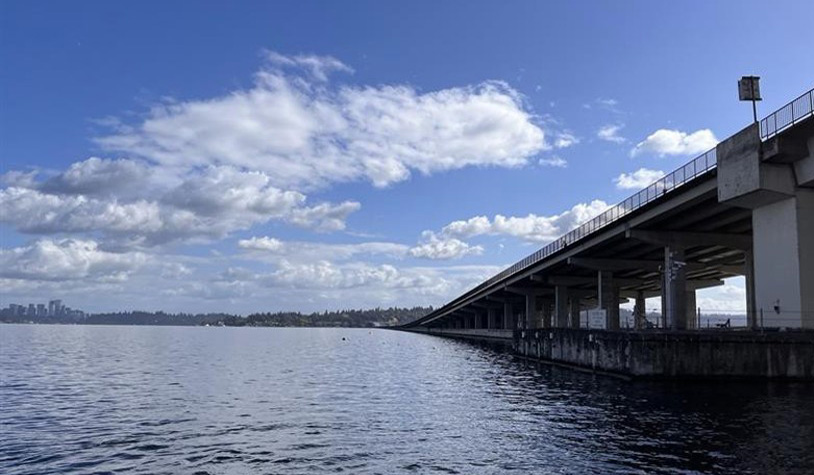
This project’s objective was to develop and implement a functional digital twin system for critical bridge infrastructure under real-world conditions to demonstrate how IoT sensors, cloud computing platforms, and advanced analytics can improve monitoring of bridge health and operational decision making. The project was installed on the I-90 Homer M. Hadley Memorial Bridge in Seattle, a floating bridge that carries not only vehicles but also light rail.
In the lab, researchers successfully connected IoT sensors to Microsoft’s Azure Digital Twins platform. They co-created an instrumentation plan with WSDOT bridge engineers and maintenance crews. They then installed IoT sensors at select bridge locations and created a functional DT model with data stream visualization and alert capabilities. Twelve months of collected bridge data captured full seasonal variation.
With the system operating stably and data flowing reliably, WSDOT maintenance teams have direct access to the digital twin platform and are using it for enhanced bridge condition insights, such as monitoring the submerged cables that hold the bridge. Demonstrating broader applicability and multi-agency application, the system has also proved useful to Sound Transit for cathodic protection monitoring and analysis of pontoon positioning for the bridge’s light rail system.
Important technical challenges included integrating older sensing equipment with modern IoT hubs; lack of standardization among competing management protocols and frameworks; cybersecurity considerations given multiple cloud storage solutions and system interfaces, which required coordination with WSDOT IT and the Department of Homeland Security; and budget constraints that required reuse of legacy equipment, necessitating creative workarounds and limiting sensor placement options.
Despite the challenges, the project successfully demonstrated that digital twin systems can be developed and deployed in the context of real-world bridge infrastructure, delivering operational value to transportation agencies. The project revealed that successful implementation depends equally on technical integration and organizational alignment. By addressing both dimensions—establishing clear communication channels between informational and operational technology teams, securing early stakeholder buy-in, and demonstrating tangible benefits through actual data—transportation agencies can effectively adopt DT technologies to enhance asset management, safety, and operational efficiency.
Authors:
Barton G. Treece, III, UW Mobility Innovation Center
Travis Thonstad, UW Department of Civil and Environmental Engineering
Carrie Sturts Dossick, UW Department of Construction Management
Timothy Bernard, UW Department of Civil and Environmental Engineering
Orgil Borjigin, UW Department of Construction Management
Sponsors:
FHWA
State Transportation Innovation Council (STIC)
WSDOT
Innovative Bridge Technologies/Accelerated Bridge Construction University Transportation Center
Challenge Seattle
Partners:
Microsoft
WSP USA
Bentley Systems
T-Mobile
Semtech
WSDOT Technical Monitors: Zachary Reid
WSDOT Project Coordinator: Mustafa Mohamedali