
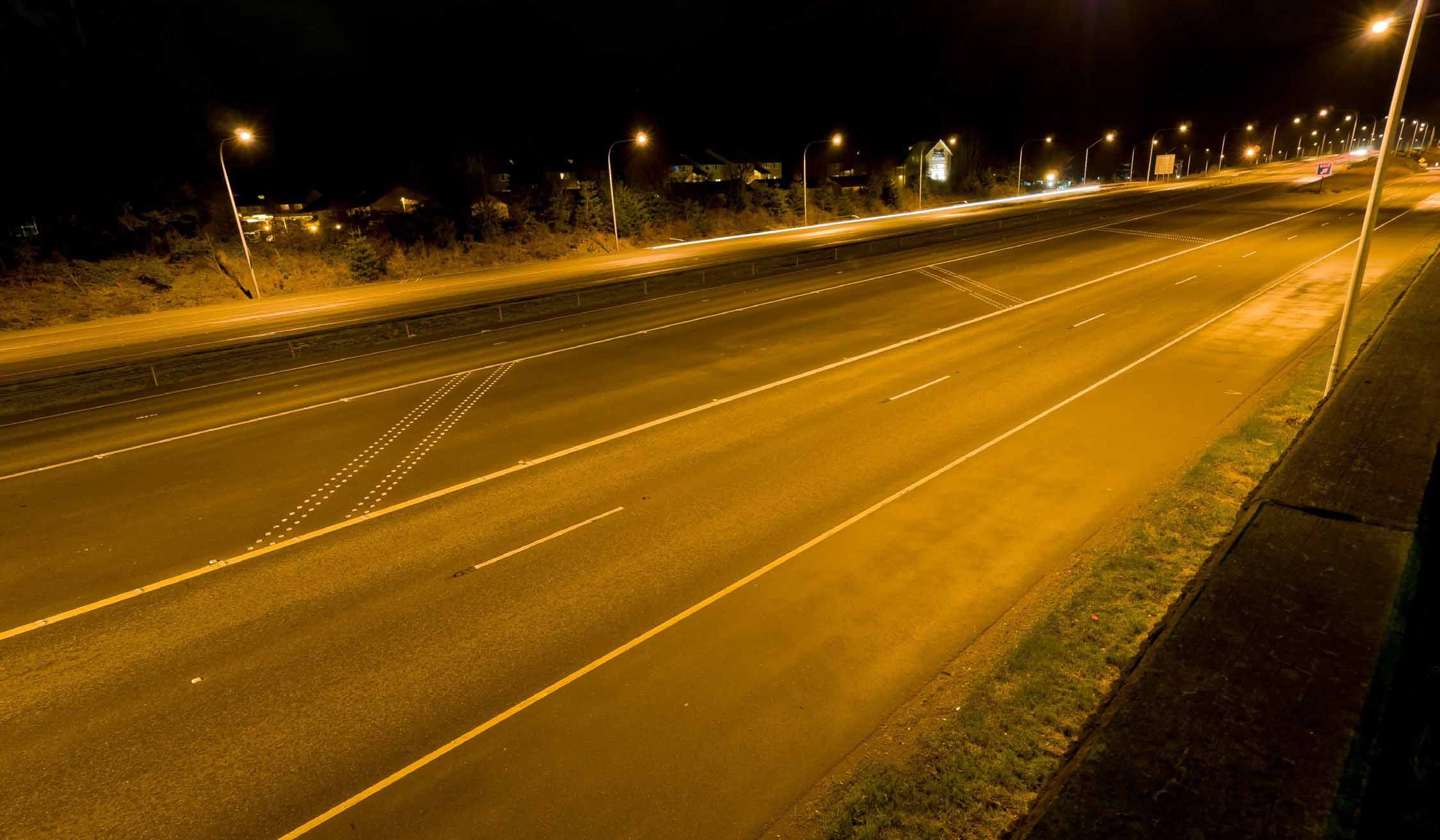
Adaptive roadway lighting has received increasing attention as a way to both improve safety and avoid over-lighting. This project developed and tested a real-time adaptive lighting method that is responsive to data from multiple sources and looks promising for both increasing safety and saving energy.
Roadway lighting is one effective way to enhance safety for drivers, as street lights provide sight beyond the field of view of a vehicle’s headlights. Adaptive lighting schemes adjust and control roadway lighting, at the level of each luminaire, on the basis of real-time data such as traffic volumes and weather conditions. Recently, the state departments of transportation in Washington and Oregon improved portions of their roadway lighting facilities to include new light-emitting diode (LED) luminaires, which are both more energy efficient and brighter than conventional lighting. Although the states are not currently adjusting light levels, the new luminaires are capable of adaptive control through a central system.
The researchers developed an adaptive lighting methodology on the basis of a thorough review of the literature and data collected in Washington state from the LED luminaire sites. They considered multiple types of data, including traffic, weather, and crash data. The resulting method considers real-time, multi-source data and is based on best practices and operational requirements that ensure timely responsiveness, appropriate lighting level, and uniformity. The methodology also includes an active traffic management component that supports the provision of advisory messages based on the same input data.
The researchers also developed an adaptive lighting simulation platform and used it to compare the utility and energy consumption of the new methodology with those of other common adaptive and conventional lighting schemes. Average brightness and uniformity affect the ability of drivers to detect potential hazards, and the study’s definition of utility included level of brightness and average vehicle stopping distances. The results of the simulations were that the utility of the new lighting method was comparable to that of existing adaptive methods and that energy savings was higher.
WA-RD 889.1
Authors:
Yinhai Wang
Zhibin Li
Hao Yang
Kristian Henrickson
John Ash
UW Department of Civil and Environmental Engineering
Haizhong Wang
Chen Chen
Shangjia Dong
OSU School of Civil and Construction Engineering
Sponsors:
PacTrans
WSDOT
WSDOT Technical Monitor: Ted Bailey
WSDOT Project Manager: Doug Brodin