by Jennifer Frost
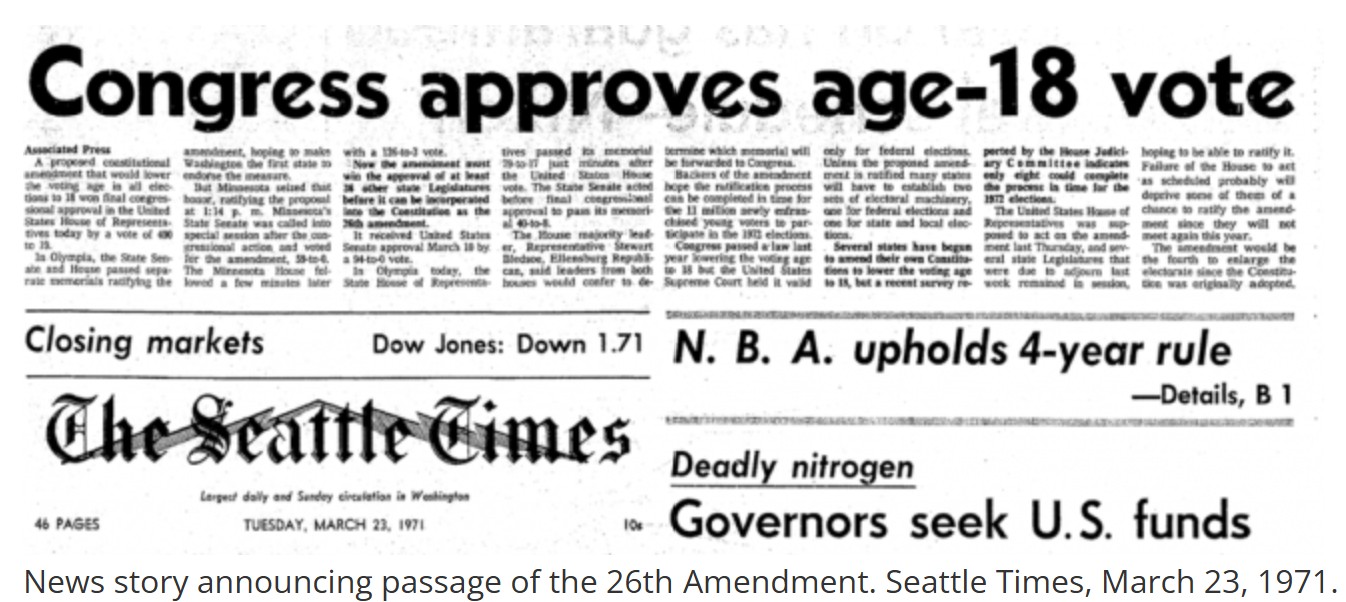 Seattle Times March 23, 1971 (courtesy Washington Secretary of State)
Although the power to determine voter qualifications and election regulations belongs first to the states, the US Constitution also grants a role for the federal government. Article 1, Section 4 states: “The Times, Places and Manner of holding Elections for Senators and Representatives, shall be prescribed in each State by the Legislature thereof; but the Congress may at any time by Law make or alter such Regulations….” Historically, Congress had stepped in. Before the 26th Amendment, five constitutional amendments related to elections and voting had been passed by Congress and ratified by the states. The 15th Amendment (1870), the 19th Amendment (1920), and the 24th Amendment (1964) prohibiting the denial of voting rights on the basis of race, sex, and failure to pay poll tax. The 17th Amendment (1913) providing for the direct election of Senators, and the 23rd Amendment (1961) enfranchised residents of the District of Columbia for presidential elections.
Proponents of youth voting rights at the federal level drew on Article 1, Section 4 and the precedent set by earlier suffrage amendments to push for the 18-year-old vote. Over a thirty-year period, presidents and members of Congress worked to convince their congressional colleagues, as well as their fellow citizens. In 1969, the Youth Franchise Coalition formed to provide leadership and lobbying for federal action as well as to facilitate communication among state-level campaigns. The coalition included the National Education Association and its Project 18, the NAACP, the US National Student Association, the Young Democratic Clubs, the YMCA and YWCA, the AFL-CIO, and others. Over these years, the opposition to federal action to lower the voting age stood strong, refusing to allow debate in the House of Representatives or pass legislation through the Senate when it came up for debate and a vote in 1954.
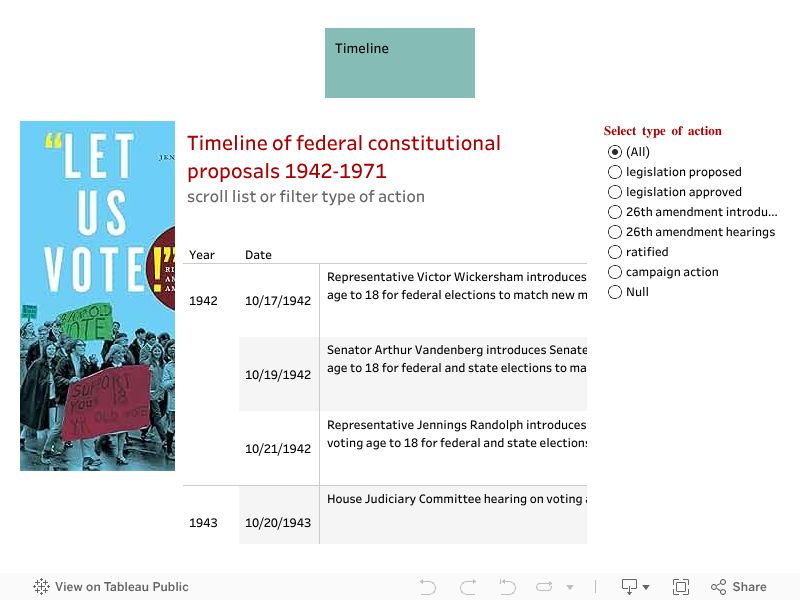
That is, until the events of 1970. That year, proponents included the right to vote at 18 in the Voting Rights Act of 1970. But the Supreme Court in Oregon v. Mitchell (1970) only upheld the 18-year-old vote for federal elections, revealing the need for a constitutional amendment. Jennings Randolph, a Democrat from West Virginia, had long believed an amendment was necessary. Over his long political career as a member of the House of Representatives and then of the Senate, he proposed eleven joint resolutions for a constitutional amendment to lower the voting age, starting in 1942 and finally succeeding in 1971. For this achievement, Randolph is known as the “Father of the Twenty-Sixth Amendment.” This timeline is hosted by Tableau Public and may take a few seconds to respond. If slow, refresh the page.