
Accurate information about parking availability at truck rest areas, weigh stations, and private truck facilities is essential for making freight trips more efficient and safer. Truck parking information management systems (TPIMS) are intended to help monitor, identify, and broadcast the real-time availability of truck parking stalls to commercial vehicle operators. This study developed a framework for improving TPIMS by better detecting anomalies in collected parking data and better calibrating counting systems to improve the reliability of truck parking occupancy information.
By collecting data on open and occupied parking stalls and sharing that information, TPIMS are meant to maximize the utilization of truck parking facilities. However, the data must be accurate. Many TPIMS rely on sensors that count trucks moving in and out of lots to estimate parking occupancy. But while the use of in/out counting sensors is cost-efficient and scalable, they may accumulate counting errors over time as a result of missed detections, irregular parking behavior, or environmental conditions. These errors can significantly reduce the reliability of reported parking availability.
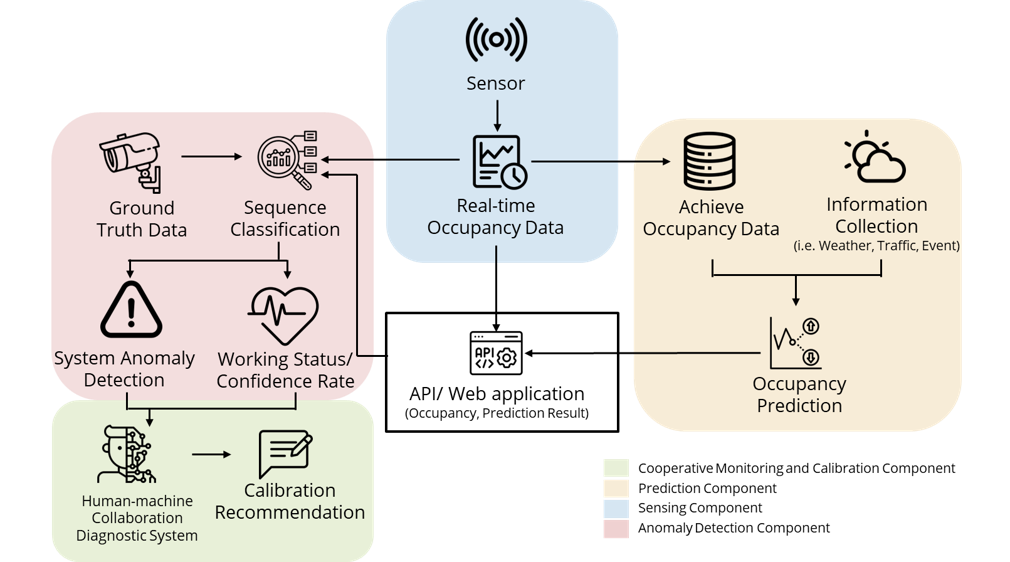
For this study, researchers developed a truck parking monitoring and calibration system, empowered by machine learning, for in/out truck parking counting systems. The proposed framework integrates a sensing component for the truck parking lot and components for information collection, anomaly detection, and calibration.
Within the framework, a prediction model learns the normal temporal pattern of parking occupancy for the particular lot and identifies anomalies when observed values deviate significantly from predicted trends. The system evaluates discrepancies between radar and reference camera sensors and classifies the sensor status into three categories: okay, moderate, and suspect. Then the system produces a confidence score to indicate the reliability of that classification. When strong evidence of sensor error is detected, the system provides calibration recommendations by leveraging reference sensor measurements to correct radar-based estimates.
The researchers integrated the framework into an operational TPIMS environment, and the data were pushed through a monitoring dashboard for system operators. The results demonstrated that the approach can effectively identify sensor anomalies and reduce occupancy estimation errors, thereby improving the reliability of truck parking information systems.
Report: WA-RD 958.1
Authors:
Yinhai Wang
Nutvara Jantarathaneewat
Kehua Chen
UW Department of Civil and Environmental Engineering
Sponsor: WSDOT
WSDOT Technical Monitor: Matthew Neeley
WSDOT Project Coordinator: David Strich