
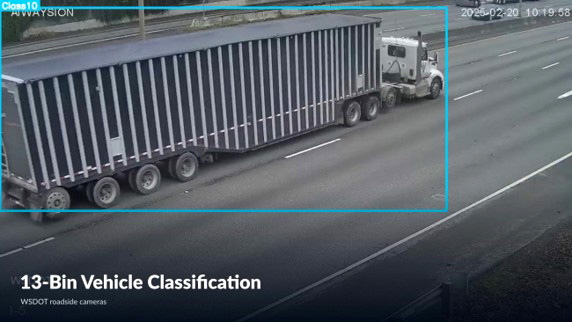
This project developed and evaluated a flexible, scalable, and cost-effective camera-based system for automated FHWA 13-bin vehicle classification in real-world traffic environments. The system, which uses roadside video, edge computing, and deep learning, will enable the collection of more detailed and reliable data to support transportation planning, infrastructure management, and safety analysis for state and regional agencies.
Like many states, WSDOT’s traffic sensor coverage is limited to a fraction of the roadway network, particularly in rural and remote areas. This creates “data black holes”—locations where reliable volume, classification, and roadway-condition data are missing. Such gaps hinder planning, maintenance prioritization, safety studies, freight analysis, and compliance with federal reporting requirements.
An additional issue is that traditional vehicle classification methods such as inductive loops, pneumatic tubes, and manual counts are often expensive and hazardous to deploy and maintain, and they provide limited vehicle classification detail, particularly under challenging traffic, weather, and lighting conditions.
Given these challenges, WSDOT needs a cost-effective, flexible, and accurate traffic sensing solution capable of extending data coverage into locations where traditional sensors are impractical. The system must operate reliably across a variety of environmental conditions—daytime, nighttime, and rain—while running efficiently on edge hardware. It should reduce the need for manual fieldwork, support more consistent statewide data collection, and integrate smoothly with existing WSDOT equipment and workflows.
To address these needs, researchers designed a portable roadside sensing platform that integrates video cameras with edge computing hardware for on-site, near–real-time vehicle detection and classification. The system operates effectively in daytime, nighttime, and rainy conditions while minimizing data transfer requirements. At the core of the platform is an enhanced YOLOv11 deep learning model that incorporates a mixture-of-experts (MoE) architecture. The model uses a shared backbone with multiple expert heads tailored to different environmental conditions, supported by a weather encoder and feature-wise linear modulation (FiLM) that allow it to adapt to variations in illumination, glare, and wet pavement. This design supports accurate classification of both common and rare FHWA 13-bin classes, including multi-trailer trucks and other heavy-duty vehicles.
The researchers conducted model training and evaluation using a curated dataset of more than 20,000 vehicle instances annotated into the 13 FHWA vehicle classes and collected at WSDOT-relevant sites under diverse conditions. The training pipeline addressed class imbalance and visibility challenges by augmenting data, enhancing nighttime images, and using class-weighted loss functions.
The proposed system achieved an overall classification accuracy of up to 97.9 percent, with particularly strong results for heavy-duty vehicles and rare FHWA classes, even under adverse weather and lighting conditions. This level of performance suggested that the system has potential as a practical alternative to manual counts and traditional hardware-based systems and can provide high-quality traffic classification data suitable for planning, design, and monitoring applications.
Report: WA-RD 961.1
Authors:
Yinhai Wang
Yan Shi
Chenxi Liu
Kehua Chen
UW Department of Civil and Environmental Engineering
Sponsor: WSDOT
WSDOT Technical Monitor: Natarajan Janarthanan
WSDOT Project Coordinator: Shervin Jahangirnejad