
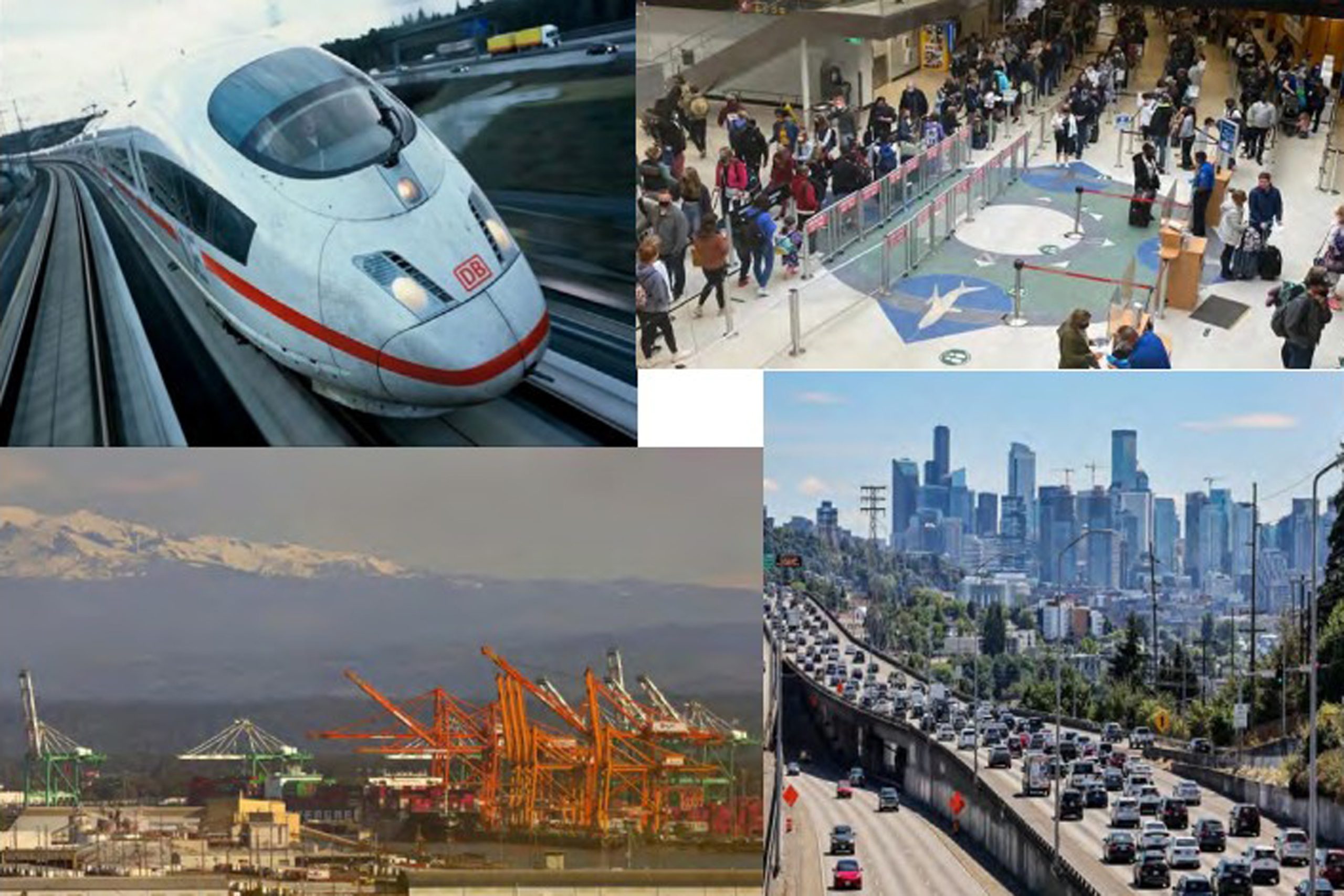
With the state’s population projected to rise sharply by 2050, within the next 25 years numerous factors will affect transportation mobility, economic vitality, and quality of life in Washington state. To aid in planning, this project developed a data-driven, web-based visual tool, called Mobility Washington 2050: The Future in Motion, that is intended to make complex, disparate transportation data accessible and actionable for both policymakers and the public.
By 2050, the Central Puget Sound Region’s population is expected to grow by 1.5 million people to a total of 5.8 million, and the statewide population is forecast to grow from 8.1 million to 9.8 million. The growing state population will increase transportation demand from both travelers and freight haulers for surface travel on roadways, rail, and ferries and for air mobility. In addition, between 2022 and 2050, freight movements in Washington are forecast to increase from 603 million tons of cargo to 872 million tons, likely exacerbating many of the challenges that the state’s freight system already faces. Underpinning all growth in demand will be aging infrastructure that is already showing signs of underinvestment in maintenance and preservation.
To demonstrate and plan for the state’s transportation needs, sufficient data are available. However, decision-makers and the public lack access to this information in a cohesive, easy-to-understand format that is relevant and that clearly shows impending statewide issues that will require intervention and investment.
To increase that access, the Mobility Innovation Center at the University of Washington undertook a project to provide clarity and insight into the significant transportation challenges the state will face in the next 25 years. Researchers in the UW Department of Human Centered Design and Engineering developed a platform that uses existing planning-level data to inform and educate decision-makers and the public. The platform successfully incorporates I-5 corridor data from travel forecast models from three metropolitan planning organizations, as well as future Puget Sound commercial aviation demand data, statewide freight demand data, and bridge condition data.
The platform also employs a human-centered approach that captures users’ attention and interest to help them create a personal connection with the data. The platform was developed with input from both technical and non-technical users to ensure clarity and usability.
With this human-centered design approach, users will be able to better see the larger picture of current and future transportation system challenges and better understand the relevance of future transportation needs.
Website: Mobility Washington 2050: The Future in Motion
Report: WA-RD 953.1
Authors:
Barton G. Treece, III, UW Mobility Innovation Center
Andrea Figueroa
Vishnupriya Ravikumar
Susanna Lammervo
Cecilia Aragon
UW Department of Human Centered Design and Engineering
Ryan P. Avery, Washington State Transportation Center, UW
Sponsor: WSDOT
WSDOT Technical Monitors:
Ron Pate
Rob Berman
Clair Leighton
WSDOT Project Manager: Jon Peterson