
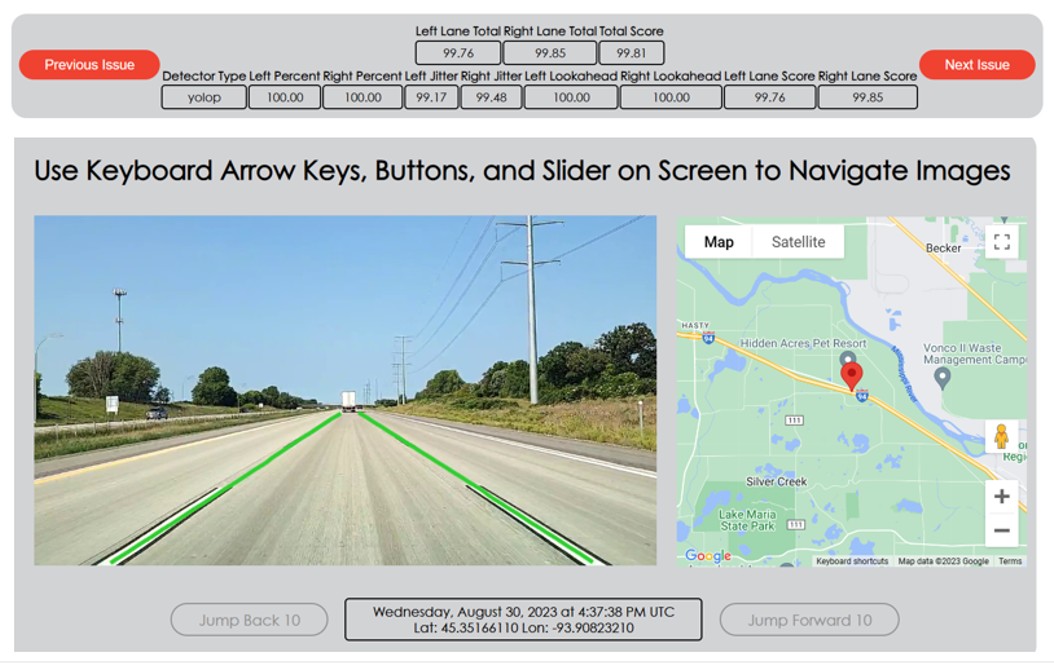
Vehicle lane departure is a primary cause of roadway crashes, and it leads to serious driver injuries and fatalities in Washington state and beyond. This study characterized the leading factors that contribute to lane departure crashes in Washington, looking particularly at lane markings, by developing an analysis framework and leveraging new types of data.
Between 2015 and 2017, lane departures accounted for 48.2 percent of fatalities and 37.6 percent of serious injuries in Washington. Besides serious injuries and fatalities, traffic crashes also lead to travel delay and reduce travel reliability for both travelers and goods. In the rural areas of the Pacific Northwest, the issue is even more significant because of fewer lanes, lack of alternative highways and re-routing options, scarce emergency response resources, and dark road conditions in winter.
To reduce lane departure crashes, a more systematic and detailed way to analyze their causes is needed. Among others, lane markings are a key factor affecting roadway visibility and lane departure crashes. However, a lack of detailed data on lane markings and road conditions hinders our understanding of lane departure crashes, and no model had been developed to evaluate the benefits of lane markings and other factors for reducing lane departure crashes.
Meanwhile, advanced driver assistance systems (ADAS) are maturing and can potentially reduce lane departure crashes through functions such as lane detection, lane keeping, and lane departure alerts. Therefore, it is now feasible to collect machine vision data (from video and LiDAR), which provide detailed information on driving conditions such as lane markings, road signs, curves, and other roadside objects, and evaluate the ADAS lane detection function given lane markings of varying condition. Such data can help reveal the effectiveness of ADAS in detecting existing lane markings.
For this study, the researchers developed a framework to characterize the factors that contribute to lane departure crashes in Washington. The framework used emerging ADAS-based data, which were integrated with existing Washington pavement lane marking asset management data and roadway crash data. Machine vision data were collected from the field to demonstrate the feasibility of leveraging ADAS technology. Regression models were developed to identify and quantify the key factors that contribute to lane departure crashes.
The researchers found that, across a three-year analysis period, driver age, driving speed, lighting conditions, and surface conditions were the top factors associated with lane departure crashes.
The findings of this study could help the state prioritize its investment in safety improvements to ultimately reduce fatalities and serious injuries on Washington roads. For example, in response to the significant factors found to contribute to lane departures, the state may emphasize corresponding safety countermeasures such as young driver education, speed limit enforcement, improved lighting, and adoption of new vehicle-infrastructure detection and communication technologies.
Report: WA-RD 947.1
Author: Jia Li, WSU Department of Civil and Environmental Engineering
Sponsor: WSDOT
WSDOT Technical Monitors:
Scott Davis
Dina Swires
WSDOT Project Coordinator: Doug Brodin