
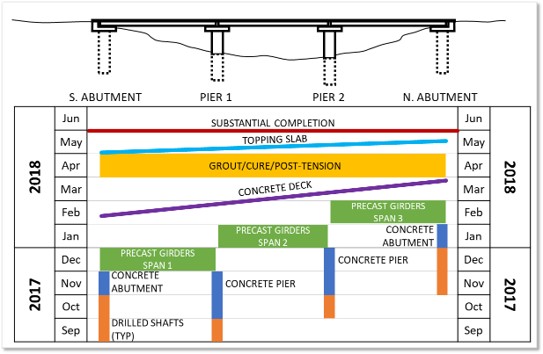
This project evaluated the importance of the use of the linear scheduling method (LSM) for planning and conducting linear construction projects, including large, complex transportation-related construction such as highway, tunnel, and bridge projects. Two off-the-shelf LSM software programs demonstrated potential to support the implementation of LSM for the Washington State Department of Transportation (WSDOT).
WSDOT’s design teams, working with multiple and varied partners and internal specialists, need to be able to quickly grasp the nature of a construction project, its context, and its work activities, including where and when they will occur. WSDOT also has an ever-increasing and challenging need to fully understand and communicate project information to diverse audiences and communities.
Traditional project scheduling methods provide an overwhelming amount of data for large projects that can be cumbersome and confusing to interpret. Project meetings with various stakeholders therefore become less effective and unproductive because stakeholders do not have a shared understanding of the project progress and schedule.
The linear scheduling method can be an effective tool for completing constructability reviews earlier in design and identifying coordination opportunities. It can also enhance processes related to project cost risk assessment, value engineering, and stakeholder engagement. The most common questions asked regarding projects are cost, duration, and appropriate justification. LSM has the potential to effectively help answer those questions and to further enhance WSDOT’s current processes related to project cost risk assessment and value engineering analyses.
To demonstrate the capabilities of LSM, this multiphase research included surveys and interviews of relevant industry personnel and pilot use of LSM with off-the-shelf software programs in a selected project.
In Phase I, a literature review included an examination of five case studies sponsored by various states’ departments of transportation that evaluated the use of LSM in roadway construction. These studies found that, for linear projects, LSM improved schedule overview, facilitated better communication, ensured work continuity, and enhanced project control. However, none of the case studies was recent, which highlighted the necessity of this research to assess how LSM is currently implemented in practice. The Phase I research also revealed the need for a benefit-cost analysis to demonstrate the cost-effectiveness of using LSM.
During Phase II, the researchers distributed linear scheduling user questionnaires and conducted expert interviews to gain insights into the benefits, challenges, and implementation processes of LSM in organizations including owners, contractors, and consultants. They also developed a project performance measurement framework to facilitate the benefit-cost analysis. This was supported by performance indicators gathered from surveyed subject matter experts.
Phase I also involved the categorization and comparison of several off-the-shelf linear scheduling software programs. In Phase II, the researchers further examined two of those software programs: GraphicSchedule and TILOS. GraphicSchedule is a small Excel add-in that enables users to create one page of linear schedule visualization from an existing critical path method schedule. TILOS is a larger, stand-alone scheduling program that can build from scratch a linear schedule with many features, such as calendars, a work breakdown structure, work rate calculations, logic links, clash detection, and progress tracking.
With a linear project in its early planning stage provided by WSDOT as a case study, the researchers assessed the usefulness of the software programs and the measurement framework. Both GraphicSchedule and TILOS demonstrated the potential to support the implementation of LSM for WSDOT.
The researchers also organized live and recorded training sessions for both software programs to introduce LSM to the wider WSDOT community.
Reports:
WA-RD 898.1
WA-RD 898.2
Authors:
Amy Kim
Shuoqi Wang
Lysandra Medal
UW Department of Civil and Environmental Engineering
Hessam Sadatsafayi
University of Virginia Health System
Sponsor: WSDOT
WSDOT Technical Monitor: Mark Gabel
WSDOT Project Manager: Mustafa Mohamedali