ERA (Equal Rights Amendment) History and Geography 1923-1978
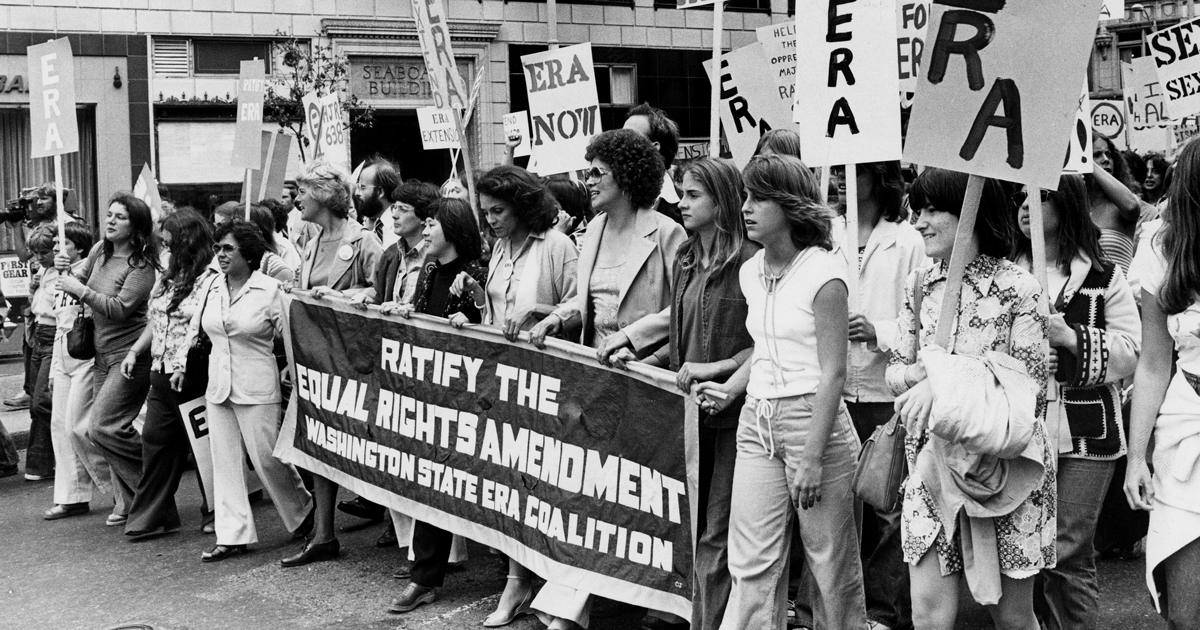 ERA march in Seattle July 8, 1978. Washington had ratified the ERA but with the deadline approaching, three more states were needed. Photo by Howard Staples, courtesy of the Museum of History and Industry (2000.107.232.26.01)
by Ella Gouran and Emma Mantovani
The Equal Rights Amendment (ERA) emerged in the wake of women’s suffrage as the next major step in the pursuit of gender equality. First introduced in 1923 by Senator Charles Curtis and Representative Daniel Anthony Jr. of Kansas, the amendment was drafted by Alice Paul and members of the National Woman’s Party. It stated that “men and women shall have equal rights throughout the United States and every place subject to its jurisdiction.” The proposal aimed to extend the promise of the Nineteenth Amendment beyond voting to include full legal equality. However, the ERA quickly revealed divisions within the women’s movement. As Rebecca DeWolf explains in Gendered Citizenship: The Original Conflict over the Equal Rights Amendment, early debates reflected two competing views of women’s citizenship. Supporters saw equality as identical legal treatment, while labor reformers believed that the law should protect women as a distinct group. This disagreement kept the amendment from advancing beyond committee throughout the 1920s and 1930s. But the campaign would resume in the 1940s.
[continue introduction]
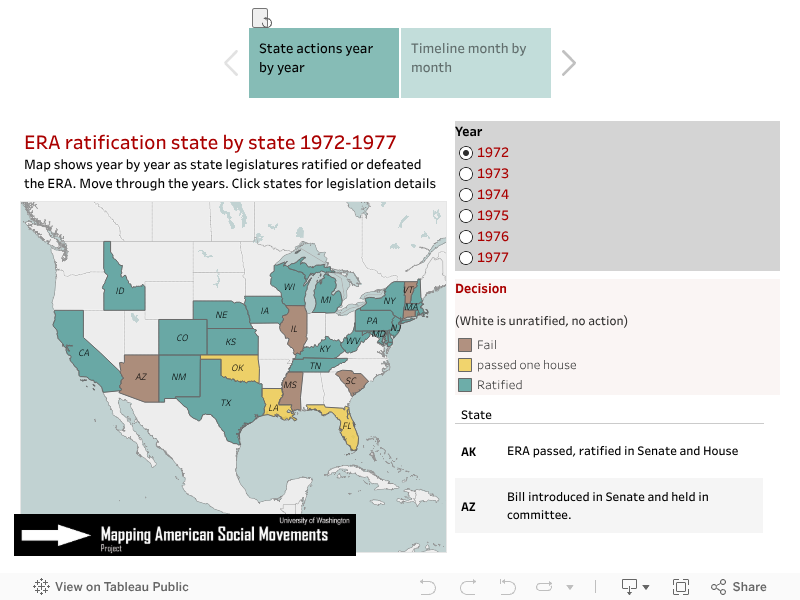
Here we show the 46 attempts to secure passage of the ERA in Congress between 1923 and 1972 and the state-by-state efforts to secure ratification between 1972 and 1978, including failed attempts to win passage in state legislatures.
The maps are hosted by Tableau Public. If slow, refresh the page.
Move between map and timelines using the tabs below
Introduction continues:
The ERA gained renewed visibility in the 1940s as more women entered the workforce during and after World War II. In 1946, the Senate held its first vote on the amendment, which failed by a narrow margin of 38 to 35. In 1950 and 1953, the Senate approved versions that included the “Hayden rider,” which would have preserved existing labor laws that supposedly protected women in the workforce by mandating maximum hours and other special conditions: “The provisions of this article shall not be construed to impair any rights, benefits, or exemptions now or hereafter conferred by law upon persons of the female sex.” Key ERA supporters rejected this provision, arguing that it would be used to undermine full equality. The House refused to take up the measure, and the ERA again stalled. DeWolf notes that these failed attempts showed how deeply the concept of “gendered citizenship” shaped legislative thinking. Lawmakers still viewed women’s rights in relation to traditional gender roles rather than as independent civic equality.
Records from AmendmentsProject.org show more than one thousand congressional actions related to the ERA during the five decades from 1923 to 1972. The ERA was reintroduced at the start of nearly every new Congress throughout the 1950s and 1960s. Most bills were referred to committee without further action. The repetition of these proposals reflected persistence among supporters but also revealed how little institutional progress was being made.
By the late 1960s, the rise of Second-Wave feminism changed the political environment. The National Organization for Women, founded in 1966, reframed the ERA as a matter of civil rights rather than women’s privilege. This shift helped move the amendment from symbolic debate into serious legislative discussion.
A major breakthrough came in the 91st Congress (1969–1970). Representative Martha Griffiths of Michigan used a discharge petition to bring the amendment out of the Judiciary Committee, where it had been stalled for decades. The House passed the ERA on August 10, 1970, marking its first major victory. Scholars Sarah Soule and Brayden King, in The Stages of the Policy Process and the Equal Rights Amendment (1972–1982), describe this moment as the transition from agenda-setting to policy adoption. Activists had successfully moved the ERA from the margins of political discourse into the formal legislative process.
In the 92nd Congress (1971–1972), both chambers of Congress approved the ERA with overwhelming bipartisan support. The House passed it by 354 to 24 on October 12, 1971, and the Senate followed with a vote of 84 to 8 on March 22, 1972. Congress then sent the amendment to the states for ratification with a seven-year deadline. The rapid success in Congress reflected nearly fifty years of advocacy and a growing national acceptance of gender equality as a constitutional principle. Soule and King note that this stage represented the culmination of decades of groundwork, coalition-building, and steady political learning that finally aligned public support with institutional readiness.
Ratification campaign
After Congress approved the Equal Rights Amendment in 1972, the ratification campaign moved quickly. Hawaii's legislature ratified the amendment just hours after the US Senate passed the amendment on March 22, 1972. Seven other states ratified within the first week. Within the first year, thirty states had voted to ratify, and many supporters believed the amendment would easily reach the required thirty-eight states before the 1979 deadline. Our maps show that the early ratifications came primarily from states with strong women’s organizations and a history of progressive reform, but there were setbacks in some surprising states, notably Connecticut, Vermont, and Illinois where legislators initially rejected the amendment. Seven more states ratified in 1973 including Vermont and Connecticut along with Washington, Oregon, Minnesota, South Dakota, and Wyoming where legislatures had taken no action the previous year.
Momentum slowed down after 1973 as organized opposition reframed the amendment’s meaning. Rebecca DeWolf argues that these debates revived long-standing tensions about women’s civic identity, with opponents presenting the ERA as a threat to family stability and traditional gender roles. Activists such as Phyllis Schlafly mobilized conservative women around these claims, linking the ERA to broader cultural issues like abortion and same-sex marriage. Although national groups like the National Organization for Women continued to push for ratification, the campaign’s early progress stalled. By 1977, thirty-five states had ratified the amendment, three short of the required number, but three states (Nebraska, Tennessee, Idaho) had voted to rescind their earlier ratification decision, although it is unlikely that these actions had legal standing.
In 1978, Congress extended the ratification deadline to June 30, 1982, but the extension did not change the outcome. Scholars Sarah Soule and Brayden King describe this stage as one in which political opportunity had shifted, making policy completion far more difficult than policy adoption. No additional states ratified the ERA prior to 1982, and opposition had consolidated in key regions where ratification efforts had already struggled. Economic uncertainty, rising conservatism, and internal divisions within the women’s movement further limited the amendment’s prospects.
When the extended deadline expired in 1982, the ERA had secured only thirty-five of the thirty-eight necessary ratifications. The failure of the ratification campaign demonstrated the broader challenges of translating social movements into constitutional change. The ERA’s defeat reveals how deeply questions of family, gender, and national identity shaped the debate. Although the amendment did not enter the Constitution, the ratification struggle remains a central episode in American legal and political history and continues to influence ongoing conversations about gender equality today.
Works Cited
DeWolf, Rebecca. Gendered Citizenship: The Original Conflict over the Equal Rights Amendment, 1920–1963.University of Nebraska Press, 2021.
King, Brayden G., and Sarah A. Soule. “The Stages of the Policy Process and the Equal Rights Amendment, 1972–1982.” American Journal of Sociology, vol. 111, no. 6, 2006, pp. 1871–1909.
“The Amendments Project.” AmendmentsProject.org, Center for Constitutional Studies, Washington University in St. Louis, https://amendmentsproject.org/. Accessed 31 Oct. 2025.
Sources and methods:
Data for the ratification maps were transcribed and calculated from the following digitized documents from the Records of the National Organization for Women at Harvard Radcliffe Schlessinger Library: "States that have ratified ERA" SCH494668432; "NOW rollcall of states" SCH494668448; "History of the Bill" SCH494670068.
Data for the timeline of Congressional Bills is from AmendmentsProject.org