
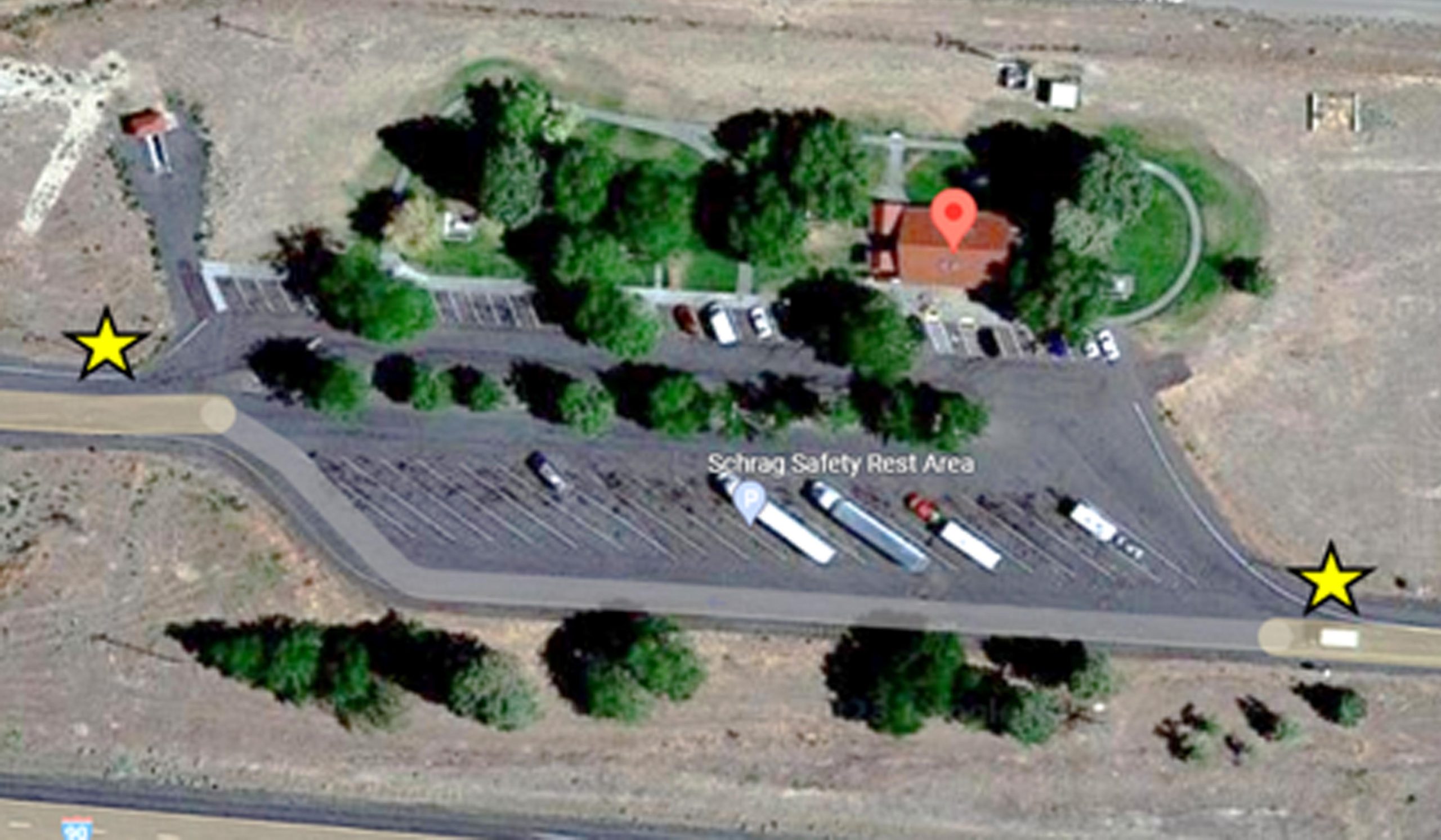
Truck parking availability for commercial drivers traveling through Washington state is limited. To help truck drivers plan their trips and maximize the use of available parking, the University of Washington STAR Lab developed a self-learning and optimizing truck parking information and management system (TPIMS) for installation at state-owned truck parking facilities such as weigh stations and safety rest areas.
A lack of reliable and accessible truck parking information for commercial drivers results in inefficient trip planning, increased fatigue-related safety risks, and operational inefficiencies for commercial freight operators across major freight corridors. This project sought to help the Washington State Department of Transportation (WSDOT) provide that needed information.
The researchers reviewed multiple vehicle detection technologies to give WSDOT a better understanding of the advantages, disadvantages, and feasibility of retrofitting existing truck parking detection products. Through field deployment, calibration, and validation, they assessed sensor accuracy, cost-effectiveness, and long-term maintainability. The field evaluation confirmed that both in/out sensors and slot-by-slot systems can reliably measure the presence of trucks when the sensors are properly calibrated and validated against ground-truth video.
The researchers also developed a multi-source data management platform that consolidates real-time occupancy, parking event, weather, and traffic data. A robust TPIMS database and server architecture support the flow of real-time data, archiving of historical data, and fusion of multi-source data. The unified data architecture and archival structure enable long-term monitoring of verification events, anomaly detection, and performance tracking across all sites.
The system also includes a machine-learning–based prediction algorithm based on site-specific, long short-term memory (LSTM) models. This prediction component demonstrated high accuracy in forecasting near-term parking availability, and it can be retrained as new statewide data become available.
An application programming interface (API) provides access to occupancy and prediction data for third-party developers, private truck stops, and other agencies, which will enable broad dissemination of truck parking information. The API provides clean, consistent output while accommodating exceptions such as temporary site closures and changes in the level of trust in sensor output.
With testing at eleven rest areas, the project demonstrated the feasibility and scalability of a statewide TPIMS that includes a validated detection framework, an operational prediction model, and an API. Together, these can enhance parking awareness and improve safety for commercial drivers.
Overall, the project established a robust foundation for a fully integrated statewide truck parking information system that can provide actionable intelligence for drivers, freight stakeholders, and transportation managers, as well as a strong foundation for future expansion of TPIMS to additional sites and neighboring states.
Report: WA-RD 956.1
Authors:
Yinhai Wang
Kehua Chen
Nutvara Jantarathaneewat
UW Department of Civil and Environmental Engineering
Sponsor: WSDOT
WSDOT Technical Monitor: Matthew Neeley
WSDOT Project Coordinator: David Strich