
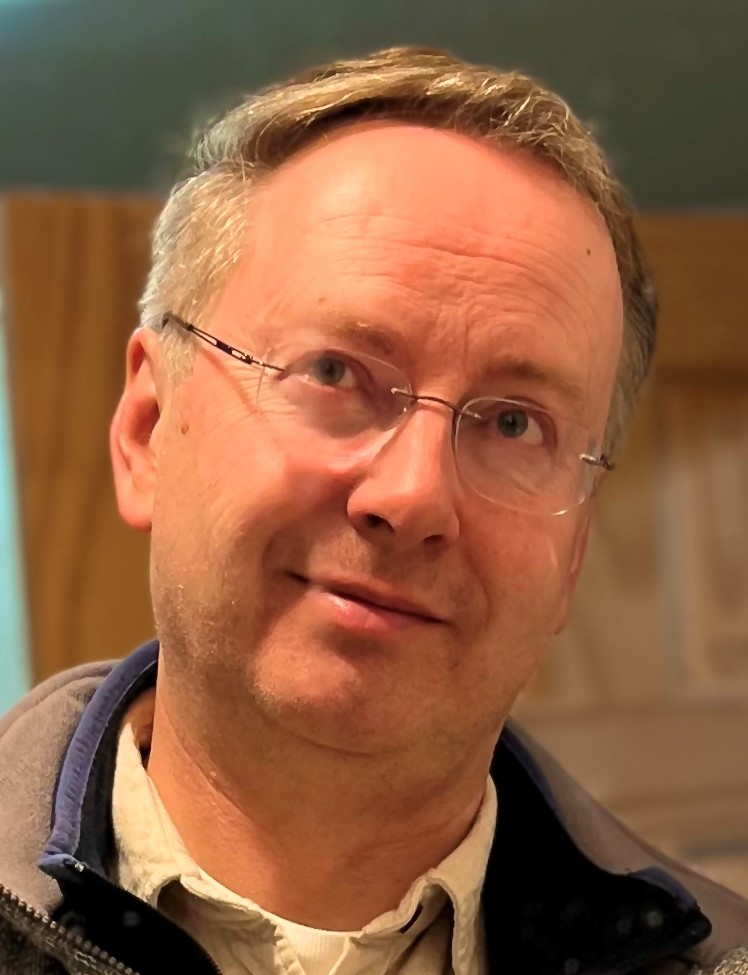
After a doctorate in the Dept. of Atmospheric, Oceanic and Planetary Physics at the University of Oxford, England, I worked as a planetary scientist near San Francisco at NASA’s Ames Research Center from 1995-2001. In 2001, I joined the faculty at the University of Washington in Seattle. I also had a stint as European Union Marie Curie Chair in Earth and Planetary System Science at the University of Bristol, England, from 2005-2008, while also an affiliate professor at the University of Washington.
Currently, I’m a Professor jointly appointed to the Dept. of Earth and Space Sciences and cross-campus Astrobiology Program at the University of Washington. My research interests revolve around understanding the co-evolution of planetary atmospheres, planetary surfaces, and life. This includes collecting and interpreting data from other planets and the Earth. A key goal is to understand the habitability of planets in general. I have also been involved in NASA’s exploration of Mars and was part of a 35-person team of scientists responsible for NASA’s Phoenix Mission, a probe that landed and operated successfully in the northern polar region of Mars in 2008. I am author of the book, Astrobiology: A Very Short Introduction— a readable and up-to-date summary of the subject. I also have co-written a technical book aimed at researchers and PhD students entitled Atmospheric Evolution on Inhabited and Lifeless Worlds.
For more info on research, check out my publications.
I will be looking to recruit up to 2 new PhD students in projects as follows:
1) An opening for one new PhD student in a theoretical project, which is purely computational, numerical simulations. This project is concerned with the question, “are there atmospheric signatures of life?” and uses computer simulations that model atmospheric compositions with and without life on planets with both anoxic and oxygen-producing biospheres, reflecting the likely long-term evolution of carbon- and water-based life anywhere. The project is funded by the Alfred P. Sloan Foundation’s Matter-to-Life program with a brief description by the program manager here:
https://sloan.org/grant-detail/g-2025-25204
2) An opening in analysis of Mars Perseverance Rover and other Mars data.
Current Students:
- Shintaro Kadoya (Postdoc)
Past Students & Postdocs:
- Joshua Krissansen-Totton (NASA Sagan Fellow, University of California at Santa Cruz)
- Owen Lehmer (Research Scientist, NASA Ames Research Center)
- Mark Claire (Reader, Univ. of St. Andrews)
- Sanjoy Som (Research Scientist & Director, Blue Marble Space. Also at NASA Ames Research Center)
- Megan Smith (Technical staff, Aerospace Corp.)
- Erik Goosmann (Data Analyst, Institute for Health Metrics and Evaluation (IHME))
- MacKenzie Day (Assistant Professor, University of California, Los Angeles)
Selected Publications
D. C. Catling, J. F. Kasting, Atmospheric Evolution on Inhabited and Lifeless Worlds, Cambridge University Press, 2017.
J. Krissansen-Totton, D. Bergsman, D. C. Catling, On detecting biospheres from chemical disequilibrium in planetary atmospheres, Astrobiology 16, 39-67, 2016.
T. D. Robinson & D. C. Catling, Common 0.1 bar tropopause in thick atmospheres set by pressure-dependent infrared transparency, Nature Geoscience, 7, 12-15, 2014.
D. C. Catling, Astrobiology: A Very Short Introduction, Oxford University Press, 2013.
D.C. Catling, S. E. Wood, C. Leovy, D. R. Montgomery, H. Greenberg, C.R. Glein, J. M. Moore, Light-toned layered deposits in Juventae Chasma, Mars, Icarus, 181, 26-51, 2006.
D. C. Catling, C. P. McKay, and K. J. Zahnle, Biogenic methane, hydrogen escape, and the irreversible oxidation of early Earth, Science, 293, 839-843, 2001.