
by Dominic Joseph Driscoll
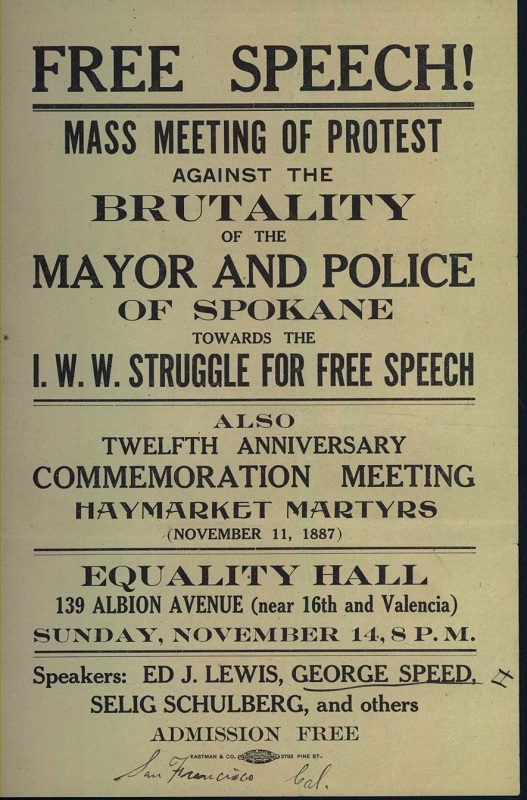 Poster for November 14, 1909 solidarity meeting in San Franciso (Wikipedia)
One of the key achievements that the Industrial Workers of the World are known for are the “Free Speech Fights” they led across the nation in the first decade after their founding. While they were not always successful, these fights were foundational to both our modern legal and social views of free speech in the United States. The IWW’s fight showed free speech is not a privilege afforded to only those you agree with, but that it must be a guaranteed right to every person from every walk of life.
While there are disagreements about the exact number of what constituted a Free Speech Fight, the IWW History Project has identified more than two dozen cities and towns where the IWW conducted campaigns between 1907 and 1916[1]. The first major action took place in Spokane, Washington. On the border of Idaho and a short train ride to Northeast Oregon, Spokane was the central city of the region. The Spokane campaign of 1909-1910 became the strategy guide for every other free speech fight across the country. Not only did the fight prove that the IWW could win in large cities, but that popular support could be obtained from various sections of the public through publicity and mass mobilization.
Job Sharks, Hoboes, and The Jewel of the Inland Empire
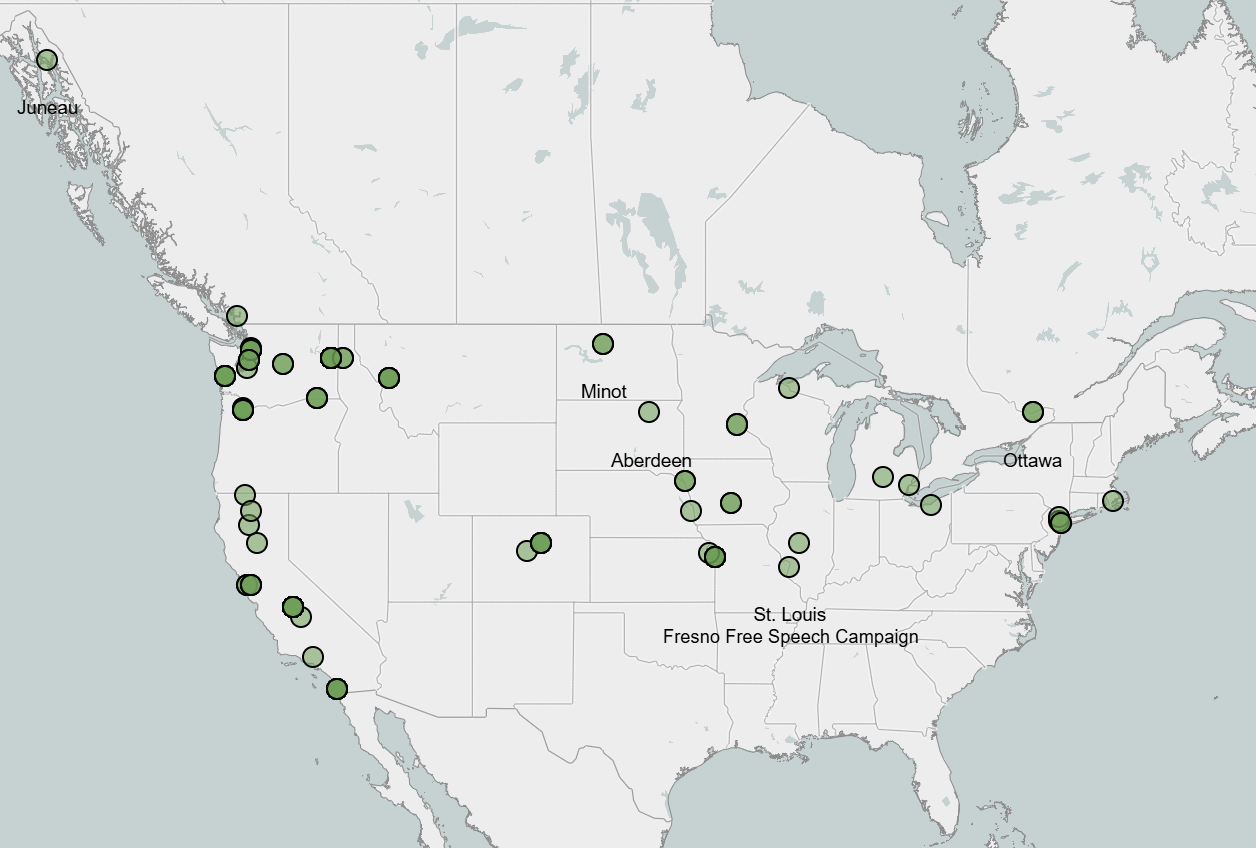 Map showing location of IWW free-speech campaigns 1909-1919. Click to see interactive map.
At the beginning of the 20th century the economy of the Pacific Northwest, east of the Cascades, was built on the extractive industries of mining, timber, and agriculture. On the back of these industries and the workers that kept them running grew the city of Spokane. The city functioned as a transport center connecting Pacific Northwest extraction to Midwest and East Coast Production. As the demand for raw materials grew in the east with the continued expansion of American Industry, so did Spokane. The city’s population nearly tripled in size during the first decade of the 20th century from 36,848 in 1900 to 104,402 in 1910.[2]
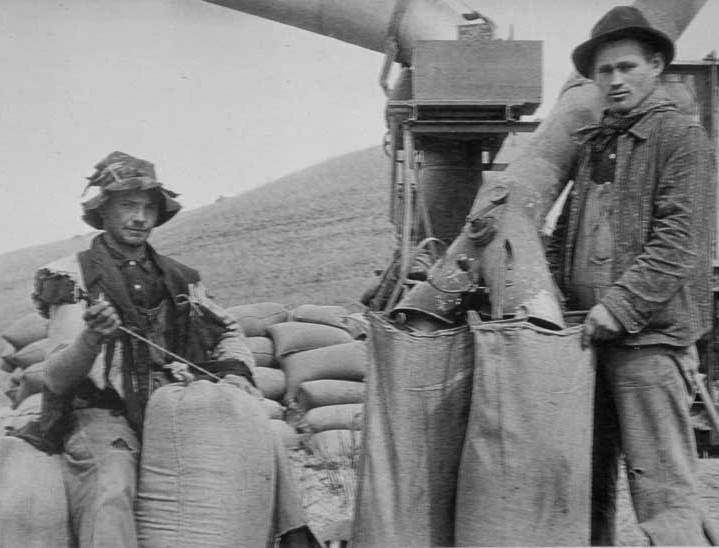 Wheat harvests employed thousands in eastern Washington each summer. Here men fill and sew sacks of wheat.
Not only did Spokane act as a hub for material but it also a hub for labor. Migratory workers, colloquially called Hoboes, used the city as both a hiring center and a refuge when the fields were barren and the timber and mining camps were snowed out. These itinerant workers were not viewed kindly by most of the city, being seen as little better than vagrants or refuse. The irony of this is that much of the local economy was both directly and indirectly reliant on the labor and needs of these migratory workers. A comic in the Industrial Worker put it best when it came to the city’s opinion on Migratory Workers “IN WINTER WE’RE “HOBOES”-IN SUMMER WE’RE ‘HARVEST HANDS’.” This negative mentality left these workers ripe for exploitation and abuse.[3]
The cornerstone of connecting the migratory laborer to jobs were the 31 employment agencies that dotted Spokane.[4] These agencies ranged in ownership from private businessmen to “reputable” organizations like the YMCA and Red Cross. Workers would see advertisements in the windows of the agencies and would usually have to pay a fee for more information. Fees could cost the equivalent of a day’s work, or more.
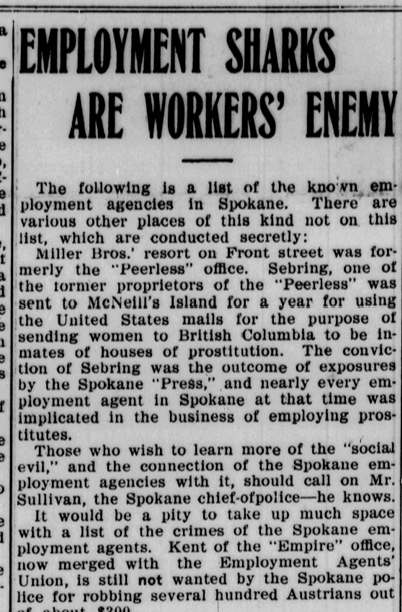 Industrial Worker November 3, 1909
The IWW charged that the system was rife with abuse and corruption. Often the employment agents (nicknamed Job Sharks) would be in league with foremen or bosses running these jobsites and would split the profit of the job chits with said foreman. And the agents and bosses might collude to rotate as many workers as they could through these camps to maximize fees. G.B. Tallman described this rotation in a letter he wrote to the Industrial Worker in April of 1909.
“I paid two dollars for the job and the following evening landed at Deek and Deek’s camp, Weatherby, Ore. I was told that a man who stayed a week was an old man on the job. On the third day the foreman called up the gang and picked out a few who had not worked there long enough to pay the hospital fee. These he sent back up to work and fired the rest of the gang – about thirty men. We went on our way with stakes ranging from 50 cents to $5.00 and most of us were broke and hungry before getting another job. We were fired because the contractors had just got a wire that 100 more men would arrive from Spokane and Portland on the noon train. There were easily 5,000 men sent there to this camp in two months and there was never more than 100 working at any one time. The employment sharks, such as the “Red Cross” hire the men. They charged a $2.00 fee. The sharks get part and the boss gets the rest for firing the men. The men average three or four days on the works. This rake off and the hospital fee - there is no hospital of course – pay about half of the work on the job.”[5]
Fred Thompson called this the “Three Job System” with workers constantly moving to and from the jobsites with little enough time on site to cover the expenses they were charged. Each job chit a worker bought was a crap shoot as to whether one would be working a season or a couple of days or as in some cases, working at all.[6]
There were few alternatives to the job shark system. If you wanted to work, you had to pay. But the workers despised the cost and corruption and in 1909 the IWW saw an opportunity to try a new strategy of organizing.
Reds on the Rails: The IWW comes to Spokane
>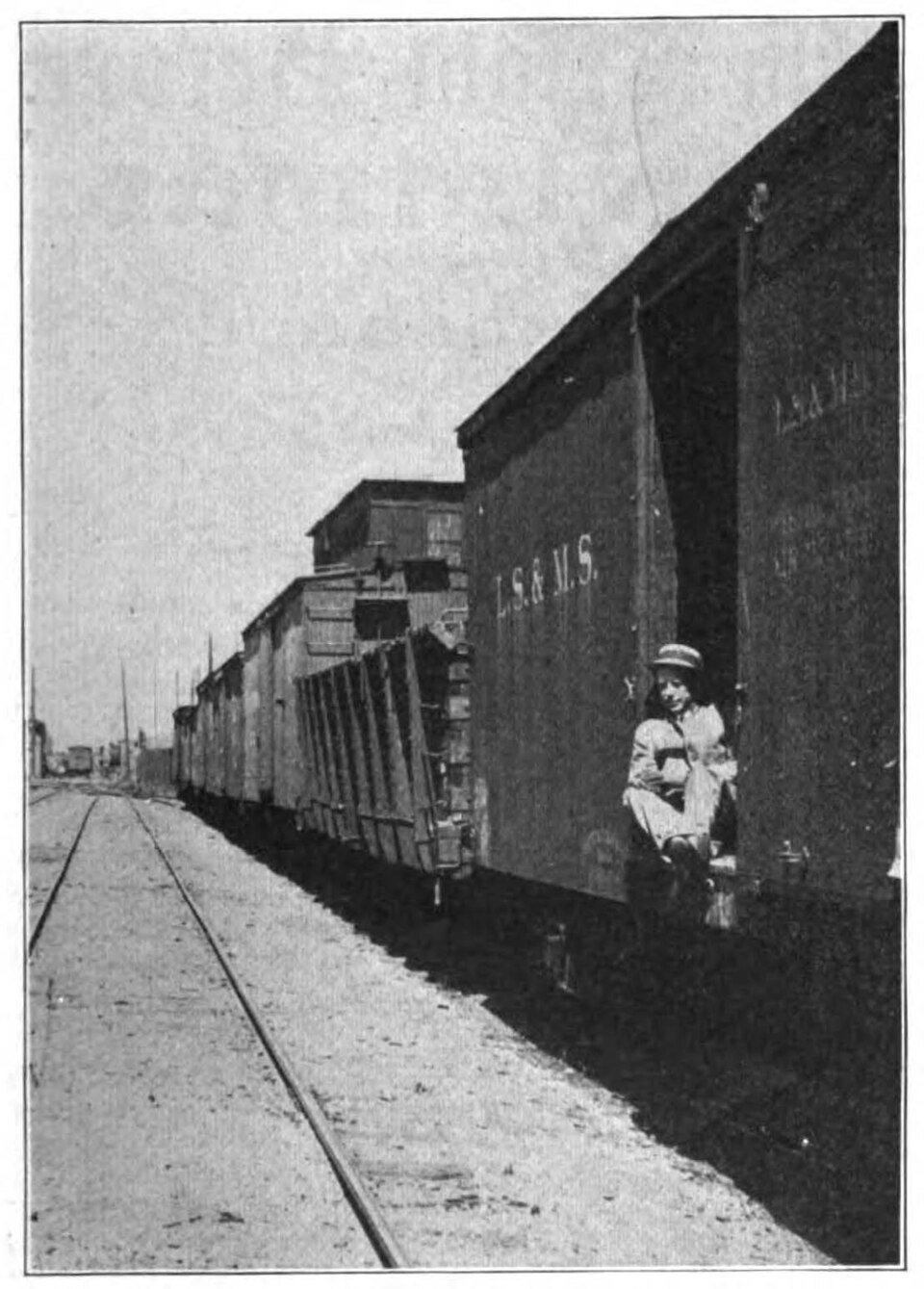 IWW member train hopping to Spokane ("The Shame of Spokane" by Elizabeth Gurley Flynn from The International Socialist Review. Vol. 10 No. 7. January, 1910).
The Industrial Workers of the World are often considered the most radical, rowdy, and revolutionary union in the United States. From its inception the union was explicitly socialist and believed in a strategy of industrial unionism. By the time of the Free Speech Fight, they were explicitly revolutionary as best described in The Constitution of the IWW “It is the historic mission of the working class to do away with capitalism. The army of production must be organized, not only for everyday struggle with capitalists, but also to carry on production when capitalism shall have been overthrown.”[7] Founded in 1905 as an alternative to the American Federation of Labor (AFL) which disavowed socialist affiliations and practiced craft unionism while ignoring major industries and less skilled workers, the IWW had been active in the West for several years.
The organization had several structural and ideological advantages that allowed them to gain ground with the migratory workers in the region. First, the industrial model used by the union was much more effective at organizing “unskilled” workers as it focused on organizing both the entirety of a workplace and industry over specific trades. This allowed for unity among workers and more effective coordination on the shop floor. This mentality also allowed for universal transfer which allowed a member to transfer from any local or branch to another regardless of industry or location. As migrant workers were constantly on the move and weren’t necessarily working out of one town, the union gave them support in any town with a local Wobbly presence. Combine this with almost all branches having an attached mixed local i.e. a local for all industries meant that the migratory workers who would often work in different industries depending on the season had the ability to coordinate and organize on any job site.
Rejecting electoral politics while focusing on direct action and industrial organizing may have also made sense to migratory workers who were rarely in one place long enough to establish voting rights. James H. Walsh put it best in a 1908 edition of the Industrial Union Bulletin “I have seen for sometime that the workers of the northwest who carry their homes on their backs will have some difficulty in emancipating themselves at the ballot box, and especially so when they have to move on about twice and leave counting to some Citizens Alliance disciple or the Mine Owners’ Association”[8] While the American Federation of Labor saw migratory workers as an unorganizable reserve army of labor, the IWW was ready to prove otherwise.[9]
In March 1908, the national office sent organizer James H. Walsh to Spokane to bolster the local branch which at the time had only a handful of members in good standing operating out of a 7ft x 11ft tin shack. This was one of the major pushes in the Pacific Northwest’s Inland Empire and one of the main focuses of the branch was to launch a hiring hall to replace the job sharks in the city (and eventually across the region).
James Walsh was a member of what was known as the direct actionist wing of the IWW[10]. As the name implies, this wing advocated direct action as the main method of organizing, opposing ties to any political party (including the Socialist Party), and arguing for decentralized authority within the IWW. By 1908 the direct actionists were gaining influence in the IWW and became the driving force in the free-speech fights nationwide. Walsh was known as the leader of the Overall Brigade, “a group of hobo orators adorned in black overalls, black shirts, and red ties that were known for their oration on the way to the 1908 convention.”[11]
Upon arrival Walsh started an aggressive recruitment and fundraising drive to pay off the branch’s debts and recruit new members. This was done through hawking the Industrial Union Bulletin, the IWW’s English language newspaper, while dropping the price from five cents a paper to one cent. This and other creative tactics, including using music and skits to attract crowds, led to rapid growth of the Spokane branch.[12] By May 1908, the branch had paid off all its debts and gained three hundred members. The branch now included two locals: Local 434 for Public Service workers (which included two sub-branches for Italian and Serbian speaking workers respectively) and Local 222 a mixed local i.e. the local that catered to the migratory workers.[13]
Growth continued into the summer with an increase to seven hundred members by July as a job slump hit the region causing many unemployed migratory workers to flock to the union for support[14]. And still more members joined in the fall as the Spokane Wobblies implemented a “Don’t Buy Jobs Campaign”.[15] This initially consisted of members soapboxing in front of employment agencies trying to convince workers not to buy jobs from them. Nor did the city’s new Gag Law slow momentum. Early 1909 found membership reaching several thousand.
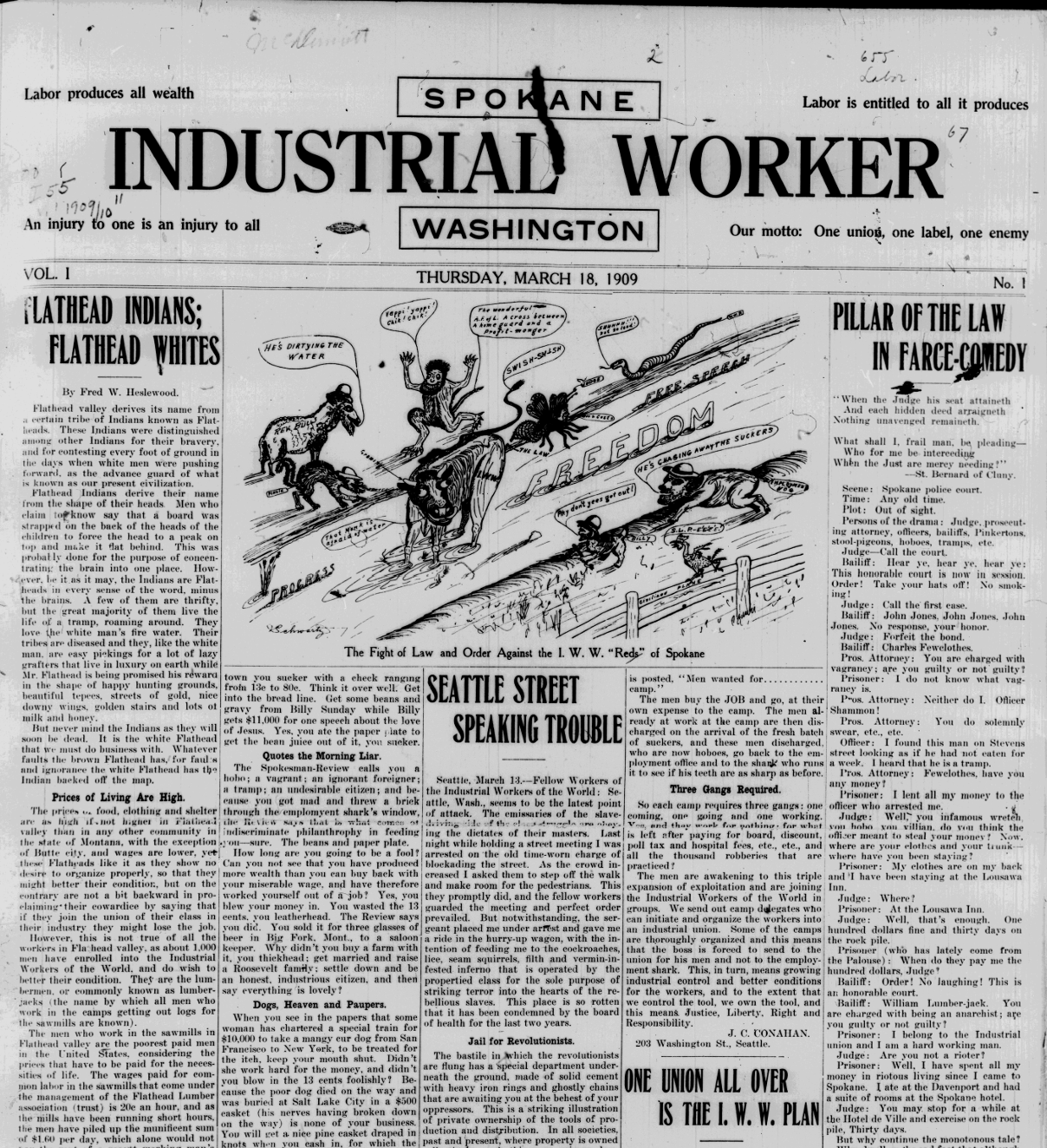 First issue of Spokane-based Industrial Worker March 18,1909
In April of 1909, several changes took place in the Spokane I.W.W. After a multi-month hiatus, the Industrial Union Bulletin was rechristened the Industrial Worker. Published first in Spokane,later in Seattle, then moving to Chicago in 1931, the Industrial Worker remains today the main publication of the IWW.[16]. On a local level the union expanded to include two more locals: Building Constructors Local 223 and Hotel and Restaurant Workers Local 132. Most importantly, the branch had been able to formalize its administrative labor. The local organizer was receiving consistent pay, and the union had been able to hire an editor for the paper and a secretary allowing for better tracking of membership which had ballooned to three thousand with fifteen hundred in good standing at any given time.[17]
This new size meant a new headquarters and more support for local workers. Now headquarters could fit several hundred members in its hall, had a library with 9am to 9pm reading hours, a cigar stand, and a movie theatre in a shed behind the hall which played movies for five cents a picture (refundable and mainly charged to prevent drunks from wandering in).[18]
While the amenities were useful for providing services to members and helped build a stronger sense of community in the branch, two more important programs were set up for members to use that strengthened the union’s organizing position against the job sharks. The first was union run hospital insurance, which would cover the first ten dollars of hospital expenses per week for up to ten weeks. The buy in cost was fifty cents a month and saw heavy participation from members in good standing (the local reporting six hundred dollars saved up within the first few months of the program).
The second was an on-retainer legal firm to help with legal disputes. This was particularly useful not only for members arrested under the new gag law but also in dealing with the hospital insurance and other fees employers were trying to take out of the pay of workers. These two combined programs gave the union significant leverage when dealing with both job sharks and employers and saw several of both stand down in disputes after a simple threat of legal action.[19]
The I.W.W. was becoming an ever-stronger force in the city of Spokane, but the companies and men of privilege who ran the city were none too happy about it.
Opposition and the Fight Before the Fight
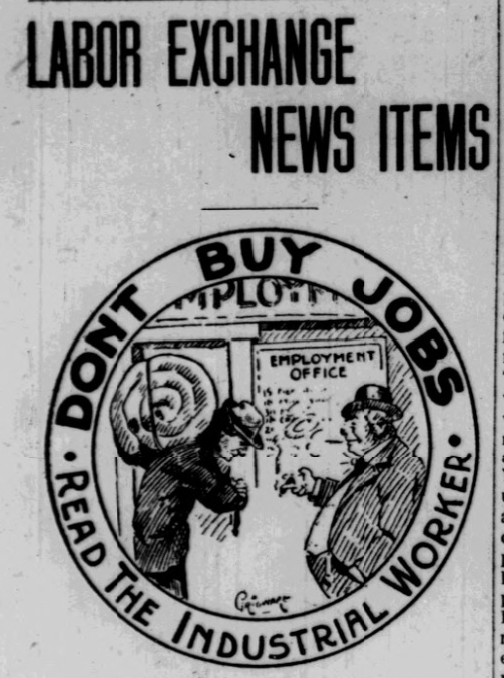 Competing with the "job sharks," the Industrial Worker provided free information about jobs in its weekly Labor Exchange column while warning workers against "buying" jobs.
Anyone experienced in organizing knows that once a campaign gets underway those who oppose change will organize in reaction. This is what happened in Spokane. The IWW had not only organized “the Bummery,”[20] the unhoused, but worked to rally other locals in the public service, restaurant, and construction sectors. They started organizing permanent laborers (known to the Wobblies as the Home Guard).[21] This meant that the bosses were seeing the results of industrial unionism with the militant wing of the working class organizing across industry.
Most alarmed were the employment agencies.[22] The “Don’t Buy Jobs” campaign’s soapboxing strategy was working. The IWW was sending members to stand in front of agency offices gathering crowds and urging workers to boycott the sharks. The job sharks also understood that the union’s own free hiring hall posed another danger-- the opposing force was also becoming competition.
The job sharks first created their own organization, the Associated Agencies of Spokane.[23] Then they turned to the Spokane city council and persuaded the city to pass Public Ordinance 3890 to go into effect on New Years 1909. This was the first “Gag Law,” an ordinance that banned all street speaking in Spokane. [24] Even though the ordinance was neutral on its face, the police enforced it only against the IWW. On March 4th the branch demanded that Ordinance 3890 be enforced evenly instead of just targeting the union. The City Council complied and then subsequently had forty-three Wobblies arrested and tried over the next week before sentencing them to 30 days in jail. Meanwhile the police also shut down street speaking by the Salvation Army and Volunteers of America, whose members were fined but not detained.[25]
Violence was part of the crackdown. The one-armed Wobbly Alber V. Roe was first assaulted, dragged from his soapbox, by an employment agency owner, then a month later arrested and beaten by Officer A.H. Jessett for ‘blocking the street.” IWW lawyers filed a lawsuit against the officer for the assault which would take several months of time and resources.[26]
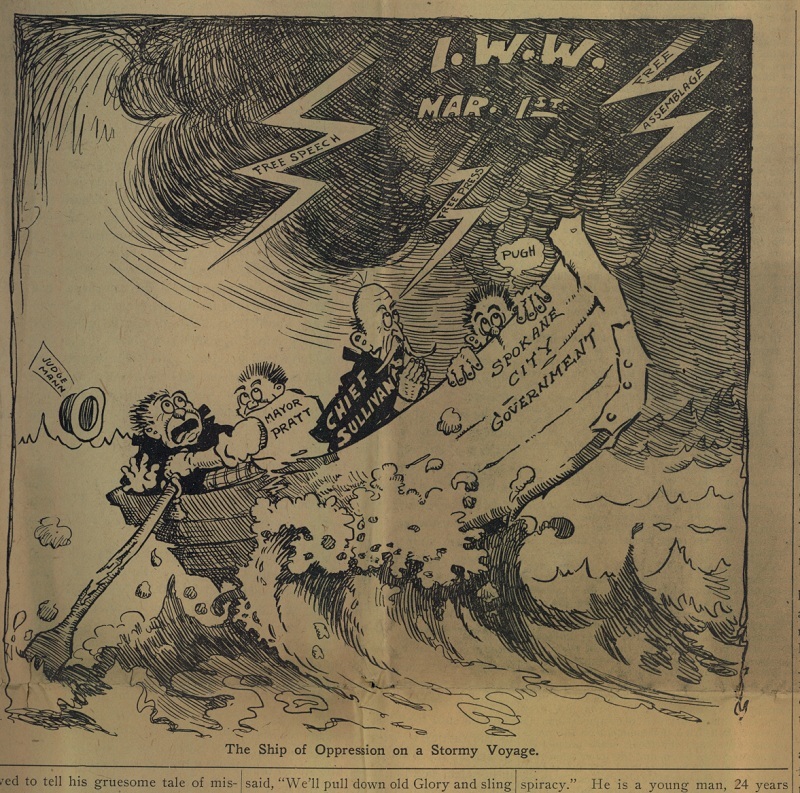 "The Ship of Oppression on a Stormy Voyage" lampooning mayor, police chief, and Spokane City Council in the month before they capitulated to key IWW demands (Industrial Worker, Febrruray 26, 1910)
Over the next few months, Spokane police under Chief O’Sullivan kept up the harassment campaign while the IWW continued to resist. A string of soap boxers went to jail as the IWW tried to sell their papers. And the organization continued to grow, Spokane branch membership reaching four thousand during the summer of 1909.[27] The gag law to stop IWW seemed not to be working. What is more, the Salvation Army and other religious organizations were demanding that City Council lift the restrictions on their street corner activities.
The Council responded with Public Ordinance 4391 on August 10th, 1909.[28] The new law gave the mayor power to make exceptions in the ordinance for religious organizations like the Salvation Army and Volunteers of America. It is an understatement to say the IWW was enraged, but instead of advocating for any kind of violence they cautioned workers against it. Stating in the Industrial Worker “Such attempts are childish and silly and are a drawback to real success. The opportunity for real agitation and organization, however in the wintertime is magnificent!”[29]
The IWW knew that many of its members were out at the camps for the summer harvest work. So, the IWW waited, planned, organized, and more importantly brought in reinforcements as they prepared for a hell of a scrap.[30] For months, the Industrial Worker and other IWW media had been publicizing events in Spokane. And not just Wobblies but also Socialists had responded, sending letters to the City Council condemning the gag laws and the actions of police. The Industrial Worker published some of them including letters from the Socialist Party of Butte, Montana[31] and IWW locals in Phoenix, Arizona.[32]
Calling All Wobblies: The Fight is On![33]
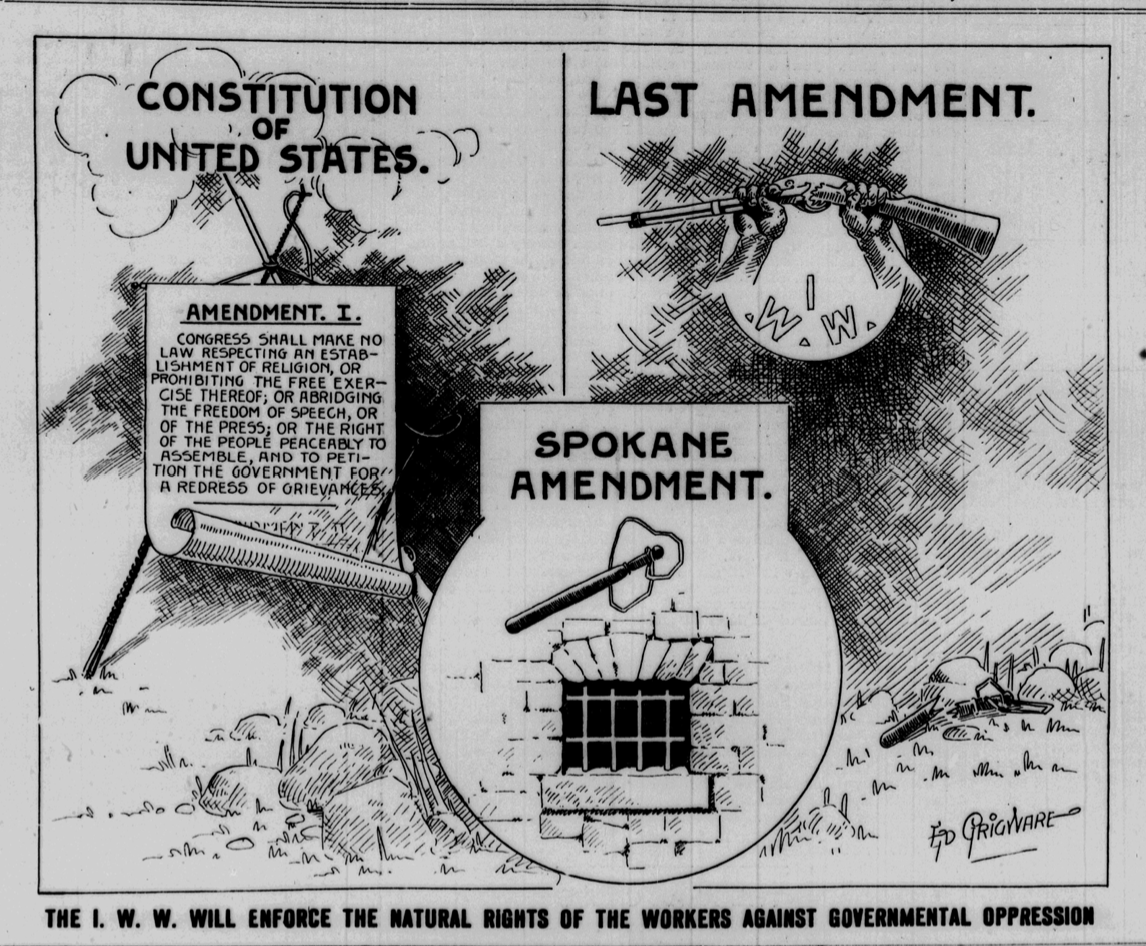 "The IWW will enforce the natural rights of workers against government oppression" Industrial Worker November 3, 1909
On October 25th,1909 the IWW made their move in Spokane. National Organizer James P. Thompson orated on a soapbox until they were arrested. The IWW used this as an excuse to call a street meeting posting “REMEMBER, TUESDAY, NOVEMBER 2, THERE WILL BE A STREET MEETING IN SPOKANE”[34] in the Industrial Worker. Thompson was acquitted and Judge Mann ruled that Ordinance 4391 was unconstitutional, however this did not satisfy the IWW. Ordinance 4391 may have been repealed but Ordinance 3890 was still in effect[35]. Thus, it was still illegal for the IWW to hold street meetings or soapbox under Spokane city law.
On November 2nd, right after Thompson was released, the IWW held the first public mass meeting of the fight. The police promptly arrested 83 participants, charging most with disorderly conduct misdemeanors and four with felony criminal conspiracy.[36] More arrests followed. In just the first ten days of the fight, an estimated 251 Wobblies were arrested. The Industrial Worker described the scene, “Speakers poured from the I.W.W. hall onto the streets, but few said more than ten words before heavy hand of the American Cossacks descended in their shoulder.”[37]
As news of the campaign and arrests spread, IWW publications called for help, urging members and friends to come to Spokane. Wobblies from around the nation were now hopping trains and arriving in Spokane. Organized contingents set out from all over the West and Midwest, from as far as Chicago and Minneapolis.[38] And they came alone or in small groups, planning to stand up, start speaking, and go to jail for the cause. By December, the IWW was estimating ten arrests per day.
Meanwhile the city jail was full, and city authorities were commissioning temporary facilities to hold the newly arrested. An old and abandoned Franklin High school was converted and the stockades at nearby Fort George Wright became auxiliary jails with the permission of the Fort’s commanding officer.[39]
The police retaliated against the IWW by trying to destabilize the leadership of the campaign. Every person that the police saw as a “leader” found themselves (often very publicly) arrested, assaulted, and charged with conspiracy by the end of 1909.[40] The police also raided IWW headquarters four separate times in November and December. They then pressured the hall’s landlord into cancelling the Union’s lease and pressured other landlords in Spokane to refuse to rent space to the IWW.[41] Spokane PD also targeted the Industrial Worker, from the beginning of the fight. Each consecutive editor of the paper found themselves arrested and charged with conspiracy. Newsboys faced harassment if they carried the newspaper. On December 11, police confiscated all copies of the Industrial Worker straight from the presses.[42] This led to the paper moving to Seattle for the rest of the fight.[43]
These attempts to disrupt and dismantle the union were not working. For several reasons. Doctrinally and structurally, the IWW was a very horizontal union, while there were some staff, almost all decision making and leadership choices were deferred to the general membership. Distribution of power meant that you could not target one person to collapse the campaign. The doctrine of “everyWobbly an Organizer” compounded this. If someone in a leadership position was arrested they could be replaced, as Joe Panzner recounts in Rebel Voices
The plan was to call for volunteers to speak on the streets in violation of the city ordinance. If we were arrested, we would go to jail until all of the jails were full. A joint meeting of the four locals was held and a committee of ten was selected from the floor of the meeting. These ten went into the office of the secretary and picked a committee of five to be the fighting committee. They in turn each picked one alternate to take their place in case of arrest. The alternates were to appoint other alternates. All names were to be kept secret. Every five or ten volunteers would go on the streets and speak. When they were arrested, they would go before the judge, plead guilty and go to prison.[44]
Having redundancies in place helped with the operation of the campaign especially as the number of those in jail began to rack up.
Finally, a membership mainly consisting of migratory workers proved advantageous. It meant that instead of calling for sympathy strikes in other towns you could ask a membership already built on travelling to mobilize and show up at the fight itself, meaning the police weren’t just combatting the Hobo Jungle of Spokane but every “bum with a red card” in the region.
One Big Jailhouse Union
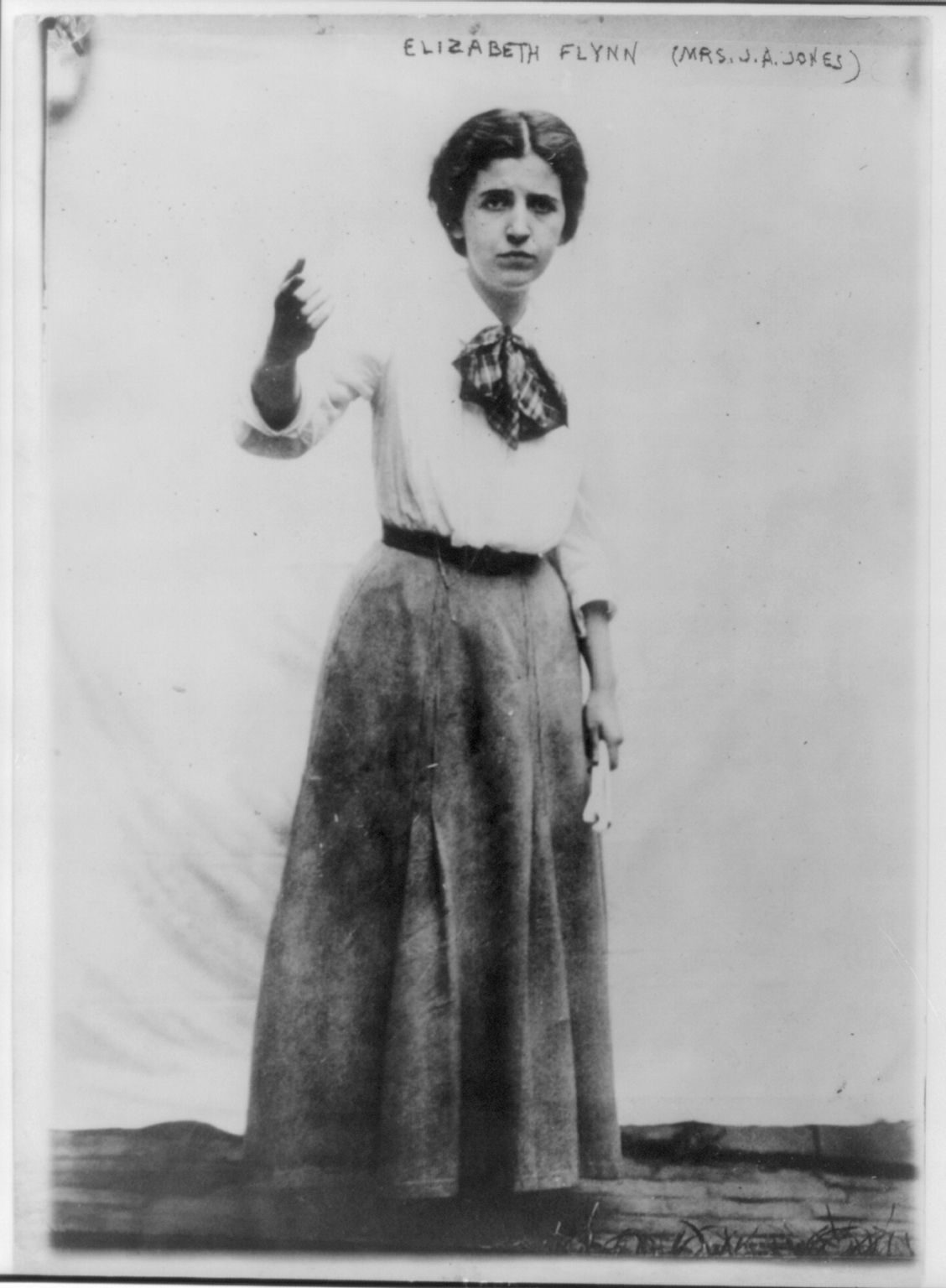 19 years old and pregnant, Elizabeth Gurley Flynn joined the Spokane fight. Already a celebrated Wobbly orator, she quickly landed in jail. But authorities released her early after pressure from the Woman's Club of Spokane.(Library of Congress)
Regardless of whether a Wobbly ended up at the city jail, county jail, high school, or Army stockade the conditions they dealt with were inhumane. As the city was trying to break these men, they put them in prison conditions that were considered horrid even for the time. The cells were intentionally overcrowded and alternating hot and cold exposure was used deliberately to torture the prisoners. Elizabeth Gurley Flynn described the practice in the International Socialist Review.
“The condition of the city jail is such that it cannot be described in decent language. Sufficient to say, the boys have been herded twenty-eight to thirty at a time in a 6 x 8 cell known as the sweat box. The steam has been turned on full blast until the men were ready to drop from exhaustion. Several have been known to faint before being removed. Then they were placed in an ice-cold cell and as a result of this inhuman treatment several are now in so precarious a condition that we fear they will die. After this preliminary punishment they were ordered to work on the rock pile and when they refused were placed on a diet of bread and water.”[45]
Bread and water diets combined with exposure and beatings led to sickness with many men having to be moved to a hospital both during and after their sentences. James Starks maintained a journal during his incarceration and recorded his experience in the “so called hospital” which was later published in the Industrial Worker.
“Dec 7. – I awake this morning to myself in the so called hospital, a vermin-infested cell in the city jail. Spaulding, Gordon, Allen and myself in a cell 7 by 8 feet. We have nothing to lay on during the daytime but the bare grates of a cot. They take our mattresses and quilt away at 8 a.m. and we don’t get it back until 5 at night. The cell is as cold as a refrigerator. The window is open and I am informed that it is zero weather outside.
Dec. 8 – My time not up, but am turned out with thirty-six others to make room for more from the school. Am closing the record, am too weak to walk. Some of the men who had money and trinkets on them when arrested cannot get them from the police. On insisting getting the property back, the police threaten to put us all back in jail. Many have to be carried to hall.”[46]
As this account illustrates, the shortage of jail space forced authorities to release some prisoners early so that new prisoners could be accommodated. This rotation echoed the “three-job system” used by the job sharks but in this case as someone was booked, others sat in the jail, while others rotated out to make room.
<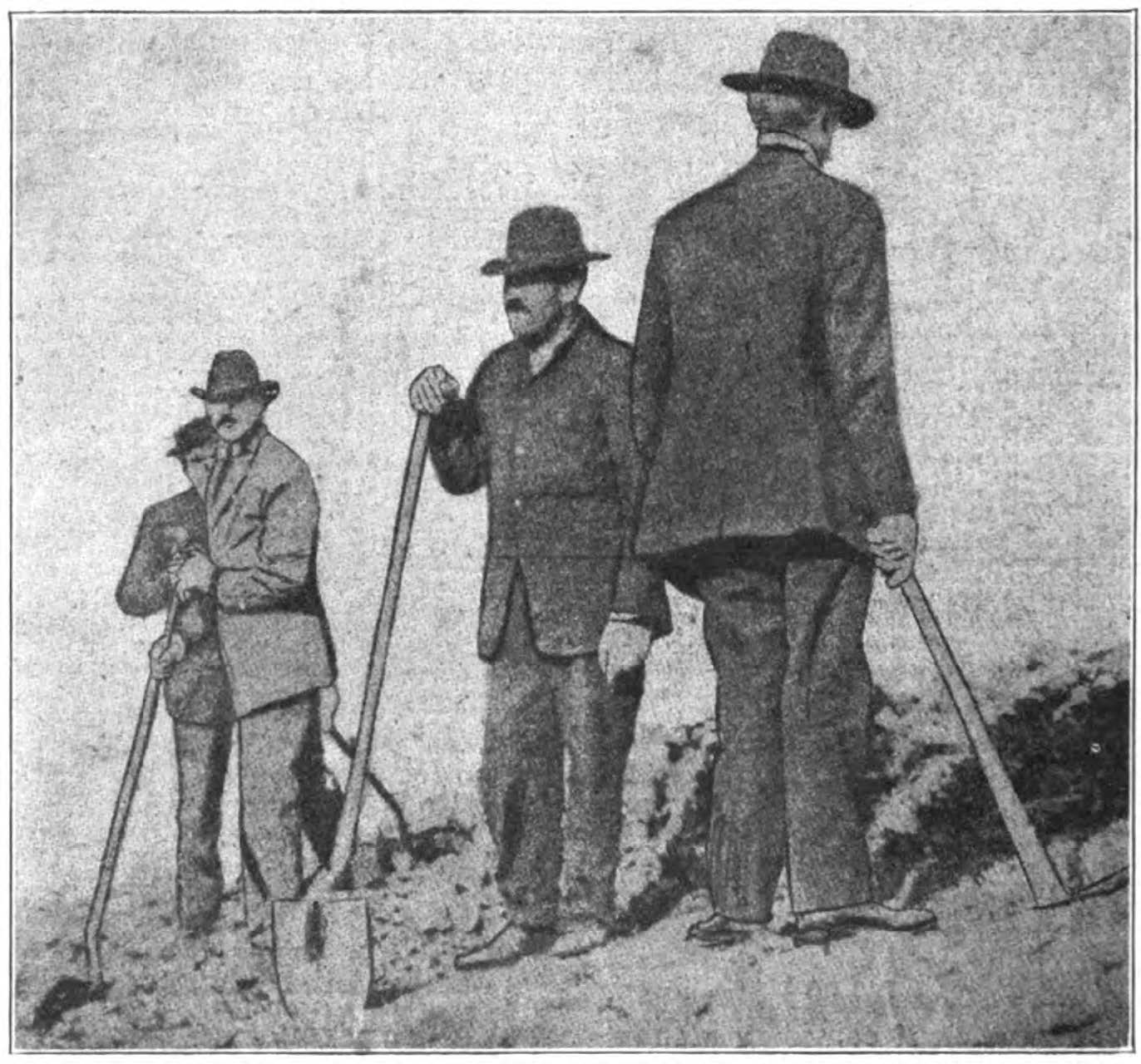 IWW prisoners working on a rock pile under guard during the free speech fight. ("The Shame of Spokane" by Elizabeth Gurley Flynn from The International Socialist Review. Vol. 10 No. 7. January, 1910).
Another reason for the early releases had to do with what IWW prisoners were doing inside.
The union took over the jails, setting up temporary locals inside the prisons themselves. This gave them a degree of control that the authorities did not know how to counteract. What confounded the police even more was the horizontal structure of the locals, thus even if they targeted suspected leaders and isolated them, the union was still able to function. William Z. Foster described the effect these locals had on the prisoners in the Workingman’s Paper.
“In the jail we had rousing meetings and in order to do it systematically we elected a secretary and chairman and set aside Sunday night for propaganda meetings and Wednesday night for business meetings. It was surprising the amount of business we had to transact, and we established rules and regulations of all kinds, from tactics to be pursued if our shackles were put on too tight, to forbidding I.W.W. members from shouting to the women prisoners who might be insulted by some of the doubtful remarks continually bandied between the men and women prisoners. Needless to say, these rules and regulations were scrupulously obeyed by the I. W. W. members, and also by many of the ordinary prisoners, who fell under the magic spirit of the well known I.W.W. discipline.”[47]
This strategy allowed them to also coordinate actions and deal with groups like the Salvation army when they came to preach at the jail. In particular the locals allowed the coordination of hunger strikes, work strikes, and work slowdowns to call attention to the horrifying conditions and the fear of the men dying. William Z. Foster recounted how the jail locals organized to defeat chain-gang work requirements. “We accomplished almost nothing. For instance, two men chained together pounded for four days upon one rock, when it was accidentally broken. To break that small rock (about as large as a wash bucket) cost the city of Spokane $4.00 for food alone, at the rate of 50 cents per day per man…”[48]. Thus, the second edge of the sword that was filling the jails was sharpened, which was not just to be large in numbers but also be extremely hard to control as a body of prisoners. This was so efficacious in keeping the men going, that multiple prisoners signed up to the Union because of these locals[49].
Solidarity and Community Resistance
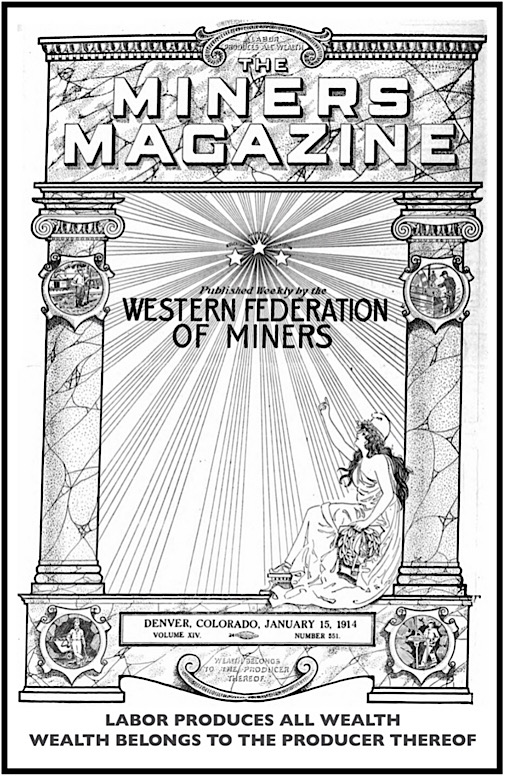 Western Federation of Miners locals throughout the region supported the Spokane fight. This is the cover of a 1914 edition of the Miners Magazine.
Several organizations and community members stood in solidarity with these free-speech fighters and found a variety of different tactics, big and small, to support the union in their fight. These can be divided into three groups, left and labor organizations, community organizations, and the greater community.
By far the union to provide the most support outside the IWW itself were the Western Federation of Miners’ Locals in the Pacific Northwest. For those familiar with the history of both organizations this makes sense, the WFM helped found the IWW and up until 1907 when they split from the IWW[50], had been the part of the IWW Mining Department[51]. Multiple W.F.M. locals sent letters, made statements, and passed resolutions opposing the ordinance and behavior of the police. The Coeur D’Alene and Burke Branches W.F.M. even boycotted Spokane products calling it a “Scab Town”[52].
The other two major forces of labor weren’t slouches either, both the Spokane Socialist Party and Central Washington American Federation of Labor worked with the IWW to lobby the city council to repeal the ordinance but made little progress. By November 5th, the Socialist Party had fully endorsed the strike and later that month led a boycott on the Spokane Apple Show. After the I.W.W. got kicked out of their hall the Spokane Socialists Party allowed them to hold meetings and speeches at their hall before they were also evicted after the proprietor was pressured by the police[53]. It is also worth noting that this is what was officially done by these two organizations. Beyond that, unknown numbers of socialists and AFL members helped in other ways with some joining the street speaking and going to jail.
Some of the citizens of Spokane of various classes and political persuasions opposed the actions of the City Council and police and were willing to help. The lawyer Samuel Crane spoke out and was arrested as recounted by historian Robert Tyler in Rebels of the Woods:
"Samuel T. Crane, a lawyer, watching the police and deputies rounding up Wobbly street speakers under his window, leaned out and began to berate the police. When he hurried down to the street to deliver his objections in person and at closer quarters, the police arrested him with the Wobblies and charged him with disorderly conduct. He conducted his own defense in police court and tenaciously cross-examined the police chief testifying against him. He pressed the chief with leading questions and innuendoes. How much had you been drinking on the day you arrested me?" The judge had to clear the court to silence the spectators, who laughed as if at a vaudeville show.""[54]
Crane’s respectability as a member of the community and indignation at the behavior of the police shows that the appeal to constitutional rights that the IWW was basing its arguments on had traction. Even though the Wobblies were internationalists they knew that basing the argument in the constitution in an age of liberal nationalism would legitimize it.
There were other examples. Robert Ross described a crowd of Spokane citizens attempting to get food and tobacco to the prisoners in a letter he wrote to the Industrial Relations Commission.
“They took us down to the city jail and made us strip off our clothes and walk under a cold shower bath but would not give us time to wash. This was in November and it is very cold in Spokane at that time of the year, so when we started back to the school house they marched us in the center of the street and on the sidewalks people had gathered with all kinds of tobacco, fruit, bread and everything in the line of eatables, but the police held them back and would not let them get near us so that the people began to throw tobacco, fruit and everything they had brought. Those who were lucky to get some of those things found themselves unlucky, for no sooner had they caught them when the police knocked them out of their hands. In one case one man had just caught an apple and had started to take a bite when the police struck at the apple and hit the poor fellow on the nose and broke it. This is only one instance of which there are many more.”[55]
In another example, the German Turners Society let the IWW use their hall after the Socialist Party had their lease terminated. The society saw the pressure from the police but had enough courage to ignore the order and show support for the IWW’s free-speech rights.[56]
Support also came from ordinary prisoners who were serving sentences not connected with the free-speech arrests. As William Z. Foster mentioned, several prisoners became Wobblies during the fight simply out of proximity and developed solidarity. That solidarity as held true for the female prisoners. A pregnant Elizabeth Gurley Flynn reflects on her time with her fellow prisoners in the women’s wing of the city jail.
“I was placed in a cell with two other women, poor miserable specimens of the victims of society. One woman is being held on a charge that her husband put her in a disorderly house. The other is serving 90 days for robbing a man in a disorderly resort in Spokane. Never before had I come in contact with women of that type, and it was interesting, Also, I was glad to be with them, for in a jail one is always safer with others than alone. One of the worst features of being locked up is a terrible feeling of insecurity, of being at the mercy of men you do not trust a moment, day or night. These miserable outcasts of society did everything in their power to make me comfortable. One gave me the spread and pillow cover from her own bed when she saw my disgust at the dirty gray blankets. I could not eat the heavy, soggy food, stews, etc., nor drink the terrible stuff called coffee; but the girls gave me fruit that had been sent into them.”[57]
As with many actions of community solidarity this may seem small, but it caused a domino effect. The support for Flynn that her fellow prisoners gave kept her stable enough for the Women’s Club of Spokane to raise the $5000 for Flynn’s bail to get the pregnant nineteen-year-old out of the horrid conditions of the jail[58]. When Flynn then went on to write about the experience and reveal that the jailers were pimping female prisoners[59] it drove the Women’s Club to campaign the Spokane city government for matrons in the women’s wing of the jail to stop such acts [60].
In short, a good segment of the city across the working and middle classes were in partial revolt against the ordinance. While the city could handle a local union, even a large local like the Spokane IWW, they could not hold against one with community support.
The City Comes to the Table
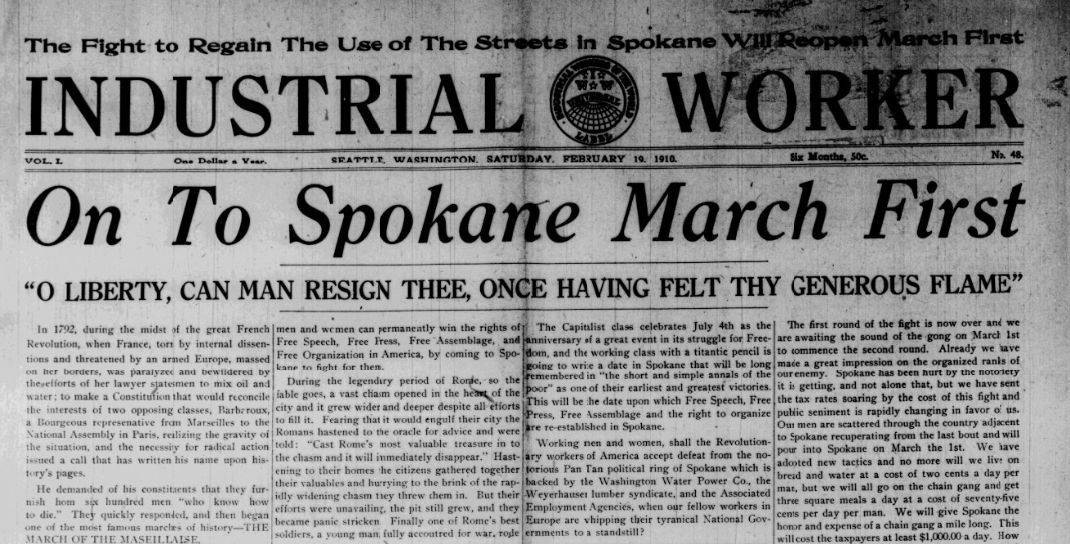 Planning a new campaign in the Spring, the Industrial Worker called for a big mobilization on March 1, 1910 (Feb 19, 1910)
By February 1910, thirteen months after the gag order had become city law, there had been a slowdown in the number of arrests of Wobblies as fewer and fewer members volunteered to speak on the streets. This can be chalked up to several factors. The first was dropping temperatures, while many Wobblies were still finding their way to Spokane via train, many more were settling in, hoping that warmer weather would allow them to make the trek, the box car was many things to the Wobbly but temperature controlled was not one of them. General attrition compounded this, many of the prisoners were coming out beaten, sick, and according to some accounts weren’t coming out alive at all[61]. While many were willing to go back, many physically couldn’t and it was having an effect on morale. This was not to say that the jails were emptying, all four jails were still in operation, but prisoners were much less likely to be rotated out before their sentence was completed than had been the case two months prior.
Another factor was the false rumor published in Spokane’s conservative daily newspaper, Spokesman-Review, stating that “THE I.W.W. SURRENDERS, WILL ABIDE DECISION OF COURTS.”[62] The union tried to correct the story with the Industrial Worker firing back “THE I.W.W. WILL NEVER SURRENDER.”[63] But the rumor was hard to contest and probably deterred some people who worried they might be joining a losing cause. Finally, several of the experienced national and local organizers were still in jail on conspiracy charges. While the horizontal nature of the union meant that this didn’t kill the campaign it did take out some of its most prolific writers and orators, many campaign participants were recruited on speaking tour circuits which couldn’t happen if the orators were in jail.
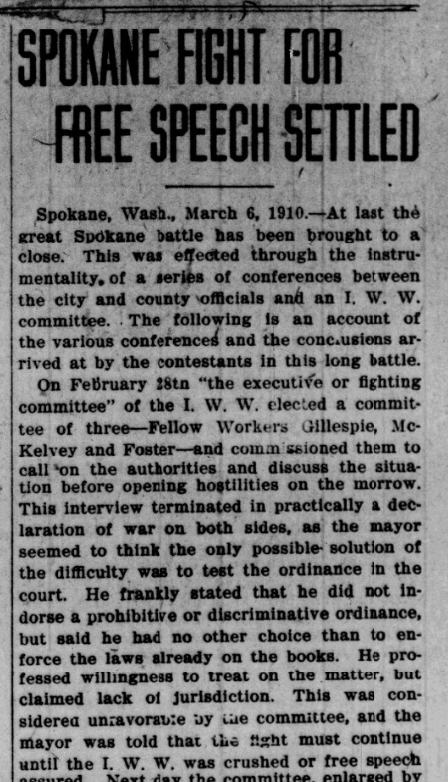 News of the settlement, Industrial Worker, March 12, 1910
The union knew it had to do something to counter this slump and thus in February they started aggressively recruiting for a new push to begin in the Spring. IWW papers around the country such as Solidarity announced the plan “The fight opens March 1st. At least 500 who will speak on the streets are needed, and as many more as possible… Every one should start for Spokane at once!! Hold meetings and gather recruits along the way. Get in Spokane with as many as you can.” [64] The gamble was that the warmer weather, continued expenses, and media push would either force the city to the table or allow the union to revitalize the fight. By the end of February, the gamble had worked.
On February 28th, a small contingent of Wobblies met with Spokane City Mayor Nelson Pratt to arrange a bargaining meeting between the city and the union. On March 3rd, a committee of four I.W.W. organizers (among them William Z. Foster) met with Mayor Pratt, Chief Sullivan, the Prosecuting Attorney, and a few other city representatives to discuss terms of ending the fight. The union came with four demands: IWW meetings were to be free from police interference (this included allowing them to rent a hall), the right to print the Industrial Worker and sell it on the street would be respected, the release of all IWW prisoners in the city and county jail, and finally the use of the streets for public assembly. The city agreed to the first three but stated that the fourth would require a vote on an ordinance by city council that they promised would take place in the near future. In return the city asked that all lawsuits be dropped, and the police be notified when street meetings were to take place[65]. The next day on March 4th the IWW held a general meeting of its members and passed the proposal on condition that the city would hold up its end of the bargain. [66]
Legacy of the Soapbox
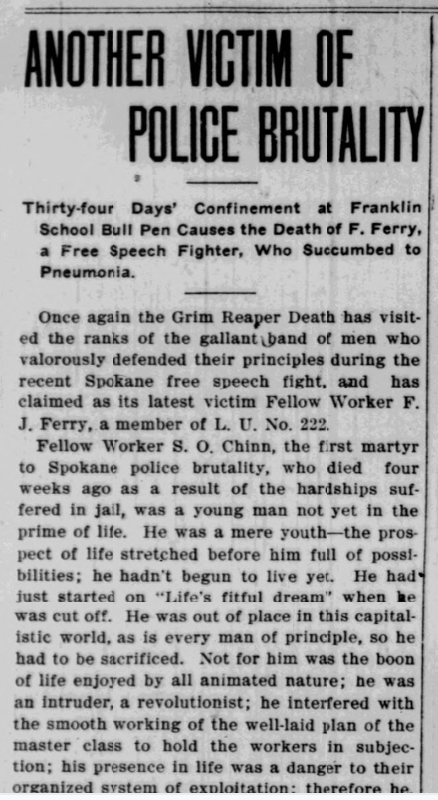 Victory came at a severe cost. Five people died during or soon after their incarceration in the brutal conditions of the Spokane jails and stockades. This story in the Industrial Worker records the sacrifice of Fellow Workers F.J. Ferry and S.O. Chinn (April 16,1910)
While numbers are disputed, the IWW claims that at least four hundred Wobblies were arrested between October 25th and March 4th. While over five hundred arrests were made[67] and five members died due to complications from imprisonment[68]. By its own estimate the city of Spokane spent at least $12,000 in prison expenses alone; with several hundred thousand dollars expended by police and other city departments.[69]
The Spokane free-speech fight ended in a victory for the IWW and a still greater victory for the cause of free-speech rights. The IWW would go on to conduct campaigns in at least two dozen cities in the decade that followed, mostly without paying the extreme price or achieving the clear results of the Spokane fight. In the years to follow the IWW would grow in numbers and become more and more reviled by government authorities, business entities, and the newspapers representing those interests. During and after World War I, government repression would devastate the organization reversing the momentum that was evident in 1909 and 1910.
But the legacy of the Spokane Free-Speech Fight transcends the history of the IWW itself. This first free-speech campaign established the efficacy of non-violent direct action as a strategy that has served not just American labor, but social movement of all kinds, and with them democratic institutions. Though not as common as it once was, when you hear of the efficacy of filling the jails as a sympathy or pressure strategy whether it be through the Civil Rights Movement, environmental action, or even the Starbucks contract fight, you can trace back the lesson back to 1909 and a union of hoboes that demanded the right to speak against their bosses on the street.
[1] IWW events Map, IWW History Project https://depts.washington.edu/iww/map_strikes.shtml
[2] U.S. Bureau of the Census, “THIRTEENTH CENSUS of the UNITED STATES TAKEN in the YEAR 1910,” ed. William Hunt, www.census.gov (www.census.gov: U.S. Department of Commerce, 1913).
[3] Schwartz, “Cartoon,” Industrial Worker, July 15, 1909.
[4] Robert L Tyler, Rebels of the Woods (Eugene, Or : University of Oregon Press, 1967).
[5] J.B. Tallman, “THE SAME OLD STORY IS TOLD ONCE MORE,” Industrial Worker, April 1, 1909.
[6] Matthew Scott May, Soapbox Rebellion: The Hobo Orator Union and the Free Speech Fights of the Industrial Workers of the World, 1909-1916 (Tuscaloosa: University Of Alabama Press, 2013).
[7] Industrial Workers of the World, “PREAMBLE, CONSTITUTION, & GENERAL BYLAWS of the INDUSTRIAL WORKERS of the WORLD,” Preamble § (1908).
[8] James H, Walsh, “Workers Conditions in Portland and the Northwest,” Industrial Union Bulletin, June 27, 1908.
[9] Matthew Scott May, Soapbox Rebellion: The Hobo Orator Union and the Free Speech Fights of the Industrial Workers of the World, 1909-1916 (Tuscaloosa: University of Alabama Press, 2013).
[10] Paul Fredrick Brissenden, The I.W.W. A Study of American Syndicalism (New York: Columbia University, 1919).
[11] James H. Walsh, “I.W.W. ‘Red Special’ Overall Brigade,” Industrial Union Bulletin, September 19, 1908.
[12] Matthew S. May, “Hobo Orator Union: Class Composition and the Spokane Free Speech Fight of the Industrial Workers of the World,” Quarterly Journal of Speech 97, no. 2 (May 2011): 155–77, https://doi.org/10.1080/00335630.2011.560177.
[13] James H. Walsh, “Eight Week’s Work in Spokane,” Industrial Union Bulletin, May 9, 1908.
[14] E.J. Foote, “I.W.W. IN THE NORTHWEST,” Industrial Union Bulletin, July 25, 1908.
[15] Gregory R. Woirol, “Two Letters on the Spokane Free Speech Fight a Document Note,” The Pacific Northwest Quarterly 77, no. 2 (April 1986): 68–71.
[16] INDUSTRIAL WORKER (Industrial Workers of the World) https://industrialworker.org/;
Chris Perry and Victoria Thorpe, “Industrial Worker,” Labor Press Project https://depts.washington.edu/labhist/laborpress/Industrial_Worker.htm
[17] James H. Walsh, “GROWTH OF THE I.W.W. IN SPOKANE,” Industrial Worker, April 29, 1909.
[18] James H. Walsh, “GROWTH OF THE I.W.W. IN SPOKANE,” Industrial Worker, April 29, 1909.
[19] James H. Walsh, “GROWTH OF THE I.W.W. IN SPOKANE,” Industrial Worker, April 29, 1909.
[20] This was a slang term used in the IWW itself to refer to migratory workers and direct actionists collectively. The union has a history of slang much of it coming out of slang used on the rail lines. Other terms included Bindle stiffs and Boomers.
[21] Paul Fredrick Brissenden, The I.W.W. A Study of American Syndicalism (New York: Columbia University, 1919).
[22] James H. Walsh, “GROWTH OF THE I.W.W. IN SPOKANE,” Industrial Worker, April 29, 1909.
[23] Matthew Scott May, Soapbox Rebellion: The Hobo Orator Union and the Free Speech Fights of the Industrial Workers of the World, 1909-1916 (Tuscaloosa: University Of Alabama Press, 2013).
[24] Glen J. Broyles, “The Spokane Free Speech Fight, 1909–1910: A Study in IWW Tactics,” Labor History 19, no. 2 (March 1978): 238–52, https://doi.org/10.1080/00236567808584491.
[25] Charles Grant, “Law and Order in Spokane,” Industrial Worker, March 18, 1909.
[26] “IT’S a LONG LANE THAT HAS NO TURN,” Industrial Worker, April 1, 1909; “The Heart of a Crocodile,” Industrial Worker, May 6, 1909.
[27] “INDUSTRIAL UNION GROWS IN SPOKANE,” Industrial Worker, July 22, 1909.
[28] Glen J. Broyles, “The Spokane Free Speech Fight, 1909–1910: A Study in IWW Tactics,” Labor History 19, no. 2 (March 1978): 238–52, https://doi.org/10.1080/00236567808584491.
[29] “The Coming Winter,” Industrial Worker, August 12, 1909.
[30] Charles Grant, “Law and Order in Spokane,” Industrial Worker, March 18, 1909.
[31] Lewis J. Duncan, C.C. McHugh, and George. II. Ambrose, “From Butte,” Industrial Worker, April 7, 1908.
[32] G.W. Reece and M.M. Elders, “Spokane Law Is a Disgrace!,” Industrial Worker, April 22, 1909.
[33] At this point there is a fair amount of disagreement around some of the numbers including number of arrests, sentencing, cost to the city, and the average size of fines along with a few other numbers that fluctuate depending on account. In these cases, I will give a range and cite the sources with the highest and lowest numbers.
[34] “‘REMEMBER, TUESDAY, NOVEMBER 2, THERE WILL BE a STREET MEETING in SPOKANE,’” Industrial Worker, October 27, 1909.
[35] “Synopsis: Spokane Free Speech Fight,” Industrial Worker, March 26, 1910.
[36] “Synopsis: Spokane Free Speech Fight,” Industrial Worker, March 26, 1910.
[37] “Story of the Fight in Spokane,” Industrial Worker, November 9, 1909.
[38] “Synopsis: Spokane Free Speech Fight,” Industrial Worker, March 26, 1910.
[39] Synopsis: Spokane Free Speech Fight,” Industrial Worker, March 26, 1910.
[40] Synopsis: Spokane Free Speech Fight,” Industrial Worker, March 26, 1910.
[41] Synopsis: Spokane Free Speech Fight,” Industrial Worker, March 26, 1910.
[42] Synopsis: Spokane Free Speech Fight,” Industrial Worker, March 26, 1910.
[43] “Important Notice,” Industrial Worker, December 15, 1909.
[44] Joyce L Kornbluh, Rebel Voices: An IWW Anthology (Oakland, Calif.: London, 2011), 98–100.
[45] Elizabeth Gurley Flynn, “The Free Speech Fight at Spokane,” The International Socialist Review, December 1909.
[46] James Stark, “Diary of a Released Free Speech Fighter,” Industrial Worker, January 8, 1910.
[47] William Z. Foster, “47 Days in Spokane City Jail,” Workingman’s Paper, February 12, 1910.
[48] William Z. Foster, “47 Days in Spokane City Jail,” Workingman’s Paper, February 12, 1910.
[49] William Z. Foster, “47 Days in Spokane City Jail,” Workingman’s Paper, February 12, 1910.
[50] Che Capilli, James Gregory, and Arianne Hermida, “Brief History and Timeline 1905-1920,” depts.washington.edu, 2006, https://depts.washington.edu/iww/timeline.shtml.
[52] Elizabeth Gurley Flynn, “The Free Speech Fight at Spokane,” The International Socialist Review, December 1909.d
[53] “Synopsis: Spokane Free Speech Fight,” Industrial Worker, March 26, 1910. and Joyce L Kornbluh, Rebel Voices : An IWW Anthology (Oakland, Calif.: London, 2011).
[54] Robert L Tyler, Rebels of the Woods (Eugene, Or : University of Oregon Books, 1967).
[55] Robert Ross to Industrial Relations Commission, “Letter to the Industrial Relations Commission,” September 14, 1914.
[56] Robert L Tyler, Rebels of the Woods (Eugene, Or : University of Oregon Books, 1967).
[57] Elizabeth Gurley Flynn, “Story of My Arrest and Imprisonment,” Workingman’s Paper, December 12, 1909.
[58] Robert L Tyler, Rebels of the Woods (Eugene, Or : University of Oregon Books, 1967).
[59] Elizabeth Gurley Flynn, “Story of My Arrest and Imprisonment,” Workingman’s Paper, December 12, 1909.
[60] “Synopsis: Spokane Free Speech Fight,” Industrial Worker, March 26, 1910. and Joyce L Kornbluh, Rebel Voices : An IWW Anthology (Oakland, Calif.: London, 2011).
[61] Robert L Tyler, Rebels of the Woods (Eugene, Or : University of Oregon Books, 1967).
[62] “SPOKANE FREE SPEECH DEFENSE,” Industrial Worker, December 25, 1909.
[63] “SPOKANE FREE SPEECH DEFENSE,” Industrial Worker, December 25, 1909.
[64] Vincent St. John, “Fight to Be Renewed,” Solidarity, February 5, 1910.
[65] “Synopsis: Spokane Free Speech Fight,” Industrial Worker, March 26, 1910. and Joyce L Kornbluh, Rebel Voices : An IWW Anthology (Oakland, Calif.: London, 2011).
[66] Central Executive Committee Spokane I.W.W., “SPOKANE FIGHT for FREE SPEECH SETTLED,” Industrial Worker, March 12, 1910.
[67] Glen J. Broyles, “The Spokane Free Speech Fight, 1909–1910: A Study in IWW Tactics,” Labor History 19, no. 2 (March 1978): 238–52, https://doi.org/10.1080/00236567808584491.
[68] John Duda, Wanted: Men to Fill the Jails of Spokane! (Charles Kerr, 2009).
[69] “Synopsis: Spokane Free Speech Fight,” Industrial Worker, March 26, 1910.