Credit: NIA
By Genevieve Wanucha and Katherine Lopez
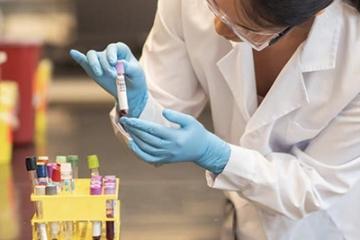
Biomarkers provide clues about a person's health. For example, biomarkers from blood can be measured in a medical laboratory, such as a cholesterol test. Brain imaging tests, such as MRI, can be measured in the clinic. Elevated blood pressure readings may indicate high blood pressure. Higher levels in the blood of the prostate-specific antigen may indicate prostate cancer. These measurable substances help doctors diagnose disease, create treatment plans, and ultimately, evaluate the effectiveness of new treatments.

Lynn Bekris, PhD, Professor of Laboratory Medicine and Pathology at UW Medicine
Biomarker tests have transformed Alzheimer’s disease diagnosis and monitoring in the last decade. Most recently, in 2025, the FDA approved the first blood test for the early detection of Alzheimer’s pathological risk in adults aged 55 years and older who are showing changes in thinking and memory. Using this blood test as a screening tool in the primary care clinic would enable earlier detection and quicker access to further clinical evaluations and community resources.
Fluid biomarkers can be essential tools in Alzheimer’s and brain health by acting as an added clinical tool to evaluate risk for Alzheimer's disease and related dementias. “The problem we have in Alzheimer's disease research is that the brain is difficult to access," says the ADRC’s Lynn Bekris, PhD, a professor of Laboratory Medicine and Pathology at UW Medicine. “We can use brain imaging, but it is a time-intensive and expensive tool. Blood biomarkers are more accessible.”
Obtaining blood biomarkers for research is minimally invasive, time-saving, and economical. “Participants are more willing to donate blood,” says Dr. Bekris. “With larger numbers of samples in research studies, we can find, for example, differences within people of different ancestries.”
Emerging evidence points to inflammation as playing a critical role in Alzheimer’s and brain health. However, a reliable blood-based biomarker of inflammation has not yet been identified. In her lab at UW Medicine, Bekris focuses on using blood-based biomarkers to study the immune response in Alzheimer's disease and related dementias. She uses circulating biomarker results from individuals in the ADRC cohort to detect early inflammatory changes associated with neurodegenerative disease.
Dr. Bekris says that ADRC participant data are helping her conduct critical research projects. In ongoing work, she is finding distinct patterns of immune responses across different stages of Alzheimer’s disease and types of pathological progression. “In just a drop of blood, we can measure over a hundred, or even over a thousand, immune-related proteins,” she says. The team can then group the different proteins by their relationship with brain biology. These findings provide specific information on the role of the immune system in neurodegeneration.
Even though the Alzheimer’s field has reliable biomarkers for amyloid and tau in the brain, cerebrospinal fluid, and blood plasma, there are still gaps in knowledge. “One problem is,” Bekris says, “that it is rare for an Alzheimer's patient to have only amyloid and tau pathology. It’s more common to see multiple other pathologies in the brain at autopsy. So, we're still trying to figure out how to find good fluid biomarkers for non-amyloid and tau pathologies, including Lewy bodies and TDP-43 protein, and the different types of immune response related to these pathologies, in living people.”
For Dr. Bekris, the highlight of 2025 has been the acquisition of a state-of-the-art research instrument. This instrument can measure a panel of 134 neurodegenerative disease-related proteins from just 20 microliters (a drop) of plasma.
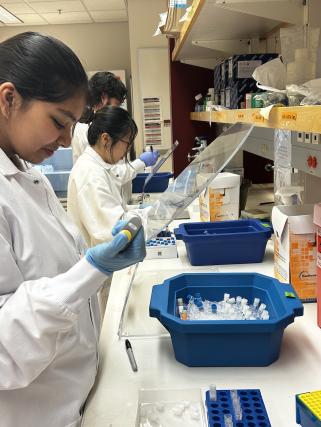
Members of the Bekris Lab in UW Medicine's Department of Laboratory Medicine and Pathology
“I'm pretty excited that we're going to be able to measure all these biomarkers at once in the same small sample,” she says. “This will help us tease apart which protein signatures best predict early-stage processes in Alzheimer's disease and related dementias.”
This year, the ADRC began a focused effort to support research into fluid biomarkers for Alzheimer's disease and related dementias in the newly created ADRC Biomarker Core, led by Dr. Bekris, alongside Donald L. Elbert, PhD and Michael Rosenbloom, MD, who are both associate professors of neurology at UW Medicine.
The Biomarker Core recently started processing the blood samples from the ADRC longitudinal study. This Core catalogs and stores the samples for investigators to access and study. This service supports researchers, locally and nationwide, in their search for fluid biomarkers to better understand the underlying biology driving resilience or susceptibility to Alzheimer's disease and related dementias.
The most rigorous aspect of work in the ADRC Biomarker Core is the handling of sample sharing for biomarker research. Investigators from the UW and beyond often request samples for their studies. The Core leaders meet as a committee to discuss whether the ADRC has the resources needed to address the specific scientific questions and to determine whether they can transfer the samples.
“So, we are involved in a lot of different research projects,” says Dr. Bekris. “When research participants donate samples in the ADRC study in Seattle, they’re also donating to the nationwide effort to figure out what's going on with Alzheimer's disease and how we can find better biomarkers.” •

__media-listing.png)


